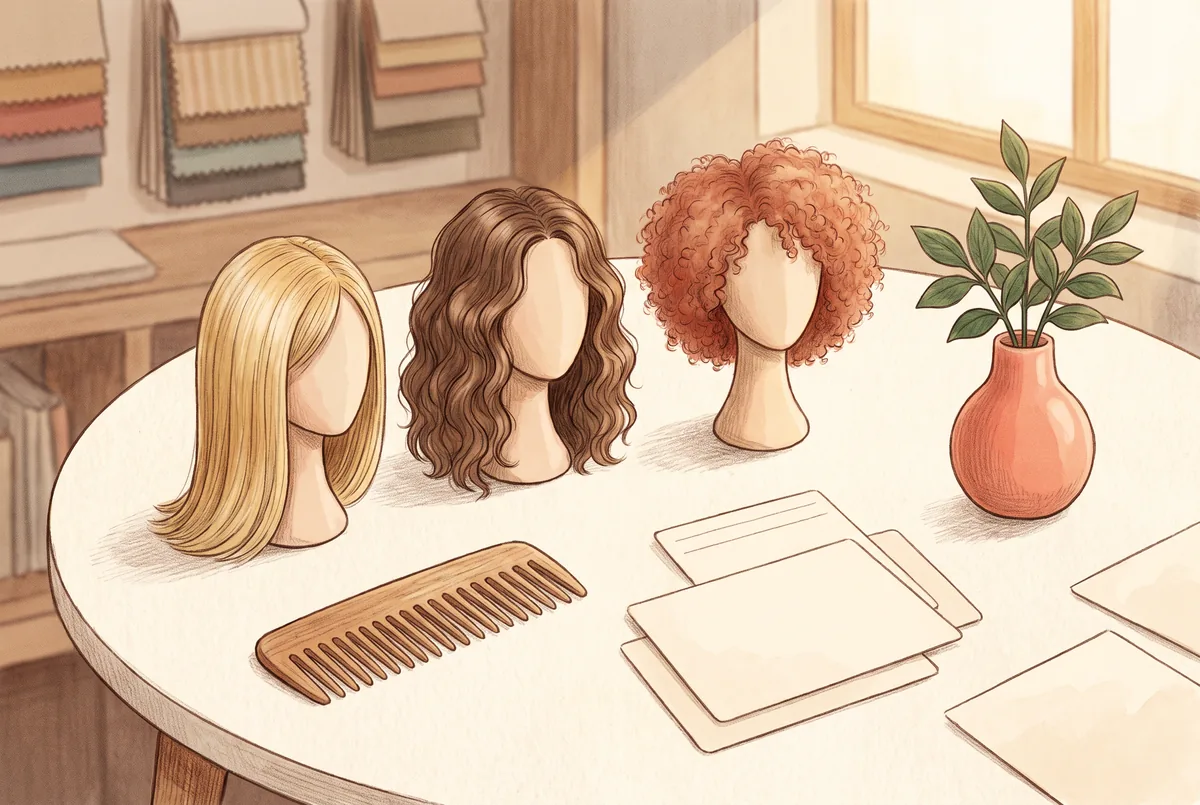
Your current drying routine may support a new curl pattern if the finish you want can be maintained with effort, tools and handling you can realistically repeat. A photograph or service name cannot answer that question. Start by recording what happens between washing and leaving home, then ask a hair professional to explain the proposed finish using that routine. If important care instructions remain unclear, waiting is a reasonable decision—not a failure to commit to a new look.
Keep a short record of real drying habits
Record an ordinary wash-and-dry occasion before changing anything. Note how you remove water, whether you detangle, which products you already use and how you arrange the lengths. Write down when you stop active styling and when the hair actually feels dry. Those are different observations: leaving the bathroom does not necessarily mean the drying process is complete. Include what you do while drying, such as dressing or preparing breakfast, because a proposed routine might require attention you currently spend elsewhere.
Use a simple note headed Curl Routine Reality Check. Give it separate spaces for observed actions, the finish you want, provider instructions and unresolved questions. In the observed space, describe actions rather than judging yourself: “brush through before leaving” is useful; “bad at hair” is not. Add a photograph of your usual dry front and side views if comfortable. Keep the lighting and camera position reasonably similar so a change in presentation does not masquerade as a change in hair behaviour.
Capture a rushed occasion as well as a more relaxed one when those naturally occur. Note whether the same routine remains possible after exercise, during travel or when you cannot use your usual bathroom. This is not a controlled experiment or a test of chemical suitability. Its purpose is to reveal constraints that a polished reference image leaves out. Do not add unfamiliar products or extra heat just to produce a more impressive record; the professional needs your baseline, not a rehearsed version of it.
Separate desired movement from time available
Describe the movement you want without relying on a style label. Perhaps the ends should turn away from your face, the outline should look softer or the lengths should retain visible bends after drying. Choose the feature that matters most, then name what may vary. If you expect every section to fall in a precise direction, that is a different upkeep brief from accepting an uneven, relaxed finish. Neither preference is wrong, but they should not be presented as equivalent demands.
An enquiry through digital perm hong kong can begin with your routine record and one clearly marked reference. Ask what work produced the pictured finish, which parts would require active arranging at home and whether the proposal still makes sense on your rushed days. The linked resource is a place to ask about a service, not evidence that its name guarantees effortless curls or suitability for your hair. Request an explanation tied to the actual proposal rather than a general promise of convenience.
Separate hands-on attention from total drying time and from the space needed to finish. A method might fit your evening but conflict with leaving immediately after a shower. Decide whether changing your wash schedule is genuinely acceptable, rather than silently assuming it will happen. For a face-framing goal, the FlintHub guide to checking face visibility in speaking videos offers a useful way to describe where strands move. That visual exercise informs the brief; it does not establish that a particular chemical treatment can deliver it.

Identify friction and heat habits worth discussing
The American Academy of Dermatology advises gentle drying rather than rubbing hair with a towel, reducing unnecessary heat and handling wet hair with attention to hair type. Its guidance distinguishes straight hair from textured or tightly curled hair when discussing detangling, so “never touch wet hair” is not a useful universal rule.1 Ask how that general advice relates to your present hair and any proposed processing. Do not turn a public care page into a personalised instruction for chemically treated lengths.
Look for places where your normal sequence might conflict with the desired finish. These could include repeated brushing after the shape is arranged, forceful towel rubbing, pulling hair tightly back or using another heated tool because the dry result feels unfinished. Record the action and why you do it. Someone who brushes for a tidy appearance needs a practical alternative, not merely an instruction to stop. Someone who ties hair back for work needs the proposal to account for that requirement rather than treating it as optional.
Bring your existing dryer attachment details and product names into the discussion. If the proposed routine depends on equipment you do not own, distinguish a necessary item from an optional styling preference before buying anything. Ask for a demonstration you can understand and a chance to explain the sequence back in your own words. The useful question is whether you can repeat the handling comfortably and consistently—not whether a tool is marketed for curls. No attachment, protective product or gentler habit should be described as making repeated heat or chemical processing damage-free.
Compare advertised names by maintenance questions
Treat named perm styles as starting points for questions, not complete descriptions of what will happen to your hair. A useful comparison begins with the proposed curl placement, preparation and home finish. Ask whether two options with different labels would actually require different actions in your bathroom. If the answer is unclear, their names have not yet helped you decide. The table below compares questions worth asking; it does not rank treatment effectiveness or define a universal salon menu.
| Advertised option | Information to confirm | Trade-off and reason to pause |
|---|---|---|
| Digital perm | Which process is proposed, how the dry finish is arranged and what equipment is expected at home | Pause if convenience depends on a styling sequence you cannot sustain |
| Korean-style perm | Which visible features the label describes and what home handling produced the reference | A preferred silhouette may still require active finishing; clarify missing steps |
| Japanese-style perm | The actual method, retained length and care instructions for the proposed result | Do not assume the label proves gentleness or a particular maintenance burden |
When considering korean perm hong kong, ask the provider to distinguish the desired appearance from the process being offered. For example, request a plain explanation of how the front would be arranged on an ordinary wash day and what changes if you skip that arrangement. A promotional reference can communicate taste, but it cannot show your own hair's suitability or guarantee the same finish. Keep the answer beside your routine record so comparisons use the same practical constraints.
Also ask what happens when your preferred finish does not appear after an ordinary dry. Is the suggested response more styling, a review of the haircut or a reassessment of expectations? These are different decisions with different effort and cost implications. Do not accept an open-ended plan to keep adding products or heat until the reference is matched. A meaningful comparison names the acceptable variation and the point where the provider would advise against proceeding.
Ask which instructions are specific to the actual product
A home trial with your current hair can show whether you have space for equipment or patience for a different sequence. It cannot simulate how your hair will respond to chemical processing. Keep those findings in separate spaces on the Reality Check. Your own observations establish routine feasibility; the hair professional must explain the proposed service and assess cosmetic suitability. Product instructions and relevant healthcare advice establish further boundaries. None of these responsibilities should be replaced by an online score.
| Known detail from your routine | Unconfirmed question | Who owns the next step? |
|---|---|---|
| You usually stop styling before the lengths are dry | What dry-stage arrangement would the proposal require? | Provider explains; you decide whether the attention fits |
| You already use a dryer and brush | Are they suitable for the recommended home finish? | Provider clarifies the sequence and equipment needs |
| Parts of the lengths have previously been coloured | How does that history affect the proposed service? | You disclose the history; professional assesses suitability |
| The proposed aftercare is described only as “easy” | Which actual instructions and limitations apply? | Provider supplies specifics before you commit |
Ask for written aftercare tied to the products and process actually proposed. Useful clarification covers washing, drying, detangling, arranging and what to do if discomfort or unexpected breakage appears. Do not copy a fixed waiting period, temperature or product schedule from another provider's post and assume it applies. If instructions conflict, ask the provider to resolve the conflict before the service rather than improvising afterwards. A general suggestion to “use curl products” is not enough to judge whether the routine is workable.
Disclose earlier bleaching, colouring, straightening or perming as accurately as you can, including anything uncertain. Keep photographs or product records if available, but do not invent dates to complete a form. Ask how the provider handles missing history and whether further assessment is needed. Likewise, a “natural” product description does not establish freedom from allergy. Any relevant product precautions remain important; choosing a familiar marketing term is not a substitute for identifying what will actually be used.
State what effort you cannot sustain
Write the boundary before the consultation, while you are thinking about an ordinary week rather than an exciting result. You might be unwilling to change your wash schedule, buy more equipment, style several sections separately or spend additional hands-on attention after work. Choose the real constraint instead of claiming you will accept anything for the right curls. An honest refusal gives the provider something actionable: revise the proposal, clarify an alternative or explain why the desired finish and your current routine are incompatible.
A discussion through japanese perm hong kong should use those boundaries rather than an assumption that a regional label promises low maintenance. Ask which parts of the reference could remain plausible with the effort you will actually provide and which would need to change. If the only answer is that you must adopt a routine you already know you dislike, the appealing label has not solved the problem. Retain the option to decline without needing to justify your preference as a medical concern.
Consider a simpler appearance brief before assuming the service must become more elaborate. You could accept less defined movement, keep your current texture or explore a reversible styling presentation with professional guidance. Temporary presentation has its own handling requirements and is not automatically damage-free, but it separates liking a look from committing to chemical change. Evaluate equipment spending and follow-up expectations alongside the initial quotation, without assuming any published price includes all those items. The most suitable decision may preserve more flexibility rather than pursue the closest reference match.
Use an unresolved routine gap as a reason to wait
Finish the Reality Check with one of three plain-language outcomes: the routine has been explained and appears feasible; a specific answer is still needed; or the proposal conflicts with a boundary. These are planning outcomes, not safety ratings. Do not average a serious unknown against several attractive features. Missing instructions about an essential step should stay unresolved until the responsible professional answers them. A favourable photograph does not cancel that gap.
If unusual shedding, scalp pain, persistent irritation or another concerning change accompanies the routine question, first ask a qualified healthcare professional to assess the cause before considering salon care. The NHS advises speaking to a GP about hair loss before going to a commercial hair clinic.2 A scalp Spa is cosmetic care, not medical diagnosis, and a provider's marketing claims are not evidence that it treats an underlying condition. This article is not medical advice and cannot guarantee results; do not use a perm consultation to diagnose symptoms or replace healthcare.
For a purely cosmetic decision, send the provider your observed routine, the single visual priority and the boundary you will not change. Ask them to identify the missing information rather than simply confirm the booking. Once you have a clear answer, reconsider the proposal against both your ordinary day and your rushed day. You can proceed to a fuller consultation, request a simpler brief or wait. A routine that you genuinely intend to repeat is a better basis for that choice than a service name you hope will make the work disappear.
FAQs
What should I prepare before a curl consultation?
Bring your actual drying sequence, existing product and equipment details, a clear visual priority and an honest record of previous processing. Mark uncertain history as uncertain. State the effort you are unwilling to add.
Can I assess suitability by observing my own drying routine?
You can assess practical constraints, such as equipment access and hands-on attention. You cannot establish chemical suitability or predict the processed result from a home routine record. Those questions need professional assessment.
What should the provider confirm in writing?
Ask for the actual proposed process, expected home-care sequence, product-specific precautions and quotation inclusions. Separate confirmed arrangements from optional recommendations. Request clarification when an essential instruction is described only as “easy”.
When is waiting the more sensible choice?
Wait when essential instructions remain unclear, the required routine violates a firm boundary or important processing history needs assessment. If symptoms are involved, seek healthcare assessment first rather than trying to solve them through styling.
Does a named perm style guarantee low maintenance?
No. A label does not establish how much arranging your proposed finish will need. Compare actual instructions with your own routine and acceptable variation, not with assumptions about a regional style name.
About this article
FlintHub Academy prepared this article with AI-assisted synthesis of public information. It is brand editorial, not first-hand treatment reporting or advice from a medical professional. DT HUB and FlintHub Academy have the same owner; the service links are related resources, not independent recommendations. Provider descriptions do not establish efficacy, and no result is guaranteed. The image topics refer to original AI concept illustrations, not real customers, premises or documented outcomes.
References
The American Academy of Dermatology source supports general hair-handling and heat-care principles. The NHS source supports seeking healthcare assessment before commercial responses to hair-loss concerns. Neither source certifies a DT HUB service or establishes the maintenance requirements of a named perm.
FlintHub Academy · AI-assisted editorial based on public information, not a first-hand service test or a claim of hairdressing or medical credentials. DT HUB and FlintHub Academy have the same owner. This is not medical advice or a guarantee of individual results.
Connect this guide with your planning
For comparison tables and enquiry tools on this same subject, visit Hair & Scalp Planning Guides. This is an information journal, not a course, product or medical service.