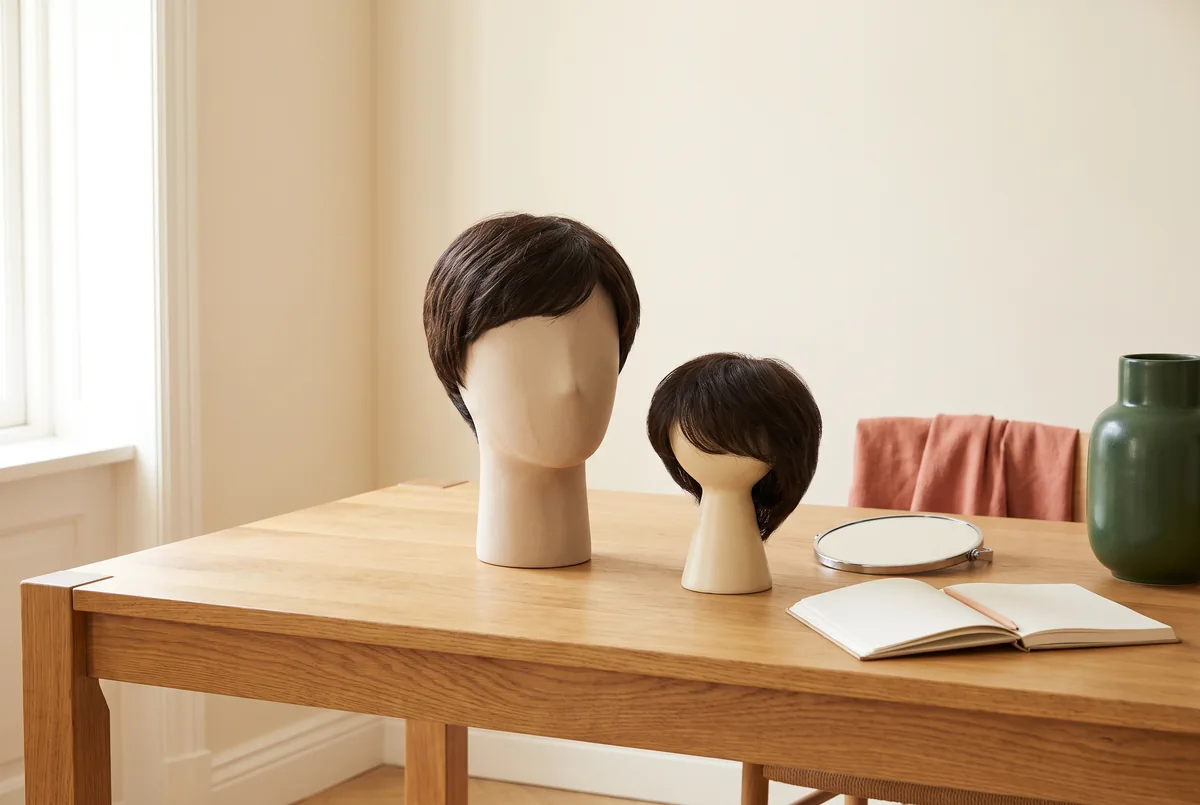
Choose a men's hairpiece by specifying the front outline and crown coverage separately, then checking whether the proposed piece can meet those goals without changing hair you want to retain. A fuller crown does not automatically deliver your preferred hairline, and a changed front does not settle the crown's appearance.
The useful starting point is not “more hair everywhere”. It is a brief that says what should change, what should stay and what still needs an in-person or product-specific answer.
1. Describe two appearance goals, not one problem
The front objective concerns the outline around the forehead and temples, how much of that outline remains exposed, and where the hair moves away from the face. The crown objective concerns the appearance around the upper back of the head: coverage, visible separation and the transition into surrounding hair. Neither description establishes why someone's hair looks that way.
Write one sentence for each zone before browsing. “I want less contrast at the temples while keeping the centre position” is more informative than “fix the hairline”. “I want a more continuous crown appearance without extra height” distinguishes coverage from a voluminous hairstyle. You can also write “no change requested” for either zone.
Add an ordinary setting in which the result must work: a working day, dinner with friends or a personal portrait. A photograph may be relevant, but it should not become the only standard if you intend to wear the piece beyond the photograph.
Then identify your main priority. If crown continuity matters most, an unchanged front may be acceptable. If you want to wear the front swept back, the front must be assessed independently even when the crown already looks satisfactory to you.
This is an appearance-led way to organise selection, not a manufacturer specification. Jon Renau's buying guide connects lifestyle, fibre, cap construction and length with selection; those general factors still need to be considered after you have separated the two objectives.1
2. Decide what the front should reveal and retain
Start with exposure rather than a fashionable reference image. Do you want hair resting over the forehead, a partly revealed front, or a front brushed away from the face? A catalogue style with a fringe may hide the very outline you need to inspect for a swept-back preference.
Next, distinguish the centre from the temples. You might want a softer temple transition but no change to the centre's position. Alternatively, you may want to retain the entire outline and change only the amount of hair behind it. These are different requests; neither implies that a straight, uniformly dense front is the right destination.
When exploring a men's hairpiece, ask the provider which part of your front objective the proposed product actually addresses. Request an explanation of the front boundary and the intended relationship with retained hair, rather than treating the category name as proof of coverage or a particular construction.
Use this comparison to keep front and crown choices from becoming interchangeable:
| Appearance decision | Front objective | Crown objective | What remains to verify |
|---|---|---|---|
| Where change is wanted | Centre, temples or hair immediately behind the front | Upper-back area or surrounding transition | Which areas the proposed piece actually reaches |
| Exposure preference | Covered, partly exposed or swept back | Visible separation or more continuous coverage | Appearance in the intended wearing style |
| Amount of change | Softer outline without a uniform new edge | More continuity without unwanted height | Whether the sample represents the ordered density |
| Features to preserve | Existing centre position, temple character or fringe | Preferred direction, modest fullness or existing front | Whether fitting requires changes to retained hair |
A proposed front can therefore be unsuitable even if its crown coverage looks convincing. Judge it against the front sentence you wrote, not against the overall impression of a product photograph.
3. Separate crown continuity from extra volume
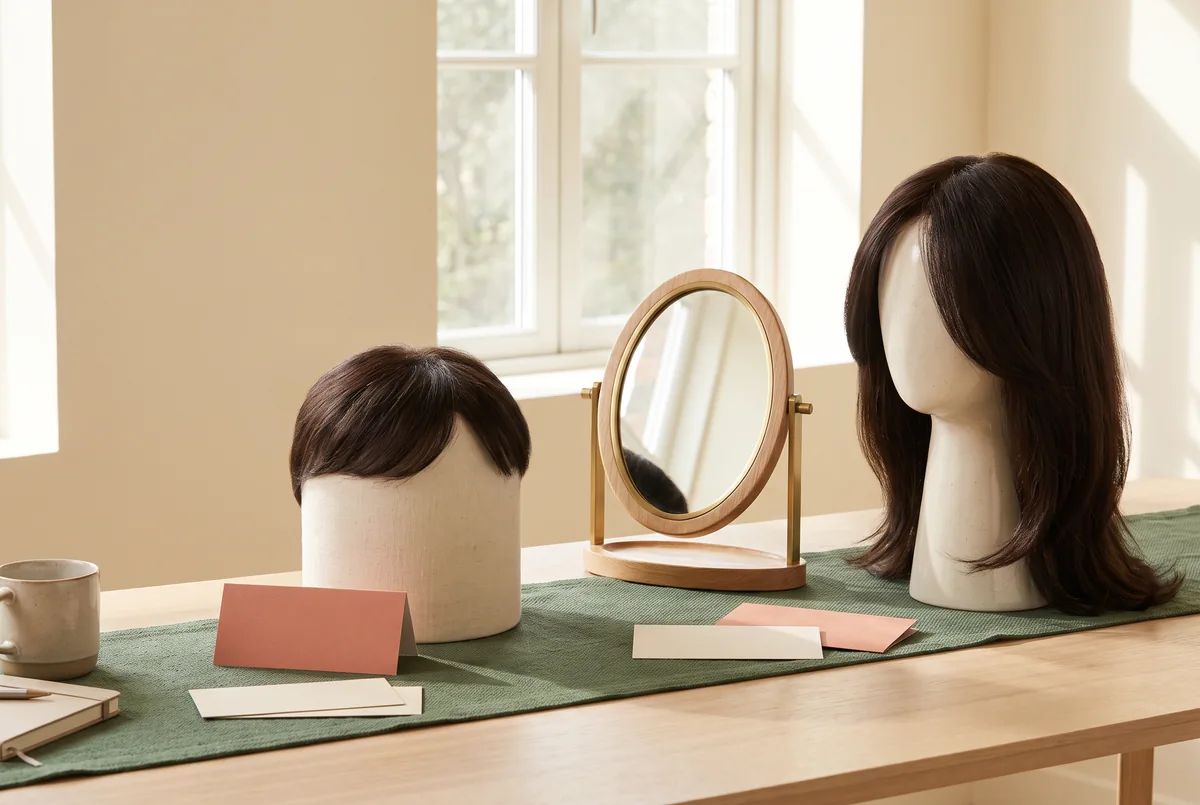
For the crown, say whether the change you want is less visible separation, a smoother transition between areas, or a different silhouette. Do not combine all three under “fuller”. Someone who likes a close, restrained hairstyle may want coverage without a raised top; a sample styled high would leave that distinction unresolved.
Retained direction also matters to the brief. If you want to keep the way surrounding hair lies, show that preference and ask how the proposed piece would relate to it. Do not assume a catalogue parting or swirl must replace your existing arrangement. Equally, a provider should explain if your requested direction cannot be demonstrated with the proposed piece.
Consider the connection forward. A crown-focused piece may leave the front unchanged, which can be exactly right for one buyer and inadequate for another. Ask where its coverage ends and whether the hair between the front and crown is included in the proposal. A hairstyle in which longer hair is arranged forward does not, by itself, establish what the base covers.
A hypothetical buyer might want a more continuous crown while retaining a familiar forehead and low top profile. A useful enquiry would ask to see that combination, not a generally denser style. If only a higher-volume example is available, record the low-profile objective as unverified rather than assuming later styling will resolve it.
Product categories are not interchangeable. A partial piece, a topper and a full wig may involve different relationships with retained hair; the label alone cannot choose that relationship for you.
4. Treat retained hair as a constraint, not spare material
Before discussing alterations, name the features you want to keep. These might include side length, sideburn shape, visible grey at the temples or a familiar outline above the ears. Preserving them is a legitimate requirement, even if changing them would make a proposed style easier to demonstrate.
Look beyond a single colour label. Ask whether the sample's colour, texture, fullness and length can be assessed alongside your retained hair. A dark top and grey sides may be an intentional preference; the question is whether the proposed transition matches your brief, not whether every strand must have an identical shade.
For a men's hair system for receding hairline, state which temple and side features must remain before discussing fitting. Ask what changes to existing hair, if any, the proposal assumes, and who would explain and carry out any agreed work. Do not approve an unspecified “blend” as though it leaves everything unchanged.
Distinguish hair direction from coverage too. FlintHub's front-flow planning article offers related reading on describing front direction; a direction reference does not establish the boundary or suitability of a replacement piece.
If the provider proposes a shorter side style, decide whether that is compatible with your retained-feature requirement. It is not a minor adjustment when preserving side length was a condition of purchase. Ask for another proposal or keep the question open; you do not need to solve the mismatch yourself by cutting or attaching anything.
5. Use photographs to communicate, not to certify fit
Photographs can show an appearance preference and identify areas for discussion. They cannot establish exact base dimensions, whether a proposed attachment is suitable, or how a particular piece will feel when worn. A flat image also cannot show every transition simultaneously.
Use a small, relevant set if you are comfortable sharing it: the front in your usual arrangement, the crown and the side features you want retained. Avoid filters, and label each image with the question it illustrates. “Keep this temple outline” is more useful than sending an unlabeled photograph and expecting the provider to infer your priorities.
For a men's hairpiece for thinning crown, use a crown image to open the discussion, then request the actual product's coverage boundary, dimensions and fitting requirements. An online image is not a measurement of your head or evidence that its depicted coverage can be reproduced with the proposed item.
Likewise, mark reference images as references. Specify whether you like their front exposure, crown profile or hair direction. You may admire one element without wanting the entire hairstyle or its density.
Ask whether images show the exact proposed product, a sample or an illustrative style, and which differences remain possible. Hong Kong Customs identifies false service descriptions and misleading omissions among unfair trade practices; obtaining clear product and service information is a practical response, not a guarantee of a particular remedy.2
You need not send a public photograph or medical history to write an appearance brief. Ask what information is needed, why, and whether a private discussion or viewing can answer the question instead.
6. Complete the two-zone objective sheet
Copy this sheet into a note before contacting a provider. Fill the desired-change and retained-feature columns yourself; leave product questions unanswered until there is actual evidence. The sheet records objectives, not DIY fitting instructions.
| Record field | Desired change: your entry | Retained feature: your entry | Question a photograph cannot settle |
|---|---|---|---|
| Front centre | Keep, soften or change the visible outline? | Current position or fringe arrangement? | Can the proposed front be shown in my intended style? |
| Temple transitions | Reduce contrast, add appearance coverage or leave unchanged? | Existing temple shape or grey detail? | What boundary and fitting assumptions apply here? |
| Crown | Reduce visible separation, change profile or leave unchanged? | Current direction or restrained fullness? | What does the actual piece cover, and where does it end? |
| Side and rear joins | How should the transition look? | Side length, texture, colour or sideburns? | What changes to existing hair would the proposal require? |
| Daily arrangement | Which style must work on an ordinary day? | Preparation limits and preferred routine? | What upkeep and professional adjustments are required? |
Give each unanswered question a next action: request written information, inspect a relevant sample, discuss fitting, or pause. Do not turn “not yet shown” into “probably fine”.
For a hypothetical front-priority buyer, the decisive condition might be retaining the existing centre while softening temple contrast. If a sample shows only a covered forehead, the exposed-front objective remains unverified even if the sample looks attractive overall.
Before accepting a proposal, use this short checklist:
- [ ] Both zones say what should change, including “no change” where appropriate.
- [ ] Retained features are specific enough to discuss without guesswork.
- [ ] The provider has explained actual coverage and any assumed hair alterations.
- [ ] Unseen product conditions remain marked as unanswered.
- [ ] There is a next action for every unresolved must-have.
Treat must-haves as gates, not a points score. An excellent crown result cannot compensate for a front change you explicitly do not want.
7. Set limits and choose the next step
The objective sheet does not diagnose hair changes, assess scalp health or determine whether an attachment is appropriate for you. Keep unexplained changes, discomfort and other health concerns outside the cosmetic brief and seek assessment from a qualified healthcare professional where needed. A product photograph cannot answer those questions.
Nor does the sheet justify DIY bonding, cutting or a universal maintenance routine. Ask for product-specific wearing and care information, along with clarification of any fitting or adjustment service. “Human hair”, “hand-tied” or a mesh description does not settle every construction detail or service condition.
If one partial option cannot meet both zone objectives, ask whether another proposal can do so without violating retained-feature constraints. You can revise a preference, discuss a different product scope or decide not to proceed. A larger coverage area is not automatically a better answer if it creates changes you did not request.
Your next enquiry can be concise: send the two zone sentences, the retained-feature conditions and the unresolved questions. Ask the provider to distinguish what can be demonstrated now from what would require further discussion, measurement or fitting. Confirm the quoted product and service scope before committing; do not assume viewing a sample establishes supply or delivery arrangements.2
Finish with a clear decision: proceed to a relevant viewing, request missing information, or pause. That is more useful than leaving with a general promise of “natural-looking hair” that neither zone has actually defined.
Frequently Asked Questions
Can front and crown needs be treated as one goal?
They can belong to one overall appearance plan, but record them separately. This allows you to prioritise one zone while explicitly preserving the other, and to see when a proposal satisfies only half the brief.
Does crown coverage settle front-line requirements?
No. Confirm the proposed coverage boundary and assess the front in your intended arrangement. Hair styled forward in a photograph does not prove that the product addresses the front outline you want changed.
Can photographs replace product measurements?
No. They communicate visible preferences, not exact dimensions or fitting suitability. Request information about the actual proposed product and ask what further measurement or viewing is required.
Does the two-zone sheet assess causes?
No. It separates desired cosmetic changes, retained features and unanswered product questions. It neither identifies a cause of hair changes nor replaces a healthcare assessment.
What if a partial option cannot meet both goals?
Keep the unmet goal visible. Consider another proposal, revise an optional preference or pause the purchase. Do not accept unwanted changes to retained hair simply because a piece meets the other zone's objective.
References
Editorial disclosure
FlintHub and OwnStrand share ownership. FlintHub Academy prepared this article with AI-assisted organisation of public sources and editorial decision tools. It is not an independent expert endorsement, a wearer review or medical advice; actual products, supply and services require provider confirmation.
FlintHub Academy · AI-assisted editorial prepared from public information. FlintHub publishes creative-learning and personal-planning resources. This is not a first-hand product test, a real client case or a claim of wig-fitting, hairdressing or medical qualifications. OwnStrand and FlintHub Academy have the same owner.
Connect this guide with your planning
For comparison tables and enquiry tools on this same subject, visit Wig Selection & Personal Styling journal. This is an information journal, not a course, product or medical service.