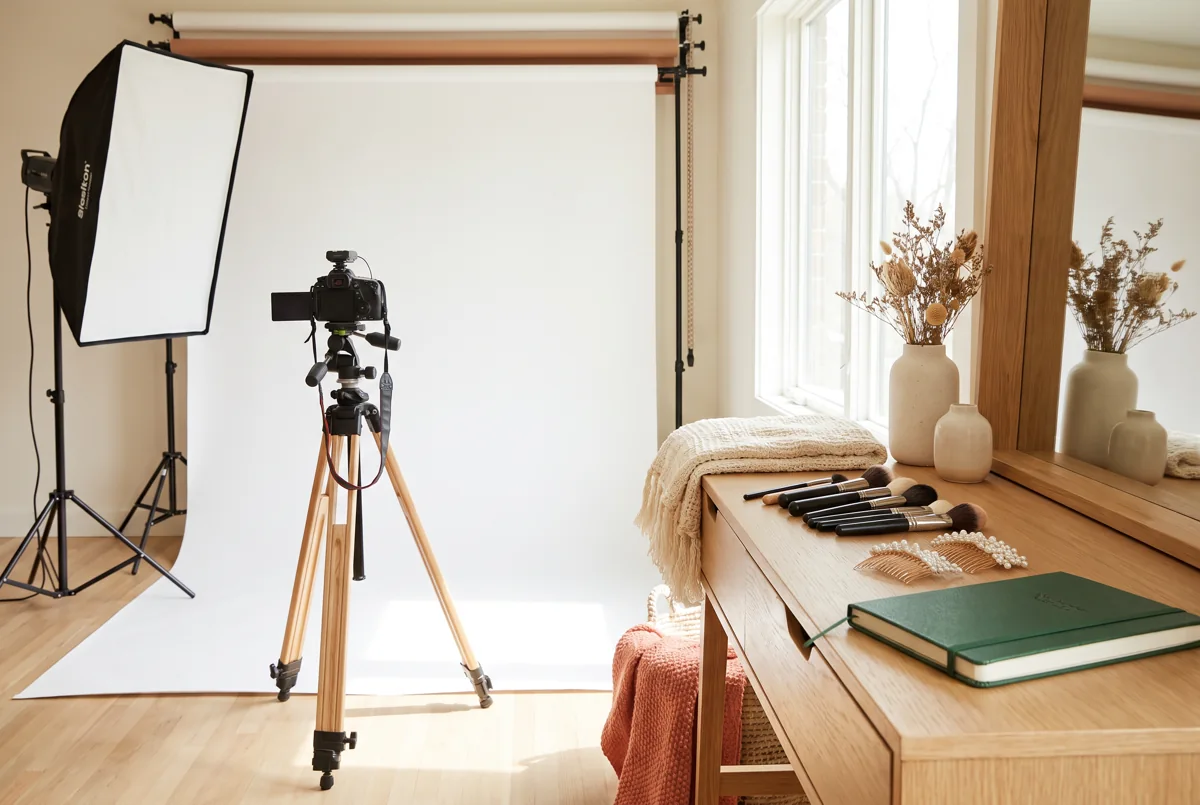
A usable pre-wedding shoot brief is one shared page that gives every supplier the same date, locations, wardrobe order, timings, scope and handoff contacts. Before anyone treats it as final, the couple should compare it against the ceremony and travel plan, venue rules, photographer’s working plan, the makeup and hair scope, and the people who can make decisions on the day.
It turns decisions that may otherwise live in separate chat threads into visible handoffs: what is known, what is an assumption and who still needs to answer.
The point is not to make a tight schedule look impressive. It is to prevent a supplier from planning around a detail that someone else has quietly changed.
What fields make a one-page shoot brief usable?
Start with decisions, not decoration. At the top, state the shoot date, the primary and fallback locations, the shared ready-by point, the wardrobe sequence and the name of the person who owns the current version. Then add a compact section for each dependency: access, travel, service scope, shooting order and weather fallback. A reader should be able to answer three questions without opening another document: what is happening, what could change, and who confirms it?
The brief is not a contract and should not pretend to be one. It does not replace a supplier’s quotation, terms, venue permission or written service confirmation. Instead, it lets the couple identify which of those documents must be requested before a choice becomes part of the day’s plan. Keep confirmation status visible: “confirmed in writing”, “awaiting reply”, or “not required for this plan” is more useful than a vague tick.
The table below is a hypothetical planning example only, not a client itinerary or a promise of availability. Its value is the way it exposes dependencies. For example, a change in the first location can affect not only travel but also the workable setup area, the wardrobe that should travel first and who needs the amended address.
| Option / decision | Known condition | Ceremony or supplier affected | Question still to confirm | Owner |
|---|---|---|---|---|
| First photo location | Outdoor setting is preferred | Photographer, transport contact, makeup and hair provider | Is there a sheltered alternative and a suitable preparation area? | Couple |
| Wardrobe order | Formal look is intended after a lighter look | Photographer, makeup and hair provider | Which look must be camera-ready first, and are changes part of the agreed scope? | Photographer to confirm with couple |
| Preparation location | Home, hotel or venue is being considered | Makeup and hair provider, venue contact | Exact address, arrival instructions, workspace, lift or parking access | Couple |
| Touch-up expectation | Couple would like a tidy appearance between setups | Makeup and hair provider, photographer | Is a touch-up, a look change or neither included in the written scope? | Couple |
| Outdoor contingency | Weather may require a route change | Photographer, venue contact, transport contact | Who calls the move, and where should everyone assemble instead? | Named day-of decision maker |
| Family participation | A relative may join selected frames | Photographer, family contact | At which location and which part of the wardrobe order? | Couple |
If the makeup portion is still being selected, use the brief to check the date, ready-by point, locations, number of looks and the written scope rather than assuming these details travel automatically between suppliers. The BigDeal Make Up guide to pre-wedding makeup booking Hong Kong is a relevant internal starting point for the details to put in an enquiry; it does not replace the provider’s written confirmation for the particular booking.
A one-page limit separates the shared plan from supporting material. Link to visual references, permits, maps or a longer shot list rather than pasting them into the operating page.
How should wardrobe order be shown?
Show wardrobe as a sequence of handoffs, not a row of outfit names. Give each look a short label, its photographic purpose, its preparation state, what may change with it and what must travel onward. “Look A / Look B” is useful only when everyone knows which outfit is first and why.
For each look, note hair and makeup direction, accessories, footwear, the photographer’s priority and any following location change. This helps the artist and photographer flag a conflict early, such as a change that would affect location time or an accessory with no named holder.
Treat a product try-out as a limited planning exercise, if one is appropriate to the service discussion. It can help record a visual preference, such as the finish seen in a reference or how a product sits in that specific trial. It is not medical patch testing, and it cannot establish that a person will not react. If there is an eye infection, inflammation or irritation, do not solve the issue with a brief; the FDA advises avoiding eye cosmetics with an eye infection or inflamed surrounding skin, stopping use if irritation occurs and seeking medical advice if it persists. It also advises against sharing eye cosmetics.1
A useful wardrobe entry gives a provider enough context to ask an informed question without claiming results. For a reader comparing a single-look makeup and hair plan with their own shoot requirements, professional makeup for photoshoot Hong Kong describes the kind of brief-led, one-look information to check. Photography, editing, venue hire and any additional arrangements should still be confirmed separately with the relevant parties.
Keep the order readable on a phone. Use a short numbered list in the live brief, not a densely formatted mood board:
- Look label and intended setting — what the photographer needs from this segment.
- Ready-before requirement — the point at which the person, clothing and accessories must be ready to begin.
- Change note — hair, makeup, accessory or location change that may affect the handoff.
- Carry-forward kit — the named person holding garments, shoes, jewellery or reference material.
The list records responsibility, not a beauty guarantee. A request for a particular style, finish or reference should remain a request until the provider agrees to its scope in writing.

Where are handoff contacts recorded?
Put handoff contacts in a compact block at the bottom of the same page, not in a separate phone note. Name one day-of decision maker and backup, then the location or access contact, photographer’s contact, makeup and hair contact, any transport contact and the wardrobe holder. Share personal details only with people who need them.
A role label matters as much as a name. “Chris” does not tell a photographer whether Chris can approve a location change; “Chris — couple’s day-of decision maker; can approve the agreed fallback location” does. This enables escalation while the couple is preparing or in front of the camera.
Add a “handoff trigger” beside each role: arrival, completion of the first look, departure, a weather decision or a missing access instruction. It identifies when the next person needs the information.
Do not use the contact block to imply that a venue has approved photography, that an artist can travel to every location or that a supplier will provide ongoing support. Those are scope questions. The brief should point to the written answer and name who holds it.
How can supplier assumptions be surfaced?
Every plan has assumptions. Add a short “assumptions to test” area for location, access, timing, creative scope and contingency. Write “workspace to be checked”, not “workspace available”, until the relevant person confirms it.
Location questions cover the precise address and preparation area. Access questions cover entry instructions, lifts, parking, stairs, venue restrictions and an arrival contact. Timing questions cover the ready-by point, travel and the last point for a decision. Scope questions cover looks, requested changes and references. A contingency question names the actual fallback rather than merely saying “weather backup”.
Ask suppliers to correct the brief rather than silently work around it. When someone corrects an assumption, record the decision, confirmer, update date and location of the written proof—enough audit trail without copying private messages.
This is where trade-offs become visible. An outdoor location may match the creative idea but add travel, access and weather dependency. One location can reduce handoffs but offer less variety. A second look may serve the photographs but creates another change and packing handoff. The useful choice is the one the couple can clearly confirm and manage.
What needs reconfirming before the shoot?
Use a final confirmation window to test the details most likely to decay: exact addresses, entry instructions, ready-by point, shoot order, scope of any look changes or touch-ups, key contacts, transport assumptions and the weather fallback. The schedule below is designed as a planning framework for the final pre-shoot confirmation one week before the shoot, not a claim that every supplier works to the same timeline. Bring it forward when travel, venue rules or a supplier’s own written terms require it.
| Action | Latest confirmation point | Handoff recipient | Written proof or version | Fallback handling |
|---|---|---|---|---|
| Confirm shoot date, call point and ready-by point | Final pre-shoot confirmation | Photographer and makeup/hair provider | Current brief version plus written confirmations | Escalate to the named decision maker before changing the shared page |
| Confirm each address and access instruction | Before anyone plans travel | All travelling suppliers | Address line, entry notes and location contact in current brief | Share a verified alternative meeting point if access is blocked |
| Confirm wardrobe sequence and essential items | Before packing is finalised | Couple’s wardrobe holder, photographer, makeup/hair provider | Numbered look list in current brief | Use the agreed reduced sequence rather than improvising a new order |
| Confirm makeup/hair scope and any requested changes | Before relying on the arrangement | Makeup and hair provider | Provider’s written scope; brief links to it | Mark unconfirmed requests as unconfirmed, not included |
| Confirm venue or public-location permissions and rules | Before travelling to the location | Photographer and location contact | Relevant written permission or rule notice | Move to the agreed compliant alternative or pause the segment |
| Check weather and safety decision route | On the day and when conditions change | Day-of decision maker and all on-site suppliers | Current brief plus official warning information | Use shelter, delay or the agreed fallback; do not treat makeup as a safety measure |
For an on-location arrangement, precise address, arrival access, workable space, call point and the requested scope are practical details to verify in writing. The internal photoshoot makeup on location Hong Kong page sets out the type of location information a provider may need; it should be read alongside the provider’s current reply, not as a promise about a particular booking.
Weather deserves a decision route because it affects safety, not only appearance. Hong Kong Observatory guidance says people outdoors during thunderstorms should seek safe shelter as soon as possible and keep away from high ground, trees and conductive objects.2 A waterproof product or revised photographic plan does not make dangerous outdoor conditions safe. Identify who pauses the outdoor segment, how the team is told and which sheltered option has been discussed.
Before the final check, run this short action list. It is deliberately specific enough to delegate:
- [ ] Mark the single current version with an update date and version owner.
- [ ] Write the exact address, entry route and on-site access contact for every location.
- [ ] State the shared ready-by point and the first photographic priority, then ask each affected supplier to flag a conflict.
- [ ] Match every wardrobe look to its accessories, holder and next handoff.
- [ ] Obtain written service scope for makeup, hair, look changes and any touch-up request before relying on them.
- [ ] Record the weather fallback, the person authorised to call it and the group message method.
- [ ] Keep venue permissions, maps and supplier confirmations linked from the brief rather than scattered across chats.
- [ ] Replace unconfirmed assumptions with written answers, or label them as open decisions.
How do you avoid duplicate versions?
Choose one editable master and one owner. Every operational change goes into the master first, and the owner sends the revision to the people affected. A static PDF is useful for final reading only when it clearly identifies its editable source.
Use a date and short revision note, plus “Last changed”, “Changed by” and “What changed”. Send a supplier-specific change directly as well as updating the master; do not assume a group chat reaches the right person in time.
Avoid shadow plans. A mood-board app, family chat and vendor thread can hold supporting material, but none should become an unmarked second timetable. Transfer a chat decision—not the whole conversation—into the brief and link its supporting image or written confirmation.
On the day, record the decision, impact, recipient and revised handoff. If time does not allow agreement, choose the safest agreed fallback rather than inventing a new plan under pressure.
A well-kept one-page brief leaves room for artistry while making dependencies visible. Use it to ask for the latest written confirmation according to your shoot date and location, then let each supplier state what they can actually provide. BigDeal Make Up can be part of that coordination where its service is relevant, but the final plan should always rest on the current, written agreements of the people involved.