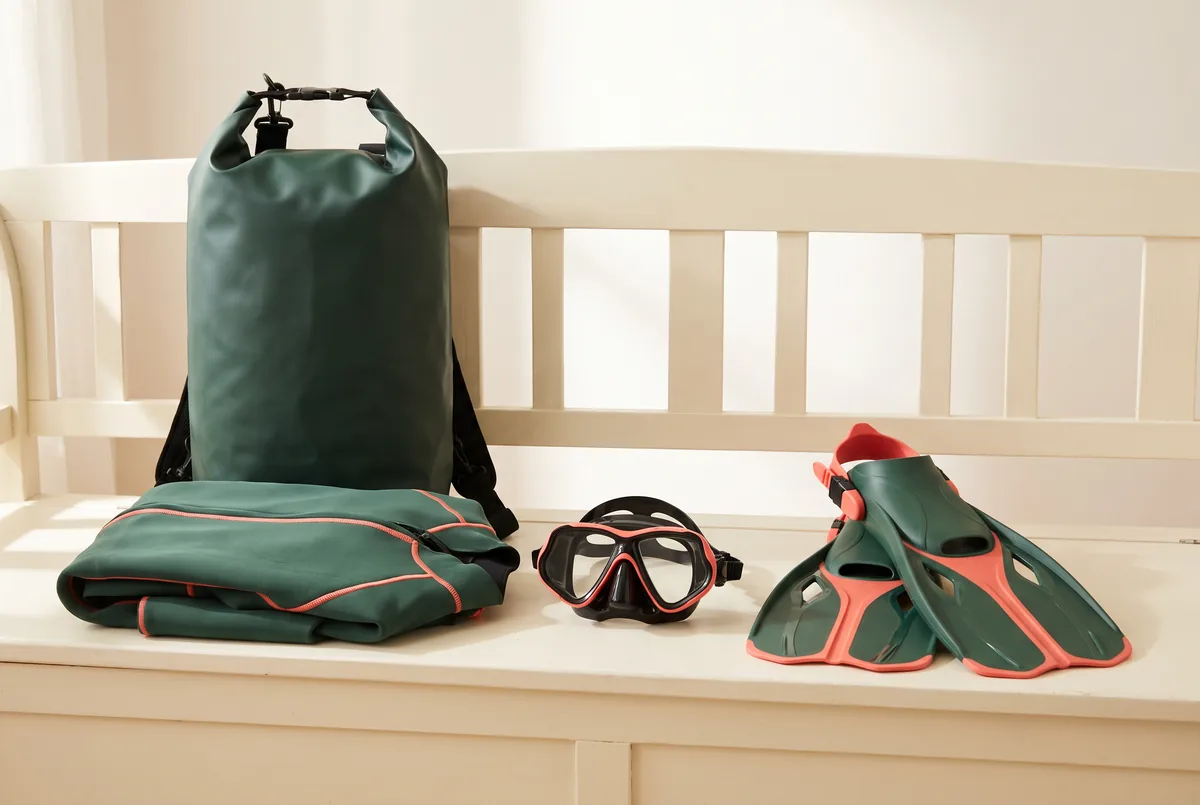
An equipment label is not evidence that a person has completed training or that a proposed diving activity is suitable for them. If a purchase page connects a product with nitrox learning, preserve the claim and ask what supports it. Do not turn its wording into a personal equipment recommendation.
This article provides a marketing claim review sheet, not gas-mixing advice. Its output is a set of unanswered claims assigned to appropriate people. A useful review can end with a decision to postpone a purchase, even when the product description is clear and the branding looks familiar.
Distinguish marketing claims from official learning routes
Start by identifying what the page actually offers: a product description, a course enquiry, or a statement about someone's completed learning. These are different kinds of information. A product can be associated with a training topic without establishing the buyer's learning status. Likewise, a course page can describe an opportunity without confirming admission or assessment outcomes.
SSI presents entry-level, continuing and professional learning routes, alongside a training-centre search. Those official resources provide a place to check how a stated course fits within its system; they do not make every commercial claim carrying the system's name authoritative 1. Keep the official route and the seller's interpretation in separate columns of your notes.
The Enriched Air Nitrox course Hong Kong page is a relevant enquiry starting point when the unresolved question concerns specialty learning rather than buying equipment. Ask the provider to identify the current official programme, explain its entry and assessment requirements, and distinguish those requirements from any associated product promotion. The link is not confirmation that a particular reader can enrol or complete it.
The following entries are hypothetical marketing examples, not quotations from a provider or manufacturer. They demonstrate how the review sheet keeps evidence gaps visible.
| Quoted hypothetical claim | Evidence source to request | What the claim does not establish | Qualified query |
|---|---|---|---|
| “Ready for your nitrox journey” | Original product description and the learning programme it refers to | The buyer's completed learning or eligibility | Ask the course provider which learning requirements remain separate from the purchase. |
| “Works with a leading training system” | Official system resource and the precise relationship being claimed | Current authorisation of this local business | Ask the system or centre to substantiate the claimed relationship. |
| “Ideal when returning to diving” | Written explanation of the advertised service | Whether this reader needs a refresher or another assessment route | Ask a qualified provider how it evaluates returning divers individually. |
| “Everything you need to get started” | Itemised description of the offer and its exclusions | That training and assessment are included | Ask the seller to define “everything” without relying on the headline. |
Do not infer suitability from an equipment label
Read a label as a statement about the item within the scope of its supporting documentation. Do not silently expand it into a statement about the owner. A brand name, compatibility phrase or specialty association does not show what the reader has learned, when they last practised, or what a qualified assessment would conclude.
A useful question is: “What exactly does this evidence describe?” If the answer concerns a product, record it under product evidence. If it concerns a training requirement, obtain the relevant programme information separately. Keeping those records apart prevents a polished product page from filling a gap that only a different decision process can address.
Hypothetical example: a reader owns equipment advertised alongside nitrox courses and assumes that ownership is enough to proceed. The review sheet should record “training status not established,” not select a configuration. The next enquiry is about the reader's existing certification and the intended learning route. Whether the product should be retained or purchased is a separate unresolved question.
Health-related questions belong outside this marketing comparison. DAN's health-status guidance addresses assessment when returning to diving and the role of appropriate medical evaluation 2. Record a need for that separate process where relevant; do not use an equipment label, this article or a sales reply as individual medical clearance. There is no health verdict to calculate in the sheet.
This separation can feel slower than accepting a simple “suitable” description. Its benefit is that each answer remains attached to the question it actually resolves. A documented product statement may answer a product question while leaving the person's learning and assessment questions entirely open.

Keep system branding separate from local authorisation
A recognised training-system name helps identify where to seek official programme information. It does not, by itself, verify the present status of the business displaying it or the person who would deliver the learning. SSI's official centre-search route is relevant to checking a centre relationship, while its learning routes explain progression within the system 1.
Record the exact local business name used in the offer. Ask how it corresponds to the centre named in the official system and who is responsible for answering course questions. If the names differ, request an explanation rather than assuming that similar branding means they are interchangeable. A logo is not a substitute for a traceable answer.
The SSI Open Water course Hong Kong page can help frame an entry-level enquiry when the reader has not established their foundational learning route. Ask which current official requirements apply and how the provider distinguishes entry-level study from a specialty enquiry. Do not infer that the two programmes can be combined, bypassed or substituted because their pages share a brand.
A screenshot can preserve what was advertised, but it may lack context or no longer represent a current claim. Note when you saw it and save the original page address. Ask for confirmation of the specific relationship being presented now, rather than treating an old screenshot as a permanent authorisation record.
The trade-off is extra correspondence. The benefit is avoiding a decision based on a broad brand association when the material question is narrower: who is authorised to provide the proposed learning, under which current programme?
Record training and refresher questions honestly
Write down what you know about your learning history without improving it to match an advertisement. Separate a certification record from a recollection of participation. Record uncertainties as uncertainties: “I cannot locate the record” is more useful than choosing a course level because it sounds familiar. Leave the assessment of that history to an appropriate provider.
A refresher enquiry has its own purpose. It can open a conversation about previous learning and returning to participation, but submitting an enquiry is not an assessment result. Nor does completing a review sheet determine what learning activity a provider should propose. The sheet prepares information; it does not classify the reader.
For a return-to-diving question, the Hong Kong scuba refresher boat dive page is an enquiry resource rather than evidence that a boat-based activity is the right route for every returning diver. Explain what records you have, what remains uncertain and what you want clarified before any activity is agreed. Ask how the provider distinguishes a refresher request from a specialty-course request.
Hypothetical example: someone remembers completing an introductory experience but cannot identify a certification. They should not translate that memory into “qualified but rusty.” Their sheet should retain the narrower statement and ask which records or assessment are needed to establish a learning route. That avoids building a purchase decision on an unsupported description.
For wider preparation, FlintHub's adventure training resources offer a related reading route. Use it to organise learning questions, not to replace the specific diving programme information or the provider's assessment process.
Exclude gas handling and configuration instructions
The review sheet should never output a gas mixture, equipment setting, calculation or handling sequence. Those would change it from an evidence-review tool into an operational instruction source. The appropriate response to a technical gap is to identify who should address it through relevant documentation and qualified training, not to improvise an answer from advertising language.
Keep technical promotional phrases verbatim when recording them. Do not decode them into a shopping instruction. Ask the seller what documentation supports the phrase, and ask a qualified training provider which questions belong within supervised learning. This preserves the claim for examination without inviting the reader to experiment with it.
If a reply includes technical directions, do not copy them into the sheet as an approved recommendation. Record the source and the question it purports to answer. Any judgment about practical use remains outside this article. A reply's detail does not establish that its author has assessed the reader or the proposed activity.
There is a deliberate limitation here: the worksheet cannot resolve technical compatibility questions by itself. It can show that such a question exists, whether anyone has taken responsibility for answering it, and whether the supplied document addresses the same item and claim. That is useful purchasing preparation without becoming a substitute for training.
Use the review sheet to request substantiation
Create one entry per claim. Copy the exact wording, identify the source, describe what the evidence does not establish, and assign a qualified query. Keep your own interpretation outside the quotation field. If a claim appears only in conversation, mark it as a recalled statement and request written confirmation instead of presenting your memory as an exact quotation.
For the evidence field, record the document title or page address and who supplied it. Distinguish a seller's explanation from an official training-system resource. Either may be relevant, but they answer different questions. A seller can explain what its offer includes; that explanation does not automatically verify an official learning requirement or local authorisation.
The missing-evidence field should be specific. Replace “unclear” with “does not establish whether training is included” or “does not identify the currently authorised local centre.” Narrow questions are easier to answer and make it harder for an attractive but unrelated brochure to appear responsive.
Assign the query by its subject, not by whoever replies fastest. The table below separates decision channels; it does not imply that every named party can resolve every individual case.
| Decision question | Appropriate channel | Useful substantiation to request | What remains outside that answer |
|---|---|---|---|
| What is actually being sold? | Seller or offer provider | Written offer scope and identified product documentation | The reader's training status |
| Which official learning route is being described? | Official training-system resources and course provider | Current programme reference and explanation of requirements | A guaranteed enrolment or assessment outcome |
| Is the claimed local system relationship current? | Official system channel or centre-verification route | Confirmation matching the business identity and claimed relationship | Individual suitability for a diving activity |
| How should previous learning or a refresher request be evaluated? | Qualified training provider | Explanation of the record-review and assessment process | A medical conclusion or equipment recommendation from this sheet |
| Where should a personal health question be addressed? | Appropriate medical professional | Guidance through the relevant health-assessment process | A conclusion from sales material |
After receiving a reply, preserve the original entry and add the answer beside it. Mark whether the answer addressed the question, supplied a source or left a gap. Do not mark a claim “resolved” just because correspondence occurred. The worksheet's final output is an unanswered-claims list, with each item attached to its next qualified query.
Stop the purchase-led plan when essential answers are missing
Pause the plan when the purchase depends on an answer you do not have. Essential gaps might include an unidentified learning route, an unsubstantiated local authorisation claim or uncertainty about what service is actually being offered. These are reasons to withhold a purchase decision, not invitations to fill the gaps with assumptions.
Ask a concrete final question: “Please identify the evidence that supports this statement and explain whether it addresses my recorded question.” If the reply repeats the headline, supplies only a logo or answers a different question, keep the item unresolved. Repetition is not additional substantiation.
A pause need not become an accusation. State that the present information is insufficient for your decision. This leaves room for the provider to clarify an incomplete description while protecting the distinction between what has been documented and what remains unknown. You can compare another offer using the same fields without claiming either provider is better.
The cost of waiting is that a purchase-led plan does not proceed as quickly. The benefit is avoiding a commitment whose rationale depends on unsupported claims. Your review is complete when it accurately records the evidence and its limits—not when it produces a product choice. Leaving an unanswered item open is an honest outcome.
FAQs
Does an equipment label prove suitability?
No. It describes an item within the scope of its documentation. It does not establish the owner's completed learning, current ability or individual assessment outcome. Keep product evidence separate from questions about the person and the proposed activity.
Will this supply gas-mixing advice?
No. There are no mixtures, settings, handling procedures or calculations here. The sheet records technical claims and directs unresolved questions to relevant documentation and qualified training without turning them into practical instructions.
Can branding verify local authorisation?
Not by itself. Use the official system's verification channel and match the claimed relationship to the named local business. Record any mismatch for clarification rather than assuming that a familiar logo establishes current authorisation.
Does a refresher enquiry replace assessment?
No. An enquiry starts a conversation. Provide an honest account of previous learning and uncertainty, then ask how the provider evaluates it. Neither the enquiry nor this worksheet decides which activity is appropriate for you.
Can I delay a purchase-led plan?
Yes. You can leave it undecided while essential claims remain unanswered. Record what is missing and who should clarify it. A review sheet does not have to end with a purchase or a recommendation.
References
- [1] SSI official learning routes and training-centre search
- [2] DAN Health Status Overview for returning to diving
Author note
FlintHub Academy prepared this AI-assisted article from public information for learning and enquiry preparation. It is not written as a qualified instructor's guidance, individual medical clearance or an independent endorsement. DiveHarbour and FlintHub Academy have the same owner; related resource, not an independent recommendation. The illustrations are conceptual, not records of actual products, learners or diving operations.
FlintHub Academy · AI-assisted editorial prepared from public information for learning and enquiry planning. The author is not a diving instructor or medical expert. This is not first-hand course testing, a real student case or medical clearance. DiveHarbour and FlintHub Academy have the same owner.