1. Decide what the gift needs to do
A corporate baked gift is not just a choice of flavour or decoration. It is a procurement decision involving the recipient, occasion, quantity, packaging, handover and any conditions that affect when or how the item can be served. Start by stating the purpose: a desk drop, a hosted event, a client thank-you or a seasonal distribution may call for different formats. Then distinguish confirmed requirements from preferences. “Must be individually packaged” is different from “a box would be nice”; the distinction helps a supplier respond to the actual need rather than guess.
Set a decision owner and a written approval path before requesting proposals. Collect the organization’s branding files, intended message, delivery or collection location, expected timing and a realistic range for quantities, if known. Treat every open commercial detail—including availability, minimum quantities, lead times, packaging, design work, delivery, payment and cancellation terms—as a question requiring written confirmation. This guide compares planning approaches; it does not establish what any merchant offers.
2. Plan the handover, access and exceptions
Map the item’s route from supplier to recipient: who accepts it, where it waits, who distributes it and when it is expected to be eaten. For an office or event venue, identify practical constraints such as access instructions, receiving hours, a named contact and what should happen if the recipient or delivery contact is unavailable. These are planning questions, not claims about a venue’s rules. If several teams are involved, agree who is responsible for receiving, storage and distributing the order before it is placed.
Ask the supplier to specify the selected product’s storage requirements and any relevant use-by or best-before information in writing; do not infer these from the word “cake” or “cream.” Hong Kong’s Centre for Food Safety sweet-food guidance, printed in June 2011, says cold desserts should be kept at or below 4°C, while its sweet-food guidance gives examples and qualifications that mean a general time rule should not be treated as a guarantee for every custom product 1. Confirm what applies to the particular item, and whether the planned handover can meet its stated requirements. If it cannot, reconsider the format or route instead of assuming a workaround is suitable.
3. Compare workable production approaches
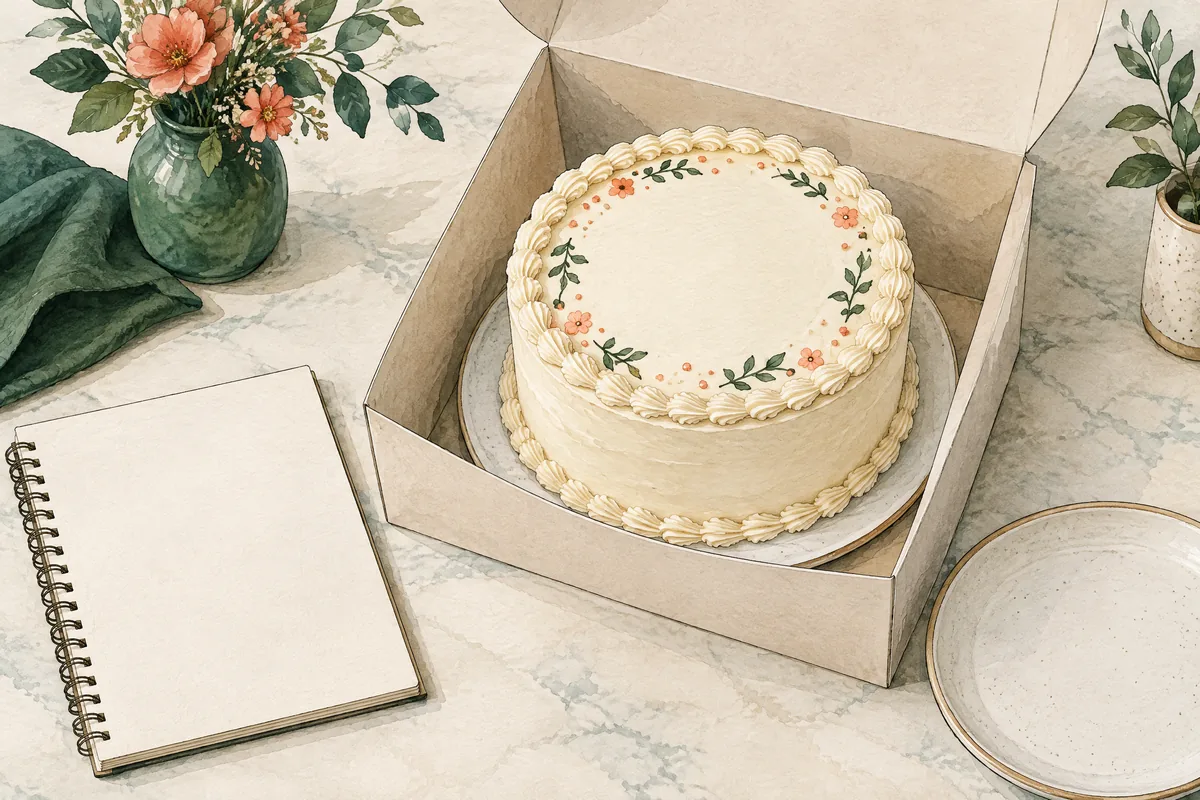
The right production scope depends on how much variation the occasion genuinely needs. A standard-format order may simplify approvals, while individually identified packs may suit a dispersed handover. A branded finish can make the gift feel specific, but it adds artwork and approval questions. A custom design can be useful when the design itself matters; it also requires clear boundaries on revisions, dimensions, edible and non-edible elements, and final sign-off. Request comparable proposals against one brief so differences in scope remain visible.
| Approach | What to specify in the brief | Trade-off to discuss |
|---|---|---|
| Standard product and shared presentation | Product options, total quantity, shared packaging and handover plan | Fewer custom decisions, but less individual identification or branding |
| Individually packed portions | Pack format, labelling needs, quantity and distribution method | Easier to allocate by recipient, but packaging and handling details need confirmation |
| Custom-branded or decorated order | Artwork, dimensions, placement, revision process and approval deadline | More tailored presentation, but artwork scope and decorative materials must be clarified |
For custom decoration, ask which components are edible and which must be removed before serving. The U.S. Food and Drug Administration advises against using decorative products on food when they lack ingredients and are marked only “non-toxic” or “for decorative purposes only”; that U.S. guidance does not certify a particular merchant’s materials or establish the specifications of any custom artwork 3. Keep the question concrete: what material is proposed, what information is available about it, and what instructions apply to the finished item?
4. Turn related enquiries into a comparable brief
A product enquiry becomes more useful when it says what the organization is trying to accomplish rather than asking for an unbounded list of possibilities. Include the occasion, desired format, estimated quantity, location context, intended handover window, packaging needs and whether branding is essential or optional. If comparing small-format options, Macaron Wholesale is a page label for an enquiry, not evidence of availability, price, capacity or included services. Specify the required quantities, packaging, branding and handover context, and ask for the requested scope and every open commercial term to be confirmed in writing.
A second enquiry route may help when the question is about a corporate gift rather than a general product category: Corporate Mooncake. Use the page name to organize your questions, then state whether the request concerns packaging, branding, quantities, handover or another requirement.
For a different product-category enquiry, Mooncake Wholesale is also a page label, not confirmation of availability or scope; specify your needs and request written confirmation. Do not presume that a page label confirms a specific design option or service. If you are exploring a hands-on activity instead of a gift order, FlintHub’s baking workshop Hong Kong route reconnects the planning conversation to learning and activity planning; it does not imply that food or gifts are included with a course.
5. Use the procurement scope comparator
Use this worksheet before inviting a proposal. Fill in what is known, mark what remains open, and send the same version to each supplier under consideration. “Not confirmed” is a useful answer at this stage: it prevents assumptions from becoming an informal commitment. Where an item is not relevant, write “not applicable” and record why. Keep the final supplier response beside the approved brief so the person arranging handover can work from the same specifications as the person who placed the order.
Corporate baked-gift scope worksheet
- Purpose and recipient: What is the occasion, who receives the gift, and is it handed out individually or served collectively?
- Product and quantity: What format is requested, what quantity range is currently estimated, and what substitutions require approval?
- Presentation: Is branding required, optional or not wanted? Who supplies artwork, and what dimensions, file format, revision limits and final approval process are confirmed?
- Decoration: Which elements are edible, which are not, and what written removal or serving instructions apply?
- Ingredients and cross-contact: Request the actual ingredient information for the selected base, filling and decoration, and ask what is known about shared equipment or cross-contact controls. Do not turn a formula change or the absence of a warning into an allergy-safety guarantee. The FDA explains that cross-contact can occur through shared equipment or production lines, and that “may contain” statements are voluntary in the U.S. framework 2. This is a prompt for questions, not Hong Kong legal advice or a finding about any supplier.
- Storage and handover: What storage conditions and product-specific time limits are supplied? Who receives the order, where is it held, and what is the fallback if access or timing changes?
- Commercial terms: What are the confirmed price, availability, lead time, delivery or collection arrangements, payment terms, cancellation terms and validity period of the proposal?
- Approval record: Who has authority to approve the sample or artwork, product, quantity, written terms and final order?
6. Match the format to recipient and participant needs
Recipient needs should shape the brief without encouraging unsupported promises. Ask what information recipients need to make their own choices, and request product-specific ingredient details rather than relying on broad descriptions such as “light,” “vegetarian” or “cream.” Identify any known dietary requirements within the organization and decide how those requests will be handled. A supplier’s written response can clarify stated ingredients and processes; it cannot establish suitability for every person with an allergy; do not describe an item as risk-free.
The FDA’s list of major U.S. food allergens includes milk, eggs, fish, crustacean shellfish, tree nuts, peanuts, wheat, soy and sesame. That list is a useful reminder to ask about components, but it is not a complete list of possible allergens or a statement of Hong Kong labelling law 2. If the gathering includes a learning activity rather than a gift distribution, FlintHub’s cake-making class page reconnects planning to learning and activity planning; it does not establish that a corporate order, catering or gifts come with a class. Keep the procurement brief and any activity enquiry distinct.
| Planning priority | Shared event presentation | Individual recipient packs | Activity-linked planning |
|---|---|---|---|
| Main decision | Serving, timing and who manages the display | Allocation, pack identification and distribution | Whether the activity is a separate objective from gifting |
| Details to confirm | Product storage, serving instructions and responsible handover contact | Pack contents, labels, packaging and recipient count | Learning purpose, format and what is or is not included |
| Common planning risk | Assuming venue storage or serving arrangements are available | Assuming each pack has a particular label or custom design | Treating a class enquiry as confirmation of food, catering or gifts |
These approaches are not interchangeable. Choose the one that best fits the handover and recipient experience, then ask the supplier to confirm which parts can actually be provided. If the order is intended for people to take away, clarify whether anyone must keep it chilled, how long it may be held under the specified conditions and who will communicate that information. If those details are not yet known, make them approval blockers rather than filling the gap with guesswork.
7. Resolve open questions before approval
Before approving a proposal, compare it with the original brief line by line. Check that product, quantity, packaging, artwork, ingredients, storage instructions, handover plan and commercial terms have an explicit status: confirmed, declined, revised or still open. Ask for a revised written proposal if a response uses vague language such as “usual packaging” or “standard lead time.” Those expressions may mean different things to different parties and should not be treated as a defined specification.
For artwork, confirm the finished size and units, whether design or revisions are included, who signs off the final proof, and which elements are not edible. For food handling, obtain the selected item’s own storage information and make sure the planned route can accommodate it. For a seasonal or branded order, request confirmation of availability and timing for the required quantity rather than assuming that an enquiry page establishes either. Approve only the scope the organization can explain to its receiving contact and recipients. Keep the final written response, approved artwork and handover instructions together as the record of what was agreed.
Frequently asked questions
What should a company include in a baked-gift enquiry?
State the occasion, intended recipients, format, estimated quantity, packaging, branding needs, handover location and timing. Ask for availability, price, lead time and all other commercial terms in writing; none should be inferred from a product-page label.
How can we compare proposals fairly?
Send each supplier the same brief and compare confirmed scope, exclusions, assumptions and open questions. Separate required features from preferences, and request clarification where a proposal leaves artwork, packaging, delivery, storage or cancellation terms undefined.
Can we assume a cake is safe at room temperature?
No. Ask for storage instructions for the specific product, including its fillings, and plan handover accordingly. General guidance does not establish the conditions or time limits for a particular custom order, and a merchant’s details need written confirmation.
What should we ask about food allergies?
Request ingredient information for the selected product and ask about shared equipment or cross-contact controls. A missing warning, a substitution or a broad dietary description does not establish suitability for someone with an allergy.
Does a corporate baking workshop include baked gifts or catering?
Do not assume so. A learning or activity enquiry is distinct from a procurement order. Ask separately what the activity includes, and seek written confirmation of any food, materials, catering or other requested provision before making plans.
Editorial disclosure
FlintHub Academy and YumYum have the same owner. The editorial preparation date is 2026-11-10, not a confirmed publication date. This article was prepared with AI assistance and is not an independent recommendation of a merchant or product. FlintHub Academy does not claim medical, veterinary or professional qualifications. The article is an editorial planning resource, not confirmation of YumYum’s availability, prices, products, ingredients, delivery arrangements, certifications or service scope. Hong Kong is discussed as a planning context only; no branch is implied. External guidance is attributed to its publisher and should be read within its stated scope.
References