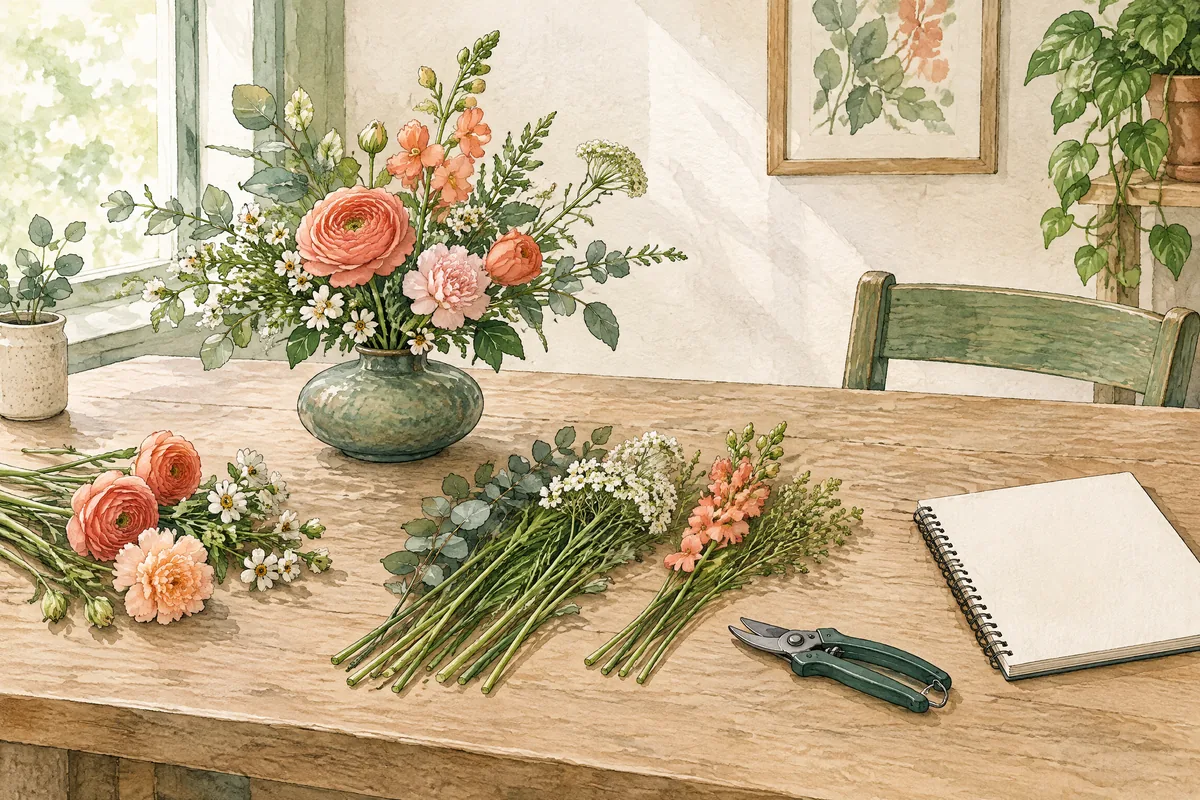
1. Decide what the flowers need to do
Opening flowers can welcome guests, mark an entrance, frame a photograph or make a reception area feel distinct. Start by choosing the purpose and the moments when the flowers need to be present. An arrangement intended for a short welcome may have different placement and removal needs from one expected to remain for several days. Avoid choosing a display before you know its location, footprint and the venue's conditions.
Ask the venue contact to identify the usable event area and any limits on fixing items to walls, floors or ceilings. A room plan is a starting point, not proof that every proposed position is permitted. Note who can approve changes on the event day and how that person can be reached. If the plan depends on a feature such as a doorway, counter or staircase, confirm that specific location rather than relying on a general description such as “near the entrance.”
For Hong Kong planning, distinguish the venue and event context from the rules of a particular facility. The Leisure and Cultural Services Department's wedding FAQ concerns its designated wedding venues; it explains that the department provides venue hire and basic facilities, rather than arranging wedding decoration 1. That example is useful for asking who is responsible, but it is not a rule for hotels, corporate venues or every event in Hong Kong.
2. Coordinate access, handover and exceptions
A flower plan needs a practical handover, not just an event start time. Confirm the date, the permitted access window, the delivery point, any check-in process and the name or role of the person who will receive the display. Ask whether a lift, loading bay, trolley route or temporary holding area is available, and whether these need separate booking. Treat each as an open question until the venue confirms it in writing.
Removal is a separate task to assign. Ask who takes away arrangements, stands, wrapping, water containers and any other materials, and when they must be cleared. Do not assume that a florist, venue team or organiser will collect items unless that scope has been agreed. Decide what happens if access is delayed, the event runs late, the recipient is absent or the venue changes the usable area. A named decision-maker and a written fallback can prevent rushed choices at the entrance.
The LCSD's guidance for its wedding venues says that booking time must include preparation, rehearsal, dismantling structures and post-use tidying, and places guest-flow management and venue cleaning responsibilities on the applicant 3. Those conditions apply to the facilities described in that guidance, not automatically to other venues. For any location, ask its own contact to confirm access and clear-down terms rather than treating a planning example as a universal booking condition.
3. Compare workable placement approaches
Compare options using the actual room, audience route and handover plan. A display that is visually prominent may be a poor choice if it narrows a passage or has no agreed collection point. The Hong Kong Fire Services Department advises keeping escape routes, including corridors and stairs, unobstructed 2. Its resident-facing education page is not event approval and does not specify a suitable width for a particular venue; have the venue confirm its approved layout.
| Placement approach | Useful when | Confirm before choosing |
|---|---|---|
| Welcome-desk display | Guests naturally pause at a staffed reception point | Whether the desk can accommodate it, who receives it and whether it affects queues or work surfaces |
| Freestanding display in an agreed feature area | A focal point is wanted away from the main welcome desk | Footprint, stability arrangements, permitted floor protection and the route for removal |
| Smaller arrangements distributed across surfaces | Several areas need a modest visual cue | Which surfaces are available, who places each item and how every item is tracked for collection |
| Removal approach | What it can simplify | Questions to settle in writing |
|---|---|---|
| Organiser collects items | The organiser retains control over distribution after the event | Who is physically available, where items wait and what happens if the event overruns |
| Recipient takes named items | Flowers can go to people or teams after the opening | Who identifies recipients, when handover happens and what happens to unclaimed items |
| Agreed supplier collection | One party may be assigned to clear specified items | Whether collection is actually offered, the time window, included items and responsibility for leftover materials |
These are planning alternatives, not promises about what a venue or supplier provides. Select an approach only after the venue and responsible parties confirm the location, access and tasks. For fixed, suspended or unusually large displays, ask the venue whether its approval process treats the proposal as a temporary structure. The LCSD wedding-venue annex calls for design details and sketches for temporary structures, but its examples do not classify every floral installation or determine requirements elsewhere 3.
4. Turn enquiries into specific requirements
When reviewing flower arrangements, use the enquiry to explain the event rather than relying on a broad label such as “opening display.” State the venue area, intended purpose, preferred position, approximate available footprint if the venue has confirmed one, access constraints and the required removal outcome. Ask for any proposed dimensions and setup assumptions in writing, then have the venue check them against its own plan. This page label is an enquiry resource, not an endorsement or confirmation of a particular arrangement, service scope or availability.
For a grand opening flower basket, describe whether it is meant to mark an entrance, be handed to a recipient or serve another purpose. Specify the venue-approved position, access arrangements and who will take responsibility for it after the event. Ask for the proposed scope and any unresolved details in writing; the page label is an enquiry resource, not an endorsement or confirmation of availability or service terms.
If considering flower baskets, clarify whether a basket is intended as a gift for a recipient or as a display at the venue. Those uses can lead to different placement, handover and collection questions. Ask what the quoted proposal includes, how it is presented, who receives it and what happens to its container after the event. Do not infer delivery timing, collection, setup or packaging details from the page name; request written confirmation of each relevant detail.
You can reconnect these logistics to learning and event planning without assuming a course supplies flowers or decoration. For instance, FlintHub's event venue decoration resource can inform activity planning around the proposed space; it does not establish a particular service package or venue approval. Likewise, its floral gardening workshop resource reconnects to learning and activity planning, not a promise that any course includes flowers, catering, gifts or event setup. Keep those learning questions separate from the supplier's written quotation.
5. Use the placement and removal plan
Copy this worksheet into the event brief and complete it with the venue contact and whoever is responsible for the flowers. Use “to confirm” where no one has given a definite answer. A blank is a prompt for follow-up, not permission to make an assumption.
- Event and date: ________
- Venue contact and event-day decision-maker: ________
- Flower purpose and intended display period: ________
- Venue-approved location and reference to the plan or photo: ________
- Permitted footprint, fixing method and any conditions stated by the venue: ________
- Access window, arrival point and person receiving the items: ________
- Who places the display, and what written scope confirms that task: ________
- Who removes each item, containers and leftover materials: ________
- Collection time and destination, or recipient handover plan: ________
- If access, layout or event timing changes, who decides and whom they contact: ________
- Outstanding questions, person responsible for answering and confirmation deadline: ________
Before approval, send the completed plan to the relevant parties and ask them to correct any item they do not accept. Keep the final venue confirmation with the supplier's written scope. If the venue cannot confirm the desired location, record an alternate position and obtain approval for that too. If the removal owner cannot attend, agree a different named person rather than leaving the display or materials without an assigned outcome.
6. Map recipient and participant needs
A display can be intended for the whole room, a particular recipient or a sequence of guests. Identify who will approach it, whether a handover is part of the opening and whether anyone needs to move it afterward. These are coordination questions, not assumptions about a recipient's preferences. If the flowers are a gift, agree who communicates with the recipient and who takes responsibility for unclaimed items. If guests will gather nearby, ask the venue how that affects its planned circulation.
If the display includes live plants intended to remain after the opening, ask who will care for them and what the venue permits. Keep this question separate from any cut-flower arrangement, and request written confirmation of any proposed maintenance responsibility. Do not assume care, replacement or ongoing support is included unless the responsible party has expressly agreed to it.
Where a display includes a fixed structure, overhead element or other feature the venue treats as requiring approval, do not presume that a smaller or lower design is automatically exempt. Ask the venue what information it needs and whether the proposal is acceptable. The LCSD annex discusses structural documentation for its wedding-venue context, including a height condition for certain structures; it does not settle how every floral feature is classified, and its requirements should not be presented as Hong Kong-wide event law 3.
7. Close open questions before approval
Approval should mean that the intended display, location, access and removal responsibilities are understood—not merely that someone has seen a picture. Request the final proposed items and dimensions, a clear location reference, the permitted setup window, the contact for event-day changes and the agreed collection outcome. If a supplier quotation leaves any of those details open, ask for a written answer or mark the issue as unresolved. Do not treat an absent detail as included.
A useful final check is to read the plan from each party's perspective: the venue needs to confirm its space and access conditions; the organiser needs to identify decisions and handovers; and the supplier needs a clear request and scope. Keep venue approval distinct from a supplier's proposal. If one party changes a location or timing, circulate the revision to everyone affected and obtain confirmation again. These steps make the plan easier to execute without claiming that they guarantee a particular visual result, safety outcome or service performance.
Frequently asked questions
When should the venue approve the flower location?
Ask for approval before confirming the final order or setup plan, especially when the proposed position uses a shared entrance, affects guest circulation or involves fixing or suspending anything. Request confirmation of the precise location and any conditions, rather than assuming that a general room plan approves the display.
Who should remove opening flowers after the event?
There is no universal answer. Name the organiser, recipient or supplier only after that party agrees to the task, timing and items involved. Confirm who handles containers and leftover materials too, and set a fallback for an overrun, absent recipient or change in venue access.
Can a wedding-venue rule be applied to a corporate opening?
Not automatically. The cited LCSD guidance concerns specified LCSD wedding venues, while a hotel, office or other event location may have different arrangements. Ask the chosen venue for its own written conditions on access, installation, approval, circulation and clear-down before making a plan.
What should an opening-flower enquiry include?
Describe the event purpose, venue and approved area, preferred placement, access window, intended display period and removal outcome. Ask which dimensions, setup tasks and collection responsibilities are actually included, and have the venue confirm the proposed location. Mark unanswered details for written follow-up rather than treating them as agreed.
What if the display cannot be removed at the planned time?
Agree a contingency before the event: who can make the decision, whether an alternate collection time or location is permitted, and who will tell the venue and other responsible parties. Do not leave items behind on the assumption that venue staff or another party will take responsibility.
Editorial disclosure
FlintHub Academy and YumYum have the same owner. This article was prepared with AI assistance on 2026-11-10; that is the editorial preparation date, not a confirmed publication date. It is not an independent recommendation. FlintHub Academy does not claim medical, veterinary or professional qualifications. It is an editorial planning resource, not a venue approval, supplier quotation or guarantee of service, safety or results.
References