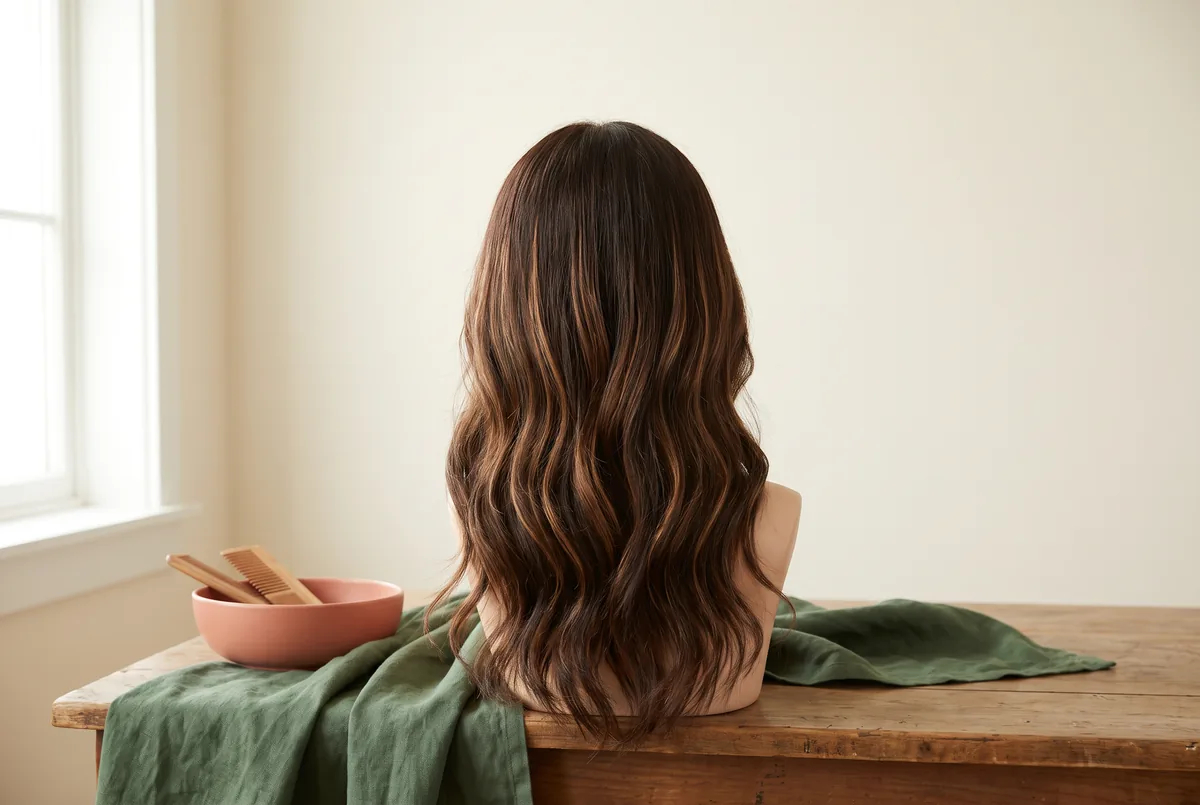
Choose a line-led colour story when separate strands should reveal direction during a turn; choose an end-gradient story when the lower edge of the hair should read as a moving shape. To decide, storyboard your actual choreography, mark the visible hair zones and test them in the intended framing before considering any colour change.
An inspiration photograph cannot show how a colour pattern behaves across a dance sequence. A bright ribbon may disappear behind the shoulder, while lighter ends may leave a tightly cropped frame entirely. Your useful question is not which name sounds more fashionable, but which visible detail supports the performance you are making.
1. Give colour one job in the choreography
Start with a single sentence: “The hair should help viewers notice the turn,” or “The bright ends should outline the final pose.” This gives the dancer, camera operator and editor a shared priority. It also creates a reason to reject changes that look attractive in a portrait but contribute little to the sequence.
Colour can support movement without becoming the main subject. Separate lighter strands may help distinguish one section from another when they spread. A broader lighter area at the ends may make the lower silhouette easier to follow against a darker background. Neither effect is guaranteed: hair position, lighting and shot size can interrupt it.
For a Hong Kong adult cover-dance project, separate rehearsal decisions from filming decisions. A mirrored practice room helps you check choreography, but its reflection and overhead lights are not the same as the final camera view. If you are exploring KPOP dance learning, keep this visual brief alongside your movement practice rather than treating appearance as a substitute for learning the routine.
Choose a secondary limit too. Perhaps the face must stay readable, or the colour must suit your ordinary workday hairstyle. A successful video brief respects life outside the shoot.
2. Draw a motion-vector grid from real movement
Here, a motion vector means a simple arrow showing where a visible section of hair travels. It is an observation tool, not a measurement of speed or a salon application diagram. Draw three frames for each important movement: before it starts, during it and after the hair settles.
Use an ordinary rehearsal recording with your current hair. Mark the crown, side lengths and ends only where they can actually be seen. Add an arrow to the moving section, then circle any area hidden by a hand, shoulder or crop. Do not assume that every strand follows the direction of the dancer's head.
| Movement beat | Arrow to draw | Visible colour zone to check | What could hide the intended effect |
|---|---|---|---|
| Small side turn | Across the side lengths | Separate surface strands | Hair collecting behind the shoulder |
| Body rotation | Around the moving outline | Mid-lengths and ends | Torso blocking the lower section |
| Forward reach | Downward where hair falls | Front lengths | Hands crossing the face or hair |
| Settled final pose | No movement arrow | Resting lower silhouette | Ends falling outside the crop |
These are prompts, not predictions for all hair lengths or textures. Replace them with movements in your own choreography. If a section never appears, colouring it for that particular shot has no clear visual purpose.
Watch the full-speed sequence before pausing it. A single freeze-frame can exaggerate a feature that barely registers in motion. Then inspect the pause to understand why the feature appears or disappears. This order keeps the worksheet focused on the audience's experience rather than on a flattering still.
3. Compare colour lines with a lighter lower silhouette
A line-led goal depends on visible separation. Ask whether you want a few readable ribbons or a finer pattern that produces a general impression of brightness. Closely spaced light areas can merge on a small screen; broader pieces may remain distinguishable but draw more attention away from the face. Those are visual tradeoffs, not rankings of quality.
An end-gradient goal depends on proportion. The relevant questions are where the transition becomes noticeable and how much lighter length stays inside the shot. A low transition may suit a wide frame yet vanish in a chest-up crop. Bringing brightness higher changes the portrait as well as the moving outline.
| Visual goal | Describe in the brief | Potential benefit | Tradeoff to accept |
|---|---|---|---|
| Readable moving lines | Distinct light areas separated by visible depth | Gives strands a clearer direction | Can become visually busy near the face |
| Soft distributed brightness | Light areas that blend into the overall hair | Supports a quieter colour presence | Individual strands may not register |
| Lighter end silhouette | Brightness concentrated in the lower visible length | Emphasises the moving outer shape | Relies on the ends remaining in frame |
| Retained current colour | No chemical change; adjust scene contrast | Keeps the decision reversible | May provide less colour emphasis |
If scattered brightness through darker lengths is your starting preference, Vit So's balayage page can help you frame questions about placement and retained depth. Bring the grid and identify which moving areas matter. The page does not establish how your hair will look under dance lighting or whether your chosen brightness is achievable on its current condition.
If your priority is a lighter lower shape, use the ombre hair service information to organise questions about transition height and the amount of brighter length. Specify the final framing and any intended trim, because removing ends changes the balance. Treat the term as a visual direction, not proof that every strand should share one boundary or that extra work is included.
4. Translate the names without prescribing the method
Balayage, highlights and ombre are useful conversation starters, but they answer different parts of a brief. Painted placement is associated with balayage; highlights concern selected lighter strands; ombre describes a darker-to-lighter progression towards the ends. These ideas can overlap. A soft transition may still contain readable ribbons, and selected strands need not produce a rigid striped finish.
For a dancer, the distinction matters only if it improves communication. “I want lighter ribbons visible during the side turn while the crown stays deep” is more specific than asking for a name alone. Separate distribution from shade: liking a bright lower area does not mean you want the same warm or cool tone as the reference.
The balayage vs highlights comparison is relevant when your storyboard alternates between individual lines and broader brightness. Use it to refine the visible pattern you want, then ask how that goal relates to your current hair. It should not become an instruction to combine several named services or a claim that one label always produces less damage.
Choose one dominant visual intention for the video. A secondary detail can remain in the brief, but it should not automatically expand the work. If colour history or condition makes the preferred change unsuitable, revising the scene is a legitimate creative solution.
5. Test wardrobe, light and framing before changing hair
Make the first comparison with your existing colour. Keep the dance phrase and camera position unchanged, then change one scene variable. Try a different top or a less distracting background before changing the lighting. A patterned shoulder area may conceal moving ends even when there is strong colour contrast.
Check both a wider frame and the crop you expect to publish. For vertical video, the hair may fit comfortably during a still pose yet leave the frame during a turn. Leave space for its natural movement instead of asking the dancer to repeat an awkward adjustment solely for the hairstyle.
Hong Kong outdoor locations add another variable: a harbour-side breeze may change the hair's resting position between takes. Rehearse in conditions appropriate to the location and confirm filming permission where needed. Do not infer an indoor result from an outdoor reference, or treat a windy take as evidence of how the hair usually falls.
Compare clips at ordinary playback size with beauty filters disabled. Keep exposure and colour settings consistent where possible. Watch for light catching existing strands; that apparent brightness is not necessarily a colour-placement change. Your notes should distinguish what the scene reveals from what the hair itself contains.
6. Complete a hypothetical colour storyboard
The following is a fictional planning example, not a client result. Imagine an adult dancer with shoulder-length brown hair making a short cover-dance video. The sequence has a side turn, a body rotation and a chest-up closing pose. The desired colour detail must help the turn without competing with facial expression.
Step 1: Write the viewing priority. The worksheet sentence is: “Separate moving strands should be noticeable during the side turn; the closing pose should remain face-led.” This makes the line-led intention primary. A dramatic lighter bottom edge is optional, not a second requirement.
Step 2: Mark what enters the frame. Draw arrows along the side lengths during the turn. Circle the ends in the closing pose if they sit below the crop. Write “not visible in this shot” rather than assuming brighter tips would solve the problem.
Step 3: Compare a reversible alternative. Record the same phrase against a plain background with a top that separates the hair from the shoulders. The hypothetical worksheet has not established whether this is enough. Its purpose is to require the comparison before a lasting change is chosen.
Step 4: Draft the consultation sentence. Use: “I prefer visible lighter ribbons through the moving side lengths, with depth retained near the crown. I do not need a uniformly bright lower section.” Add current front, side and back photographs, the usual parting and known colour history.
Step 5: Record the fallback. If that preference is not appropriate for the current hair, retain the colour and adjust the frame or background. Do not turn the fallback into an automatic request for another chemical service.
Adults choosing where to practise can explore Dance course options separately from the appearance brief. Keep choreography learning, filming preparation and any salon enquiry as distinct decisions; a course link does not establish a combined service arrangement.
7. Set a care and scheduling boundary
The colour brief must leave room for assessment. Tell the salon about earlier dyes, lightening, perms or straightening that remain in the lengths, including uncertain details. A softly blended reference says nothing about the chemical work your own starting colour might require. Confirm proposed scope, charges and appointment arrangements before committing to a filming deadline.
The FDA advises following actual hair-dye product directions and warns that a reaction can occur despite earlier problem-free use. It also states that a preliminary skin test without a visible reaction does not guarantee that dyeing will cause none.1 Share past reactions and current scalp discomfort rather than treating the storyboard as a safety check. Seek healthcare advice for a reaction; this article cannot diagnose it or set a universal waiting interval.
Repeated filming should not mean repeated aggressive styling. The American Academy of Dermatology advises reducing heat exposure, using lower heat and avoiding tight pullback or tugging that can damage hair.2 Prefer a manageable arrangement over constant heated resets, and adjust an uncomfortable style rather than tolerating it for continuity. General care does not permanently repair chemically altered hair.
If enquiring with Vit So, its receiving address is 252 Hollywood Road, Sheung Wan. Confirm consultation language directly; an English website alone does not establish English-speaking reception or consultation.
FAQ
Will fine colour lines show in a wide dance shot?
Not necessarily. Distance, movement and the background may make them read as general brightness. Check a full-speed rehearsal clip at the intended viewing size before making fine strand definition essential to the brief.
Can a line-led design also have brighter ends?
Yes, the visual intentions can coexist. Decide which is primary so the consultation does not become a request for every feature in several references. Their coexistence does not automatically require separate services.
Does an end gradient work with tied-back hair?
It may show mainly in the moving tail rather than around the head. Storyboard the tied arrangement you will actually use. A loose-hair reference cannot demonstrate its visibility, and a tighter tie is not a solution to poor framing.
Should I trim before deciding the transition height?
Discuss the length you intend to keep before agreeing on colour distribution. A trim can remove a meaningful part of an ends-focused design. This is a planning question, not a universal rule about appointment order.
What if the colour looks different across locations?
First compare lighting and camera settings, not just the hair. Choose one reference condition for continuity and note unavoidable changes. Do not request further lightening merely because one location makes the existing colour look darker.
About FlintHub Academy: This institutional article connects adult creative learning with practical visual planning. It was organised with AI-assisted editorial support. FlintHub Academy and Vit So share common ownership, so the links are not independent endorsements. This is not a hairstylist-authored review, expert-reviewed guidance or medical advice.
References
- [1] FDA: Hair Dyes
- [2] American Academy of Dermatology: 10 hair care habits that can damage your hair
FlintHub Academy · AI-assisted editorial prepared from public information. FlintHub publishes creative-learning and activity-planning resources. This is not a first-hand salon test, a real client case or a claim of hairdressing, clinical or medical credentials.