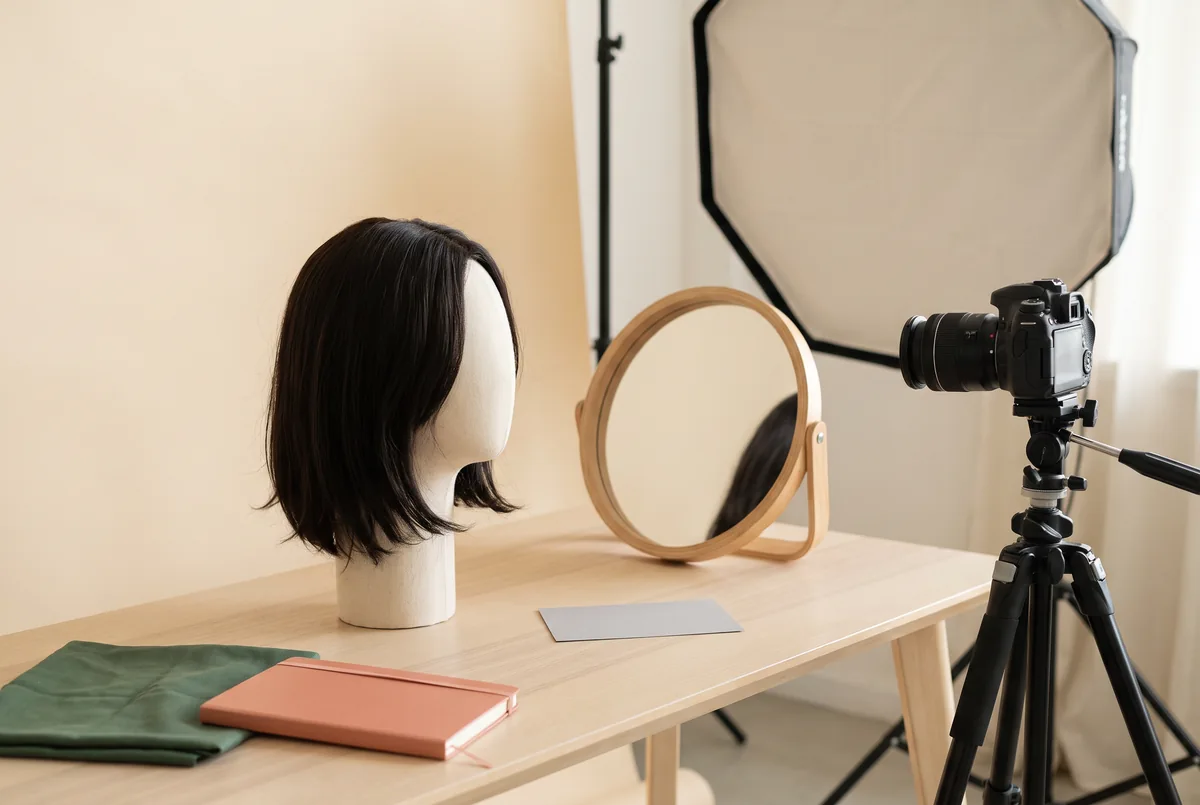
Build the board as six matched cells: one outfit, one background, and front-and-side views for each of three length or line options. It lets an auditioning performer compare where hair finishes, how it frames the face, and whether the overall outline still reads from the likely audience distance.
This is a planning tool, not a promise that a reference will look identical in person. Its value is separating a physical decision—length, parting, density, texture and cap construction—from flattering light, a camera angle or a filter.
Give the board one clear job
A useful board answers a narrow question. “Which option looks best?” is too broad. Instead ask, “Which length keeps this neckline visible when I turn stage right?” or “Which straight line supports this suit under cool indoor lighting?” Write the question at the top before collecting images.
Choose one complete outfit, including shoes if they change posture, and one plain background. A grey wall or rehearsal curtain reveals an outline better than a busy lobby. Keep the camera height, crop, light direction and stance as stable as practical. You are comparing options, not producing six different social posts.
OwnStrand is an external website with the same owner as FlintHub Academy, not an independent comparison recommendation. It may provide style-reference or product information, but your board should state what is actually specified and what is merely visible in a photograph.
Board rule: keep the person, outfit, camera, background and viewing direction stable; change only the style reference. A changed pose can otherwise masquerade as a changed hairstyle.
Map the six cells before finding images
Use three rows and two columns. Rows are the selected reference families; columns are front and side. If you have not tried an option, label that cell “reference only—unfitted”. Do not score fit, security or comfort from an image.
| Style row | Front cell asks | Side cell asks | Note down |
|---|---|---|---|
| Short | Is the jaw and neckline clear? | Does the nape interrupt the collar or profile? | Fringe, crown volume, finish point |
| Medium-length | Does it land above, on or below the shoulder? | Does it catch on or conceal costume detail? | Shoulder contact, movement, back volume |
| Straight | Does the vertical line support the costume? | Does the profile look deliberate rather than flat? | Parting, ends, shine, flyaways |
These terms can overlap: a short bob can be straight, and a medium-length option can have a straight finish. Treat the rows as prompts, then label the precise combination, such as “medium length, straight, centre part”. The short wigs category, for example, still covers distinct fringe, bob and nape shapes; recording those details is more useful than writing “short” alone.

Separate physical reference from digital treatment
Save the source image, then add a plain-text note beside it: “warm side light; chin lowered; ends hidden by shoulder; softened forehead edge may be a filter.” This small step stops a board from crediting the hair for work done by lighting, crop or retouching.
Prefer an unobstructed front or side view with a visible parting and endpoints that contrast with the clothing. An image where hair blends into a black top, is pulled over one shoulder or is held by a hand can be mood inspiration, but it is weak silhouette evidence.
The American Cancer Society advises people selecting a wig to compare colour by a window, bring everyday style references, and check brand sizing and return conditions.1 In this setting, those are practical prompts: comparable daylight can expose a colour or shine difference, and the written seller terms—not assumptions—govern a particular transaction.
Use this check for every cell:
- Physical evidence: are the hairline, part, texture and endpoint visible?
- Camera conditions: could lens, angle, distance or light alter the apparent shape?
- Digital treatment: could smoothing, grading or face reshaping conceal density or flyaways?
- Repeatability: can rehearsal approximate this pose and viewing angle?
- Missing facts: are material, cap type, measurements or shade actually unknown?
Write “unknown” rather than inferring it from a polished picture. It keeps a visually exciting option from receiving evidence it has not earned.
Make a consistent photograph or reference mock-up
When you have an outfit and an option to test, mark the floor position, set the camera roughly at eye level and repeat the same crop. Stand neutrally with level chin and relaxed shoulders. For the profile, name the side in advance—stage left or stage right—because a costume fastening, earpiece or parting can make them different.
| Control | Hold constant | Why it matters | Practical compromise |
|---|---|---|---|
| Outfit | Full look or equivalent neckline | Endpoints need a stable boundary | Use a rehearsal top with a similar neckline |
| Background | One plain, contrasting backdrop | Busy detail hides edges | Use a wall or curtain, not a mirror |
| Camera | Height, distance, lens and crop | Perspective alters head and shoulder proportions | Mark the phone position |
| Pose | Neutral front and named side | Tilt changes apparent length | Put movement images outside the six cells |
| Light | Direction and colour temperature | Backlight changes density and shine | Use indirect daylight or steady room light |
If a fitting is unavailable, build a digital board using references, but preserve that label. When you later make fitting photographs, create a version two rather than silently replacing cells. The visible difference between concept and trial is valuable information.
Read the silhouette at the right distance
View the board at arm’s length and then at roughly the distance where a panel, teacher or audience member may first see you. At that scale, locate the face, shoulder line and costume focal point. Do not judge only while zoomed into individual photographs, where tiny endpoint details receive too much importance.
Short length can free the neck and shoulder architecture, which may suit a strong collar, earrings or precise head movements. It can also make an earpiece, asymmetrical ornament or bare neck more prominent. Medium length offers a larger framing area and can move attractively in a turn, but it may cover a neckline or lose its edge against similar-coloured fabric.
A straight line directs the eye vertically and makes an uneven end, shifted parting or compressed crown easier to notice. That can support a structured character and tailored costume, while demanding more careful checking in a hurried change or humid outdoor setting. The question is not whether a look is universally flattering; it is whether it supports this brief with manageable preparation.
For movement-led preparation, use the board beside an outfit run-through for a Chinese dance class. Watch whether the chosen line still supports head turns and shoulder work. This FlintHub Academy link is a learning resource, not a claim that it supplies wigs or styling services.
Score confidence separately from preference
Use two ratings for every option. Evidence confidence asks how much you can actually see or verify. Brief fit asks how well the visible option answers your stated audition question. Keeping them separate prevents a favourite image from collecting credit for facts it does not show.
Score each from 1 to 5. For confidence, 1 means “mostly crop, filter or unknown specifications”; 5 means “clear front and side, comparable colour viewing and key written information checked”. For fit, 1 means “works against the costume or role cue”; 5 means “supports the required line, movement and preparation limits”.
| Criterion | Evidence-confidence question | Brief-fit question |
|---|---|---|
| Neckline clearance | Can I see the true endpoint against clothing? | Does it preserve the costume focal point? |
| Profile | Is the side view unobscured and unfiltered? | Does it suit the character’s visual line? |
| Colour and shine | Was the light comparable or stated? | Does it work with the garment colour? |
| Movement | Is movement shown rather than inferred? | Can I manage it through the routine? |
| Preparation burden | Are material and care conditions known? | Is upkeep realistic before call time? |
Write one sentence explaining each number before adding or weighting scores. If the most dramatic option has confidence 1, seek a clearer reference or fitting; arithmetic cannot turn missing evidence into a final answer.
Treat material and finish as separate questions
Style language describes appearance. Product language describes what may be possible. Fibre or human hair, heat-friendly status, cap design, size range and fastening method are separate characteristics. A straight-looking option is not automatically suitable for heat styling, and a cap label alone cannot predict individual comfort.
For a shoulder-level comparison, note exactly where ends land and whether that overlaps the costume edge. When browsing medium length wigs, copy stated length, fibre and cap details only where the page provides them; do not fill gaps from the apparent density in a photo.
Jon Renau distinguishes human hair, standard synthetic fibre and heat-resistant synthetic fibre in its care guide. It specifically says its standard synthetic fibre should not be heat-styled or blow-dried, and calls for product-appropriate care.2 That is an example of why the manufacturer’s instructions for the specific item matter, not a universal temperature rule or a promise that dyeing, chemical alteration or adhesives are suitable.
When colour is part of the decision, record both the shade name and the viewing conditions rather than trying to translate a screen image into a colour promise. Compare a reference against the audition garment near a window when possible, then repeat under the rehearsal lighting if that will be noticeably different. The board can say “needs in-person comparison” without treating this as a defect. It simply identifies a limitation that an image cannot resolve.
Make heat, colour, adhesive or scalp concerns a separate go/no-go check. Confirm written conditions with the seller or manufacturer, and seek appropriate qualified professional or clinical advice where needed, especially for irritated skin or treatment-related concerns. A wig is an appearance item, not treatment; no board can guarantee comfort, sensitivity outcomes, shedding or durability.
Catch familiar mismatches before deciding
Run this scan before calling a cell the winner:
- Shoulder illusion: the model is turned away, so medium-length ends look clear but would land on a collar seam in a front view.
- Filtered hairline: a beauty filter softens the forehead edge; the board credits the hairstyle for a digital effect.
- Hidden profile: only the preferred side is shown, while the other may conflict with an earpiece or ornament.
- Black-on-black loss: dark hair against a dark top removes the true endpoint.
- Texture swap: a “straight” reference has been curled or brushed out for the shoot.
- Material leap: a sleek picture is taken as permission to straighten, recolour or glue without checking conditions.
Hong Kong’s Trade Descriptions Ordinance framework prohibits false, misleading or incomplete goods information.3 Save the written description and transaction terms used in your decision, and ask where a material feature is unstated. Do not assume that an online purchase has a universal return right; the applicable written terms determine it.
Planning example: explicitly hypothetical
Assumption-only example: Maya is a fictional performer, not a client, testimonial or research participant. She is preparing for a short contemporary audition in a pale, high-collared jacket. Her six cells use the same jacket, a mid-grey wall, front and stage-right profile.
Her question is: “Which reference leaves the collar readable while keeping a deliberate line in a 30-second turn sequence?” A short, off-centre-part reference scores 5 for clearance but confidence 2 on the profile because the source hides the nape. A shoulder-skimming medium reference moves well but meets the collar seam in front. A medium straight reference best supports the jacket’s vertical seams, but its finish during movement is unknown.
Maya does not treat the board as a purchase instruction. Her next step is to find a clear short-option profile and test a neutral straight styling sample during the turn sequence. The board has converted an aesthetic reaction into two precise information gaps and a low-risk action.
Copy this reusable worksheet
Copy this into a notes app or spreadsheet before a fitting, rehearsal or shopping session. It is a repeatable planning method, not a substitute for trying the option in relevant conditions.
AUDITION SILHOUETTE BOARD WORKSHEET
Audition/role cue: _
Decision question: _
Outfit and neckline: _
Background, light and camera setup: _
Named side view: stage left / stage right
Short: endpoint _; part _; confidence 1–5 _; fit 1–5 _; unknowns _; next action _
Medium-length: endpoint _; collar contact _; confidence 1–5 _; fit 1–5 _; unknowns _; next action _
Straight: part/vertical line _; profile _; confidence 1–5 _; fit 1–5 _; unknowns _; next action _
Final choice: _
Reason it answers the question: _
Conditions to re-check: ____
Add “not chosen because” for every rejected option. For example: “Medium length not chosen because it covers the collar in the neutral front view; reconsider only if the costume changes.” Naming the trade-off makes later revision easier.
Carry a provisional choice into rehearsal
A chosen cell is not an on-camera guarantee. Run the idea through entrance, greeting, seated position, turn and exit. Check it from farther away and with someone else holding the camera. For any event, ask early about indoor or outdoor conditions, audience distance, wind, headwear, microphone placement and time available for a change.
If preparation leads to a Mall event performance, treat lighting and scheduling as event-specific questions for the organiser or provider. That FlintHub Academy link offers performance-setting context; it does not guarantee a booking, a styling service, venue conditions or dates.
For a final line-and-parting vocabulary check, straight wigs may be useful. OwnStrand and FlintHub Academy have the same owner, so that link is style information rather than an independent endorsement. Confirm any exact item’s current written specifications and terms directly before relying on them.
A six-cell board does not eliminate uncertainty. By holding outfit, background and views steady, while marking filters, missing facts and practical limits, it helps you make a clearer short, medium-length or straight reference decision without mistaking a polished image for a verified performance solution.
FlintHub Academy · AI-assisted editorial — FlintHub Academy shares planning information for creative learning and performance preparation. Read more about FlintHub Academy. This is planning information only and does not assume wig-fitting, medical or clinical qualifications.
References
- [1] Choosing and Wearing a Wig
- [2] Alternative Hair Care Guide
- [3] Trade Descriptions Ordinance and Consumer Protection
FlintHub Academy · AI-assisted editorial. FlintHub publishes creative-learning and event-planning information. This article is a desk-researched planning resource, not a first-hand product test or a claim of wig-fitting or medical qualifications.