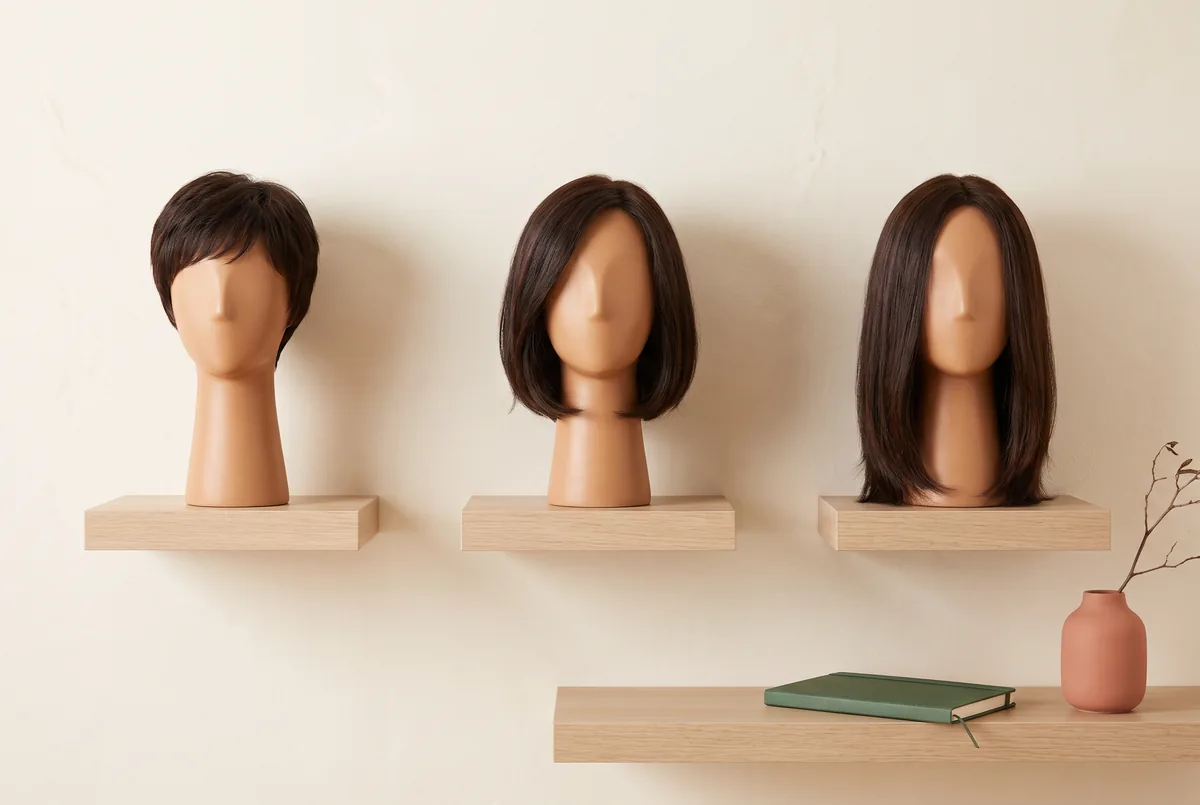
Choose long wigs when you welcome hair over your shoulders and can accommodate it around everyday clothing; favour a pixie candidate when keeping those areas clear matters more. Neither length is automatically practical: compare the actual ends, fringe and nape against your usual scarves, outerwear and work tops before deciding.
A length you enjoy occasionally may become frustrating if it needs rearranging whenever you put on a jacket. The useful question is not which style looks easier, but which one asks for changes you are willing to repeat.
Start with the clothing you wear most often
Begin with a normal week, not a special outfit. Select your most frequently worn work top, your usual outer layer and any scarf you regularly carry. Include the clothes you wear when seated, commuting or running errands, because a comfortable standing arrangement may feel different once you settle into a chair.
Write what you want hair to do around each garment. You might accept ends resting over a shirt but dislike hair inside its collar. Someone else may prefer hair behind the shoulders but not want to keep moving it there. These are different requirements, even if both people say they want a manageable length.
Distinguish a preference from a firm exclusion. “I would rather not rearrange hair after removing my coat” allows comparison. “I will not wear hair against the back of my neck” rules out any candidate that makes that contact, however short its catalogue description sounds. Naming the boundary early prevents you from negotiating against your own comfort later.
Jon Renau's buying guide treats lifestyle, length, fibre and cap construction as connected choices.1 Here, clothing is a concrete way to examine that lifestyle: record what touches the piece and how often you would have to intervene.
Do not assume you must replace a favourite scarf to make a wig work. If a garment is central to your routine, treat it as a fixed condition. Consider changing it only if you genuinely prefer that change, rather than because a reference photograph makes a particular length appealing.
Compare long and pixie contact points
Length changes where contact can occur, but the label does not tell you exactly where the ends will land on you. A long candidate may rest across shoulders, lapels and the front of a top. A pixie may clear the shoulders while still touching a high collar at the nape or brushing a scarf near the jaw.
When browsing long wigs, use the range to identify lengths worth checking against your clothing, not to assume every piece offers the same clearance. Ask where the front and back sections finish when worn, and whether the displayed arrangement is the supplied style or additional styling.
During an agreed try-on, compare hair in its ordinary resting position first. Notice whether it lies outside a collar, slips inside it or gets enclosed when you put on an outer layer. Then check whether your preferred arrangement returns after you remove that layer. A look requiring continual repositioning may be acceptable for occasional wear but not for a busy workday.
The following table identifies observations to make; it does not predict damage or guarantee that either length will avoid contact.
| Clothing feature | Long candidate: check | Pixie candidate: check | Practical decision |
|---|---|---|---|
| Scarf around the neck | Ends enclosed by the wrap or resting over it | Nape and side strands meeting the scarf edge | Keep only arrangements you willingly repeat |
| Coat with raised collar | Hair caught inside the collar when dressing | Back ends clearing or sitting on the collar | Compare with the collar in its normal position |
| Work shirt or blouse | Hair entering the neckline when leaning forward | Fringe or side hair requiring correction | Note interruptions during ordinary tasks |
| Hooded outerwear | Hair placement before and after lowering the hood | Nape or crown arrangement after hood removal | Ask permission before testing the hood |

A short option is not automatically easier
A pixie can remove shoulder-length contact without removing every daily task. Its fringe may still need arranging, and its back section may sit precisely where a scarf or collar rises. Judge the particular cut, not an imagined version with no hair near the face or neck.
Long hair also has more than one practical arrangement. You may prefer it resting forward, behind the shoulders or in a supplier-approved style. Do not count tying or tucking as an available solution until the provider confirms that the actual construction supports your intended arrangement. Wanting to move hair away from clothing does not establish that a piece can be styled that way.
Compare how often an intervention repeats. Moving ends out of a coat once on arrival is different from adjusting them every time you lean over a desk. Conversely, correcting a short fringe throughout the day might be less acceptable to you than occasional shoulder contact. “Easy” should describe your routine, not the number of centimetres in a listing.
Allow a separate decision about appearance. You can prefer the look of longer hair and still decide its clothing contact is unsuitable for daily use. You can prefer a pixie yet reject a specific example because its nape meets your least comfortable collar.
If you cannot try a candidate, mark the clothing question as unresolved. A shorter photograph is not evidence that it will clear your particular garment. Ask for relevant dimensions or clarification, but recognise that these cannot fully replace observing the piece on your own head with your clothing.
Separate style length from fibre and cap conditions
Two pieces with similar end positions may have different care requirements and fitting arrangements. Record the fibre and cap details separately from the length decision. Clearing your shoulders does not tell you how the piece should be cleaned, which styling products suit it or whether its size works for you.
A page for pixie wigs can help narrow the short-length enquiry, but it cannot answer every construction question for every candidate. Request the individual piece's fibre description, cap information and care instructions rather than carrying assumptions from another listing into the comparison.
Jon Renau's care guide distinguishes human hair, ordinary synthetic fibre and heat-friendly synthetic fibre; ordinary synthetic fibre is not intended for heat-tool styling.3 Follow the actual manufacturer's directions. Do not plan to solve a collar-contact problem through heat styling, chemical alteration or cutting based only on a length label.
Also separate contact from fit. If a garment pulls hair into an unwanted position, record that interaction. If the cap shifts, pinches or feels unsuitable, ask the provider to assess the fitting question instead of assuming a shorter style will resolve it. Do not continue a clothing trial through discomfort to obtain a complete set of notes.
Keep the comparison fair: record length-contact observations in one part of your notes and product conditions in another. A promising contact result remains provisional if essential care or fit information is missing. Equally, detailed construction information does not make an unwanted everyday contact acceptable.
Consider work and casual occasions together
List recurring occasions rather than counting outfits. A collared workday, a casual day with a hooded jacket and a regular evening class may represent most of your use. Add a special dinner only after those repeated situations are covered. Otherwise, one appealing occasion can overshadow the routine you actually need to support.
Within a broader enquiry about women's wigs, explain whether you want one full wig for repeated daily wear or a piece mainly for selected occasions. That distinction gives the provider a clearer clothing brief; it does not imply that every listed option is available or appropriate for every purpose.
Consider this hypothetical comparison: a reader wears a high-collared jacket most workdays and dislikes any hair inside that collar. A long candidate works only with repeated repositioning, while a particular pixie clears it. The pixie deserves the next fitting enquiry. If its nape also meets the collar, neither candidate has passed; the reader needs another cut or can postpone purchasing.
Another reader might welcome shoulder-length contact and wear an open-neck top frequently. A long candidate could remain viable, provided its resting arrangement and care conditions suit them. These examples illustrate preference-led decisions, not wearer results or rules for what people should wear to work.
If a recurring activity introduces additional length needs, FlintHub's guide to hair length for tying, turning and everyday use provides related planning context. Keep that activity question separate: a daily clothing trial is not proof of suitability for vigorous movement or a particular class.
Use a contact inventory to exclude poor matches
Copy the inventory below and complete it with your own garments. Repeat a row for two coats or several work tops if they create genuinely different contact conditions. Name the item precisely enough to bring it to a fitting: “the jacket with the raised back collar” is more useful than “outerwear.”
Write your unacceptable contact before inspecting the candidates. Then record each result as acceptable, unacceptable or not yet observed. Do not turn unknowns into passes. A description such as “probably fine with my scarf” identifies a question, not a successful comparison.
| Inventory item | Your entry | Long / pixie observation | Exclusion or next check |
|---|---|---|---|
| Scarves | Name, usual wrap, occasions worn: ___ | Ends, side or nape contact: ___ | Unacceptable contact: ___ |
| Outerwear | Coat or jacket, collar and hood position: ___ | Before and after dressing: ___ | Arrangement you will not repeat: ___ |
| Work tops | Neckline, collar, usual seated tasks: ___ | Contact while sitting and leaning: ___ | Interruptions you will not accept: ___ |
| Casual tops | Frequent neckline and outer layer: ___ | Hair resting position: ___ | Garment change acceptable? ___ |
| Personal boundary | Hair-contact preference that is non-negotiable: ___ | Which candidate crosses it? ___ | Exclude, or leave pending observation: ___ |
Use this concise checklist when reviewing the completed inventory:
- [ ] Include the scarf, outerwear and work top you actually repeat.
- [ ] Record one firm hair-contact boundary in plain language.
- [ ] Observe each candidate in its intended everyday arrangement.
- [ ] Separate an acceptable result from an unobserved one.
- [ ] Keep only candidates that meet your boundaries without unwanted daily changes.
One firm exclusion is enough to reject a candidate for your intended daily use. Several acceptable rows do not cancel it out. If the issue occurs only with an optional garment, decide whether changing that garment is worthwhile. If it affects required work clothing, keep the clothing requirement and change the shortlist.
Confirm the actual piece rather than buying a reference image
Bring the completed inventory and the hardest-to-accommodate garment to the next enquiry. Ask whether a relevant sample can be tried, what differs between that sample and the supplied piece, and how the front and nape lengths are described. Obtain permission before introducing scarves or outerwear during a fitting.
Clarify whether any suggested adjustment is part of the purchase, a separate service or merely an idea requiring assessment. If the piece only meets your brief after a proposed change, keep it pending until the provider confirms feasibility and scope. Do not treat a reassuring conversation as confirmation of an unspecified alteration.
Hong Kong Customs describes unfair trade practices including false service descriptions and misleading omissions.2 This supports asking clear questions about what is being offered, not assuming an unconditional refund or any particular legal remedy. Confirm applicable purchasing and return conditions directly, especially before approving changes to a piece.
Your next step should answer the remaining decision. If the contact result is unknown, seek a permitted clothing try-on. If contact is acceptable but fitting or care information is missing, request those details. If neither candidate respects your boundaries, ask for a different end position rather than buying one and hoping to adapt.
This inventory evaluates everyday practicality, not medical suitability, secure attachment during sport or future durability. Short observations cannot reproduce every garment and day. Finish with a narrow conclusion: suitable for the routines observed, unsuitable for a stated requirement, or awaiting confirmation. Each is a useful outcome, including deciding not to purchase yet.
Frequently asked questions
Are pixie wigs always easier than long wigs?
No. A pixie may clear the shoulders yet touch a high collar or require fringe rearranging. Compare the actual daily interventions you accept, rather than treating short length as a guarantee of low effort.
Can length settle fibre or cap questions?
No. Length describes the style, not its material, care conditions or fitting suitability. Record these separately and request information for the individual candidate before planning any styling changes.
Should scarves and outerwear enter the inventory?
Yes, when you regularly wear them. Record the normal wrap, collar or hood position and check hair placement after dressing and undressing. You need not replace essential clothing to keep a candidate on the shortlist.
Does a reference image prove the supplied length?
No. Use it to identify a direction for enquiry. Confirm the front and back lengths, differences from any sample, and your own clothing-contact observations where a try-on is available.
Can a candidate be excluded for everyday contact?
Yes. An unwanted recurring contact is a valid practical reason to decline it. Keep your stated boundary rather than averaging it away with other advantages; another candidate, occasional use or postponing the purchase may suit you better.
References
- [1] The Beginner's Guide to Wig Buying
- [2] Hong Kong Customs: Unfair Trade Practices
- [3] Alternative Hair Care Guide
Editorial disclosure
FlintHub and OwnStrand share ownership. FlintHub Academy prepared this article with AI-assisted organisation of public sources and editorial decision tools. It is not an independent endorsement, a wearer test or medical advice. Actual products, availability and services require provider confirmation.
FlintHub Academy · AI-assisted editorial prepared from public information. FlintHub publishes creative-learning and personal-planning resources. This is not a first-hand product test, a real client case or a claim of wig-fitting, hairdressing or medical qualifications. OwnStrand and FlintHub Academy have the same owner.
Connect this guide with your planning
For comparison tables and enquiry tools on this same subject, visit Wig Selection & Personal Styling journal. This is an information journal, not a course, product or medical service.