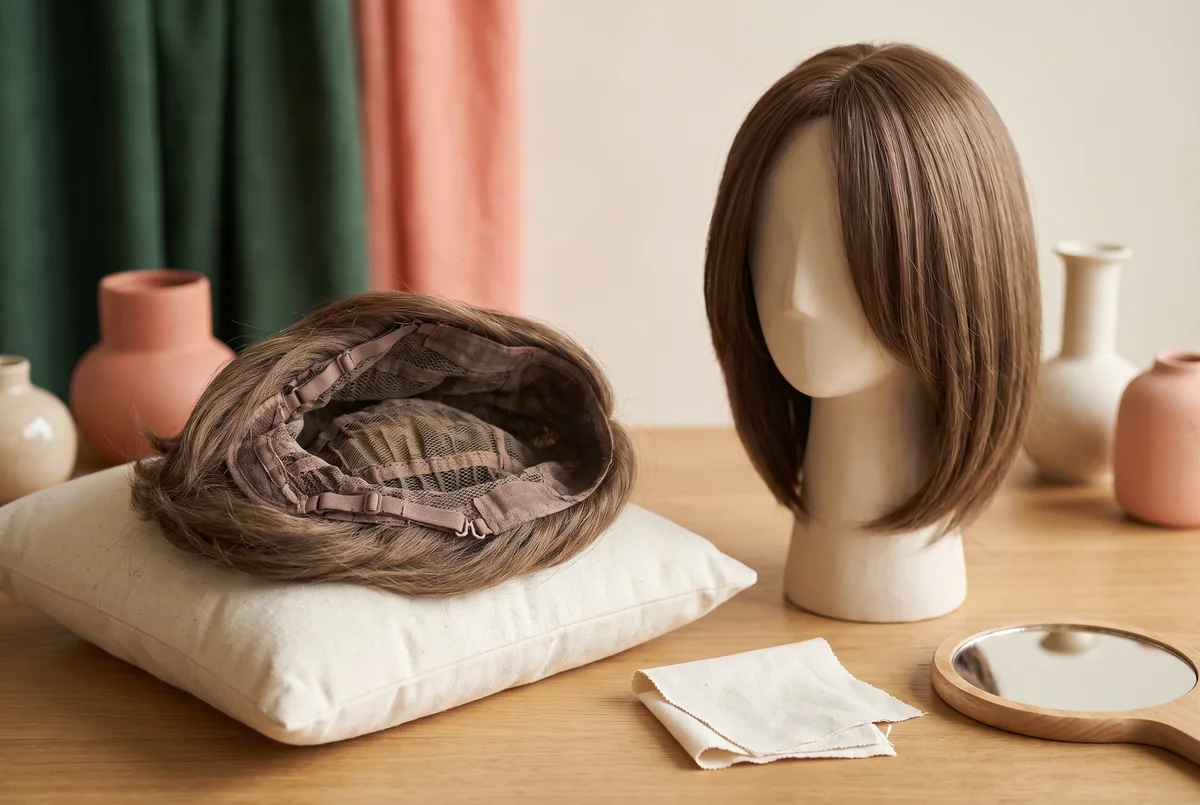
Choose low density wigs by describing where you want less visible volume and which features must remain, then ask the supplier to demonstrate those requirements on the proposed model. A density label alone cannot establish the outline, comfortable fit or whether a wig will go unnoticed.
Start with an outline rather than a density number
“Less hair” is an incomplete brief. You might want a quieter crown, narrower sides, a fringe that does not dominate your face, or ends that sit closer to your collar. These are different requests. Reducing everything could remove fullness you wanted to keep while leaving the original concern unresolved.
Describe the outline in three views: front, side and back. Use familiar landmarks rather than invented technical measurements. For example, specify that the side outline should sit closer to the cheek than in your reference, while the ends should retain a continuous bob shape. Mark each reference image with the feature it illustrates; one picture need not supply the entire brief.
Separate hair quantity from its arrangement. Length, layering, texture and the way a sample has been styled are questions worth asking before attributing every difference to density. Jon Renau's buying guide treats lifestyle, fibre, cap construction and length as separate selection considerations, rather than one interchangeable product benefit.1
If a supplier offers a density percentage, ask what it describes: the whole wig, a particular zone or a custom specification. Ask which comparable sample makes that figure meaningful. Without an explained basis for comparison, use the number as a question, not your acceptance standard.
Name the problem positively as well as negatively. “A close side outline with visible face-framing lengths” gives the supplier a destination. “Not bulky” merely identifies something to avoid and leaves room for incompatible interpretations.
Low density does not settle cap or fit questions
When browsing low density wigs, treat the category as a starting point for discussing fullness. Ask which listed or proposed model addresses your particular crown, side or fringe preference, and what evidence supports that answer. The category does not resolve the fit of the cap beneath the hair.
Keep two separate records: what you see and what you feel. A visually restrained outline may still have a cap, edge or adjustment arrangement you do not find workable. Conversely, a sample may feel acceptable while its silhouette remains fuller than you want. Do not merge these observations into a single “natural and comfortable” verdict.
Before comparing fullness, have the supplier confirm the intended size and wearing arrangement. Ask whether the sample represents the size you would receive, and whether anything worn beneath it changes the comparison. If the setup differs, record that difference instead of treating the sample as direct proof.
The following table translates common volume requests into questions. It does not prescribe a construction or rank products.
| Initial request | More useful outline language | Feature to protect | Evidence to request |
|---|---|---|---|
| “Make the top flatter” | Less height at the crown in side view | The agreed part position | The proposed model shown from the side, with styling disclosed |
| “The sides are too wide” | A closer outline beside the cheeks | Face-framing length | Front and side views of the same sample |
| “The fringe is heavy” | Less visual mass across the forehead | Agreed fringe coverage | A sample showing the intended fringe arrangement |
| “The ends look thick” | A narrower lower outline at the collar | A continuous finished edge | Back view and confirmation of any proposed professional adjustment |

Separate hand-tied construction from fullness
Hand tying concerns how hair is attached within a construction; it is not, by itself, an acceptance description for volume. Ask the supplier to identify the relevant areas and explain the proposed model rather than interpreting a craft label as “less hair everywhere.”
Useful questions are concrete: is the description for the whole cap or only a section? Which areas use another construction? Does the sample have the same construction as the model being offered? If your concern is a raised crown, ask what contributes to that outline and whether the proposed alternative actually changes it.
An interior photograph can help identify areas for discussion, but it does not demonstrate how the complete wig sits on you. An exterior photograph can show an outline, but cannot establish all the hidden construction details. Request both when each would resolve a different uncertainty. Label images with their purpose rather than collecting a large, unstructured album.
Also distinguish the sample as supplied from the sample after styling. If a supplier presents a quieter outline, ask whether that appearance is built into the proposed model or depends on a particular finish. The answer matters when your preference is something you want to reproduce during an ordinary morning, not only at a consultation.
Do not prescribe thinning, cutting or another alteration yourself. Ask whether an appropriate professional adjustment is feasible, which retained features it could affect, and what happens if the desired outline cannot be achieved. Permission to adjust is a separate decision from liking the initial sample.
Check top structure and desired part position
A low-volume preference often includes wanting the top to sit quietly around a chosen part. Specify the part first: left, right, central or the position shown in a labelled reference. Then ask the supplier which areas of the proposed top are intended to support that arrangement.
If you are considering a hand tied wig, ask how its particular top construction relates to the part you want. Keep the construction question separate from the fullness question: can the model support that part, and does its demonstrated outline meet your preference there? One answer cannot substitute for the other.
Avoid requesting a “scalp-like top” without defining what you wish to compare. You can ask to see the agreed part under ordinary room light and a closer view of that same arrangement. Explain whether you want a narrow visible part, a softer crown outline or less hair falling across the face. These are observable preferences, not guarantees of an undetectable result.
Retained features are important here. A lower crown should not automatically mean losing the gentle shape behind it. A quieter part should not automatically mean accepting a different fringe. Ask the supplier to explain any trade-off before treating a reduced-volume sample as an improvement.
FlintHub's discussion of adult stage curls by zone offers related reading for separating a local shape request from whole-head change. Here, that distinction helps you ask for a quieter area without assuming every part of the wig should become less full.
Agree what the supplier can demonstrate
For monofilament wigs, request model-specific confirmation of the top area and intended parting options. Do not infer that every product bearing the label has the same extent of that construction, the same visible fullness or the same fit. Ask which actual sample or specification supports the proposed choice.
Agree on a modest evidence set: the model identifier, front and side views, the relevant top or interior view, and a note explaining the sample's styling. Add a back view if the lower outline is your main concern. Each item should answer a question, not simply make the proposal look more persuasive.
Ask whether the evidence shows the actual offered piece, a comparable sample or a promotional image. A comparable sample can still help, provided the supplier identifies differences in length, colour, size, texture or construction that matter to your decision. Unexplained differences should remain unresolved rather than silently becoming acceptable.
Hong Kong Customs' guidance identifies false service descriptions and misleading omissions among unfair trade practices.2 For this purchase discussion, the practical response is to clarify what the product and any adjustment service include before committing; this is not advice about legal remedies or a promise of refund rights.
Request a written answer where it affects acceptance: whether the desired outline is available as shown, whether professional adjustment is proposed, and whether you can inspect it before authorising that work. If the supplier cannot demonstrate a critical feature, decide whether another sample would resolve it or whether the candidate should leave your shortlist.
Use a vocabulary card to describe acceptable volume
Create one density acceptance vocabulary card for each candidate. Keep four fields: wanted outline, retained features, unacceptable bulk and model-specific evidence. This is your description of an acceptable choice, not a score that declares one density universally better.
Write the first three fields before collecting supplier answers. Otherwise, an attractive sample can quietly replace your original needs. Choose one essential condition and label other preferences as negotiable. For each answer, record whether it is demonstrated, described only or still unknown.
| Card field | Your entry | Supplier evidence to attach | Decision question |
|---|---|---|---|
| Wanted outline | Zone, viewing angle and preferred boundary: ___ | Identified sample and matching view: ___ | Does the demonstrated shape address the named zone? |
| Retained features | Part, fringe, length or edge to keep: ___ | Confirmation of what remains unchanged: ___ | Is reducing bulk worth any proposed compromise? |
| Unacceptable bulk | Specific location and visible effect: ___ | View of that area before any adjustment: ___ | Is an essential concern still present? |
| Model-specific evidence | Candidate identifier and outstanding questions: ___ | Construction details, styling note and dated answer: ___ | Is there enough information to choose, or should comparison pause? |
In a hypothetical bob comparison, the wanted outline might be “closer sides beside the cheekbones,” with “keep the lower edge continuous” as a retained feature. If a candidate achieves narrow sides only with a different edge finish, the card reveals a trade-off rather than automatically calling it a success.
Use this checklist before accepting a candidate:
- Name the zone where less volume matters.
- Identify a feature that must remain.
- Match each image to the proposed model or record its differences.
- Separate appearance approval from fit observations.
- Confirm any adjustment scope before authorising work.
Read the completed card back to the supplier. Ask them to correct misunderstandings and identify what they cannot confirm. A clear limitation is more useful than an agreeable but untestable “yes, very natural.”
Do not turn a low-density label into an invisibility promise
Acceptance language can make a decision clearer; it cannot control what every observer notices. Avoid “invisible in all situations” as a purchasing condition. Instead, specify the views and arrangements you have actually assessed, and leave unexamined conditions open.
Appearance, fit and daily practicality should each have their own answer. If you like the outline but the wearing arrangement is not workable, do not trade that concern away because the wig carries a low-density or construction label. Stop a fitting if you experience discomfort; persistent scalp symptoms or health concerns belong with a qualified healthcare professional, not a volume comparison.
Likewise, a supplier's suggestion to reduce bulk is not permission for unlimited changes. Before any professional alteration, confirm what will change, what may be lost, who performs the work and which terms apply afterward. Do not assume an altered or customised piece retains the same exchange options as an untouched sample.
Your next step should address the largest unresolved item. Request the missing side view if width is uncertain; ask for the exact top specification if parting is uncertain; arrange an appropriate fitting discussion if size remains unresolved. Sending the entire card again is unnecessary when one precise question would move the decision forward.
Choose only when the essential outline condition is supported, the retained features remain acceptable and the wearing arrangement has been considered separately. If those conditions cannot be reconciled, keep another candidate or postpone buying. Wanting less volume does not oblige you to accept less clarity.
Frequently Asked Questions
Does low density guarantee invisibility?
No. It is not proof of what every person will notice. Assess the proposed model in the views and arrangements relevant to you, and record what remains untested rather than extending one favourable impression to every situation.
Does hand tied define volume?
No. Ask which areas are hand tied and then compare the actual outline separately. The construction description needs model-specific confirmation; it does not express your preferred crown height, side width or fringe fullness.
Can monofilament establish a comfortable fit?
Not by its name alone. Confirm the relevant top structure, intended size and wearing arrangement, then keep fit observations separate from the appearance of the part. A satisfactory visual result does not settle a comfort concern.
What belongs on the acceptance vocabulary card?
Include the wanted outline, retained features, unacceptable bulk and evidence for the proposed model. Identify one essential condition, mark unresolved answers clearly, and record any professional adjustment that would change a feature you hoped to preserve.
Must I specify a universal density number?
No. You can begin with an observable outline brief. If a supplier uses percentages, ask what their figure describes and which sample illustrates it. A number becomes useful when its meaning is clear enough to compare with your requirements.
References
Editorial disclosure
FlintHub and OwnStrand share ownership. FlintHub Academy prepared this article with AI-assisted organisation of declared public sources and editorial decision tools. It is not an independent endorsement, a wearer test or medical advice. Actual product specifications, supply and services require provider confirmation.
FlintHub Academy · AI-assisted editorial prepared from public information. FlintHub publishes creative-learning and personal-planning resources. This is not a first-hand product test, a real client case or a claim of wig-fitting, hairdressing or medical qualifications. OwnStrand and FlintHub Academy have the same owner.
Connect this guide with your planning
For comparison tables and enquiry tools on this same subject, visit Wig Selection & Personal Styling journal. This is an information journal, not a course, product or medical service.