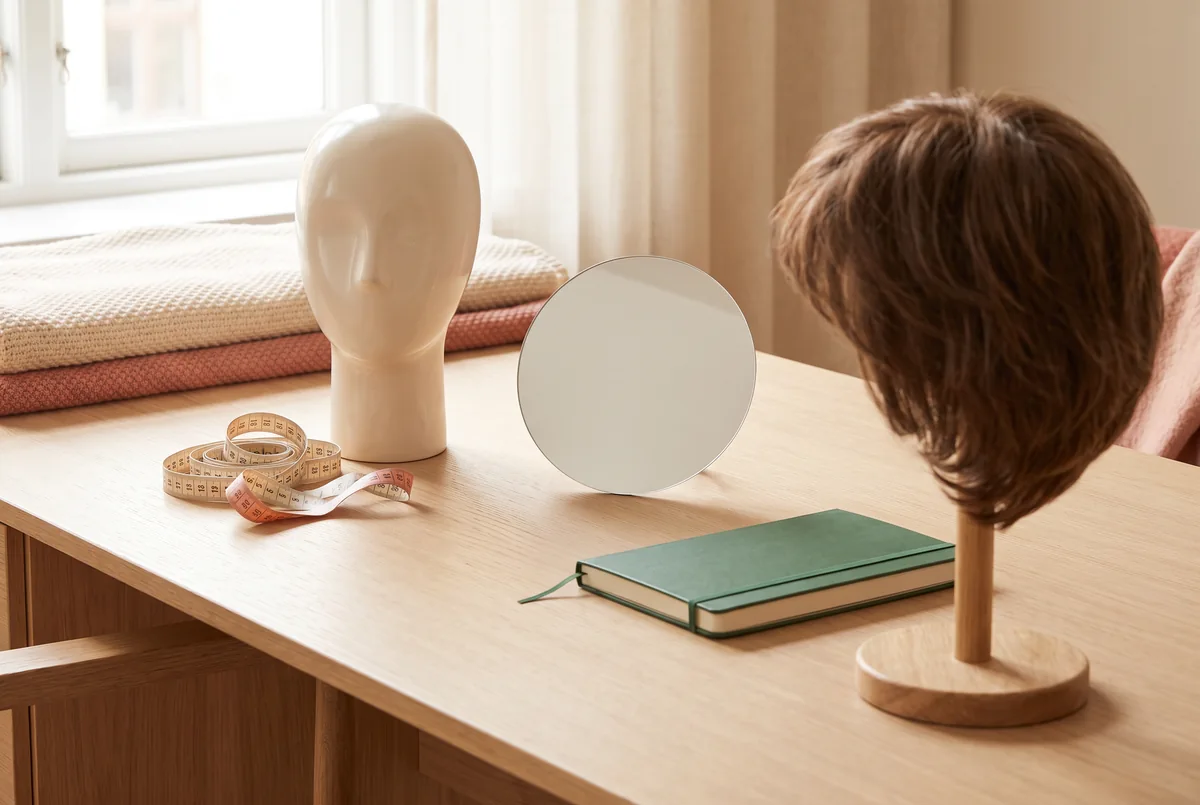
At a custom wig handover, describe what you feel or see, when you noticed it and the outcome you want, then ask the supplier what can be changed within the agreed service. Pause if wearing is uncomfortable, the proposed alteration is unclear or you do not consent; you do not need to diagnose the cause before speaking up.
This guide is about feedback on a completed piece, not measuring your head or choosing a size. The sample wording is illustrative, not a report of customer experiences or a promise that any adjustment will work.
Separate fit observations from a medical explanation
An unwanted fit can mean a sensation, movement of the piece or an appearance you did not expect. These are different conversations. “I feel pressure beside my left ear” reports a sensation. “The front moves when I look down” reports movement. “The side profile looks fuller than the sample we discussed” reports appearance. None establishes why it happens.
Avoid leading with “the cap is definitely too small,” “this material causes an allergy” or “the stitching is defective” unless you have appropriate evidence for that claim. Such explanations can steer the discussion towards an assumed solution before the supplier has inspected the actual item. Precise observations are not softer complaints; they give the person responding something specific to investigate.
Your preferred outcome is equally important. You can want less pressure, a steadier front position or less volume around the cheek. You do not have to prescribe tightening, cutting or changing construction. Ask the supplier to explain which, if any, options could address your concern and what each would change.
Keep the product discussion separate from health assessment. A fitting appointment cannot identify a scalp condition. Report discomfort without needing to disclose a medical history to justify a styling preference. For a related distinction, FlintHub’s guide to separating hair feel, scalp comfort and cosmetic care after rehearsal offers contextual reading, not a substitute for clinical advice.
Describe when and where an issue is noticed
Give the observation an anchor: a location, an ordinary moment and the setup at that moment. “At the right temple, while seated with my usual glasses, I notice pressure” is more useful than “it feels wrong.” State whether it was present immediately or appeared later. If you cannot identify the exact moment, say so rather than inventing a duration.
For custom wig fitting Hong Kong, OwnStrand describes a process involving samples, head-shape measurement and a completed-piece fitting with adjustment and wash, cut and blow-dry. Treat that description as a starting point: confirm which stages and changes are included in your own order, especially when raising an unresolved issue at collection.
Do not repeatedly reproduce discomfort to prove your point. One clear report can be enough to request a pause. For an appearance concern, ask to compare the same view before and after any proposed change. For glasses contact, describe whether your glasses were present at the original discussion; that is useful context, not an admission of fault.
Use this table to translate broad dissatisfaction into an inspectable question. The examples are hypothetical and do not establish a cause.
| Broad complaint | More precise observation | Desired outcome | Supplier question |
|---|---|---|---|
| “It is too tight.” | “I feel pressure beside my left ear while seated.” | Wear without that pressure. | “Can you inspect this contact area before proposing a change?” |
| “It keeps slipping.” | “The front position changes when I look down.” | A steadier position in ordinary use. | “What can you check on this piece and wearing setup?” |
| “It looks unnatural.” | “The cheek-level outline is fuller than the agreed reference.” | Less fullness in that view. | “Is this a styling difference or a construction limit?” |
| “The fringe is wrong.” | “The fringe crosses my sightline with my usual glasses on.” | A clear sightline with glasses. | “Can we discuss options before any cutting?” |

Hand-tied wording is not a comfort guarantee
A construction label describes an aspect of a product, not your personal response to wearing it. Jon Renau’s buying guide treats cap construction, hair type and lifestyle as distinct selection considerations.1 That supports asking what the actual piece contains; it does not establish that one construction will resolve your particular sensation or appearance concern.
At handover, request the specification for the completed item rather than relying on a name used during browsing. Ask which areas use the described construction, what other components are present and whether the demonstrated piece is the one made for your order. Leave unsupported details marked unknown. Swiss mesh, lace-front, monofilament and silk-top wording should not be treated as interchangeable.
A useful question is: “Which feature of this specific piece are you referring to, and how is it relevant to the issue I described?” If the answer is simply that the product is premium or handmade, bring the conversation back to the observed location and desired outcome. Craftsmanship language alone does not explain a contact point or a difference from your agreed outline.
Also distinguish a full wig from a partial topper or a men’s hair system. Their coverage and wearing arrangements are not identical. Advice about another category may not apply to your item. If a proposed change concerns attachment or the base, ask the provider to identify the relevant component and explain the process; this article does not provide DIY attachment or alteration instructions.
Ask what adjustment is inside the agreed service
Once the issue is understood, ask about scope before anyone starts work. Separate inspecting the item, adjusting its wearing position, changing its styling and altering the piece itself. The supplier should explain what is proposed, whether it can be reversed, who will perform it and whether further charges or another appointment would apply.
When reviewing a wig shop Hong Kong service description, bring your order confirmation into the handover conversation. Ask which promised fitting or finishing item covers the proposed work. A general service page is not evidence of unlimited revisions, a particular remedy or a confirmed return arrangement for your order.
Hong Kong Customs identifies false service descriptions and misleading omissions among the unfair trade practices addressed by the Trade Descriptions Ordinance.2 The practical takeaway here is to clarify product and service information in writing. It is not a legal finding about a disagreement or a guarantee of a refund.
Ask the supplier to distinguish a correction against the agreed specification from a newly requested style change. If the distinction is disputed, record both explanations without pretending agreement has been reached. Confirm any charge before authorising work, and ask whether collection paperwork records receipt, approval of the finish or something else.
Do not let an event deadline answer those questions for you. A supplier may need to review the item or schedule further work. Ask for the actual next step and timing, not an assumed completion date, and keep an alternative appearance plan if the matter remains unresolved.
Use product evidence rather than blame or vague naturalness
“Natural” can refer to colour, density, front outline, part placement or overall silhouette. Choose the one you mean. Saying “the part is further towards the centre than the reference I approved” creates a different request from “the colour looks warmer here.” Combining both into one complaint makes it harder to know whether a proposed change addresses either concern.
For a hand tied wig, ask for the completed product’s construction details alongside your approved appearance reference. Use those records to frame the question, not to assume every listed piece has identical structure or that hand tying guarantees comfort. The supplier still needs to confirm what applies to your specific order.
Bring the most relevant evidence: the order description, the approved sample or reference, and a short observation note. Catalogue photographs are useful discussion material but are not identical to an agreed specification. If no sample was formally approved, describe the source of your expectation honestly. A preference can still be discussed without being presented as an established product mismatch.
For a colour or outline comparison, note whether the lighting, angle or glasses changed. That does not dismiss the concern; it identifies what the supplier is comparing. Ask to distinguish an appearance difference visible now from a limit that cannot be changed through the proposed finishing service.
Photographs are optional communication aids. Ask before taking them in the fitting area and agree what is needed. You can request a private conversation, decline promotional use or offer a written description instead. Do not include unrelated people or private health information merely to make a product concern seem more persuasive.
Apply a feedback script and record the answer
Use five parts in order: observed issue, when noticed, desired outcome, supplier question and stop request. Keep one issue per script. If there are several, address discomfort before an appearance preference so an aesthetic discussion does not prolong unwanted wearing.
Here is a hypothetical script that can be spoken or sent as a message:
“I feel pressure beside my left ear. I noticed it while seated with my usual glasses during today’s fitting. I want to wear the piece without that pressure. What can you inspect, and what change would you propose within my agreed fitting service? Please pause the fitting and do not alter the piece until you explain the option and I agree.”
For appearance feedback, replace the first three sentences with the specific visible difference and intended result. Keep the question and stop request. This leaves the supplier room to inspect without granting open-ended permission to cut, thin, chemically process or otherwise modify the piece.
Record the response in this reusable handover sheet. Blank fields are questions to complete together, not assumed service commitments.
| Record field | Write down | Question still to resolve | Pause condition |
|---|---|---|---|
| Issue and context | Location or view; moment noticed; glasses or other relevant setup. | Has the supplier understood the same issue? | The response addresses a different concern. |
| Proposed action | Exact change, purpose and person performing it. | Is it reversible, and what else changes? | The action is unexplained or not authorised. |
| Service scope | Relevant order item; any quoted charge. | Included correction or additional request? | Cost or responsibility remains unclear. |
| Follow-up | Contact person, review arrangement and status of the piece. | What happens if the issue remains? | No usable next step has been agreed. |
Before the conversation ends, use this short checklist:
- Confirm the supplier can restate the issue and desired outcome.
- Separate an inspection from permission to alter anything.
- Record charges, limitations and the proposed next contact.
- Mark each issue resolved, still under review or paused.
Pause discomfort and leave clinical concerns to clinicians
A pause is a communication decision, not a diagnosis. You can say “I do not want to continue wearing this now” without proving a cause or accepting the suggestion that you must get used to it. Ask the provider for appropriate assistance to stop the fitting; do not improvise removal of an unfamiliar attachment.
Pause an alteration when its purpose, consequences or cost is unclear, even if the original concern is purely visual. If the proposed work cannot be reversed, ask to see the intended result explained against your reference first. Agreement to inspect one concern is not blanket permission to change the whole style.
Scalp symptoms and health concerns belong with a qualified healthcare professional. The supplier can describe the product and inspect the wearing setup, but this guide cannot determine whether a symptom comes from the piece or from something else. Do not continue an uncomfortable fitting merely to obtain a longer observation record.
If leaving with the concern unresolved, ask for a concise written summary: the item discussed, your observation, work already performed, work not authorised and the follow-up offered. Keep your own copy of the order and correspondence. Do not label the matter resolved if your note still says otherwise; equally, distinguish a proposed review from an agreed remedy.
Your next step should match the unresolved question. Product details go back to the supplier; service terms need written clarification; health concerns need clinical assessment. You may defer additional styling or decide against authorising more work. That preserves a practical choice without claiming any particular cancellation or refund entitlement.
Frequently Asked Questions
Can fit observations diagnose a scalp problem?
No. Location, timing and sensation help describe what happened, but they do not establish a medical cause. Keep the product feedback specific and leave scalp symptoms or health concerns to a qualified healthcare professional.
Does hand tied guarantee comfort?
No construction label establishes how a particular piece will feel to you. Ask which components are present in your completed item and how the supplier proposes to investigate the issue you reported.
How should an unwanted fit be described?
Name the observation, say when it appeared and state your desired outcome. Then ask what the supplier can inspect or change and give a clear stop request. Avoid prescribing a cause or an alteration before the explanation.
Are adjustments always included?
Do not assume so. Check the order, the proposed action and any additional charge. Ask whether the work is a correction against the agreed specification or a new styling request, and record unresolved differences.
When should a fitting be paused?
Pause when wearing is uncomfortable, you do not consent or an alteration’s purpose, consequences or cost is unclear. Ask for assistance and a defined follow-up rather than continuing simply because collection was planned for that day.
References
Editorial disclosure
FlintHub and OwnStrand share ownership. FlintHub Academy prepared this article with AI-assisted synthesis of public sources and editorial communication tools. It is not an independent expert endorsement, a wearer test or medical advice. Actual products and services require provider confirmation.
FlintHub Academy · AI-assisted editorial prepared from public information. FlintHub publishes creative-learning and personal-planning resources. This is not a first-hand product test, a real client case or a claim of wig-fitting, hairdressing or medical qualifications. OwnStrand and FlintHub Academy have the same owner.
Connect this guide with your planning
For comparison tables and enquiry tools on this same subject, visit Wig Selection & Personal Styling journal. This is an information journal, not a course, product or medical service.