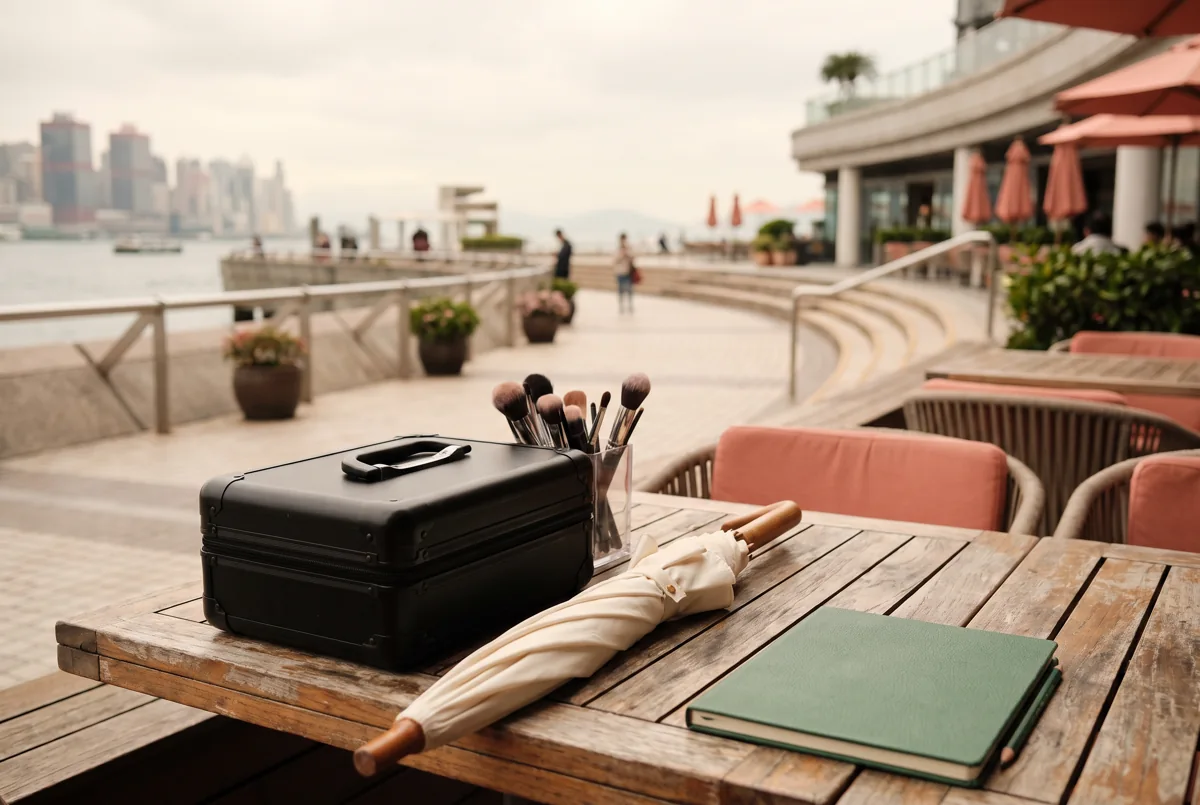
Plan the route before the look: the conditions at each pre-wedding location decide whether a makeup plan can be carried out, not just how it should appear in reference images. Before choosing a finish or adding a look change, cross-check the locations with the photographer’s shooting order, venue access, travel plan, changing facilities, daylight, and the people who need the same schedule.
A beautiful image reference is useful only after it has met the real day. A wind-exposed promenade, a hotel room with a late access time, a hill path with no sheltered changing point, and a studio with a fixed departure slot all create different decisions. The practical question is not “Which look do we like most?” but “What can the route support without placing people, timing, or safety under pressure?”
Here is a hypothetical planning example, not a real client or a service estimate. A couple is considering a hotel room for preparation, a shaded streetscape for first portraits, and a waterfront viewpoint later. Confirm room access, a clear work surface, lift use, the departure point, wind, rain cover, storage, toilets, and privacy for an outfit adjustment. One finished look carried through the route may be wiser than a transformation that the confirmed conditions cannot support.
Which site conditions change the makeup route?
Treat every place as a working site, not simply a backdrop. Record the address, entrance, drop-off point, floor, lift or stairs, parking and walking distance. Then record access time, rules, power, mirrors, table space, washroom proximity, privacy, shade, and a dry place for bags. These details shape preparation, departure, and whether touch-ups can happen calmly.
Daylight belongs in the site record. The photographer can identify the intended shooting direction and location order; the couple can ask whether the plan depends on a particular outdoor window or whether an indoor alternative is acceptable. This prevents a reference from being treated as a promise when the available light, cover, or sequence is different.
A site can also change who needs the plan. A private room might need a venue contact to confirm entry; a public outdoor location might need the photographer to nominate a meeting point; a family home may need a relative to protect a clear preparation area. Do not rely on a verbal chain that ends with “someone will know.” Put the owner of each question beside the question.
| Route option | Known conditions to record | Ceremony or supplier affected | Question still to confirm | Owner |
|---|---|---|---|---|
| Hotel or home preparation base | Access window, work surface, mirror, lift, bag storage | Couple, family contact, artist, transport | Who can admit the team and where can bags stay? | Couple or venue contact |
| Studio first, then outdoors | Departure rule, stairs or lift, indoor light, rain exit | Photographer, studio contact, driver | Is a small refresh possible before leaving without delaying handover? | Photographer and studio contact |
| Outdoor-first route | Meeting point, shade, wind exposure, nearest cover and washroom | Photographer, transport, wedding party | Where does the group move if the site becomes unsuitable? | Photographer with couple |
| Multiple public stops | Walking distance, parking, privacy, route order | Couple, driver, photographer, artist | Which stop is essential and which can be omitted first? | Couple and photographer |
This matrix is a comparison tool, not a price list and not a service promise. It helps the couple decide whether a location is compatible with the intended route before asking any provider to make an assumption. Once the address, access details, and ready-by point are assembled, the same-owner external guide to a pre-wedding makeup artist on location Hong Kong is a useful place to compare the location details that should be confirmed in the written service discussion.
How do travel and changing facilities affect the plan?
Travel is not empty time. Equipment is packed, outfits are protected, people find transport, daylight changes, and the next stop may lack a private surface or mirror. Name each transition point: departure place, item carrier, next meeting point, and the alternative if a vehicle cannot stop at the entrance.
Changing facilities determine the scale of any transition. “There is a nearby café” is not a confirmed private changing point. Verify a workable base with the venue or host; do not infer it from a map, photographs, or a previous visit. Without privacy, shelter, a clean surface, and room for people and items, simplify rather than assume an elaborate public change.
Makeup application also belongs in a stable place. The FDA’s eye-cosmetic guidance advises against applying or removing eye cosmetics in a moving vehicle because a sudden movement can cause an eye injury. It also advises keeping instruments clean and not sharing eye cosmetics. 1 In route terms, that means assigning eye-area work to the preparation base or another stationary, suitable location, rather than trying to recover travel time in a car.
The handoff is specific: the photographer owns the shooting sequence; the venue or host confirms the space; the transport contact confirms pickup and drop-off constraints; and the makeup or hair provider confirms what can be included after receiving the route and scope. If BigDeal Make Up is part of the plan, request the agreed scope and location requirements in writing rather than treating a general discussion as confirmation.

When is a look change realistic?
A look change is realistic only when the route has a protected place, a defined interval, the necessary people and items present, and a clear reason to use the time. It should not be counted merely because there is a gap between locations. A gap may be consumed by travel, finding the entrance, checking in, moving bags, bathroom access, family coordination, weather adjustments, or the photographer’s setup.
Separate three ideas that are often blurred together. A touch-up maintains what is already in place. An outfit adjustment changes clothing or accessories. A look change may involve a more substantial shift in hair direction or makeup choices. They demand different space, tools, sequence, and written service scope. Calling all of them “a quick change” leaves too much unresolved.
Use the route matrix to compare the trade-off. One continuous look can protect momentum and reduce the number of handoffs. A planned change may better suit distinct outfits or locations, but it adds dependencies: a private base, a verified interval, access, transport coordination, and a plan for delays. Neither approach is automatically better. The right choice is the one whose conditions are actually confirmed.
Before deciding what to request, the same-owner external page on pre-wedding makeup one look can help frame questions about a single finish, a changeover, touch-ups, and on-site follow-up. Read it as a prompt to obtain current written scope for the actual booking, not as a substitute for confirming the day’s locations and timing.
What does the photographer need to confirm?
The photographer need not choose the makeup, but does need to make the route usable. Ask for the location order, priority shots or settings, each meeting point, direction of travel, and the point at which waiting would compromise the plan. This shows whether a location is a preparation base, photograph-only stop, or realistic change point.
The photographer should know route limits: an outfit needing privacy, a person who must leave, a venue entry rule, or the couple’s weather threshold. The artist or hair provider should receive the same current route, ready-by time, and confirmed address. A screenshot on one phone is not a shared plan if changes are not distributed.
Agree on a single source of truth. It can be a simple document, but it should show the current route, contacts, access instructions, essentials, and backup decisions. Put the last update date on it. When the schedule changes, replace the old version rather than adding a conflicting message thread. This is less glamorous than a mood board, yet it protects the creative plan by making the logistics legible.
How do weather and safety change the backup?
A weather backup is a route decision, not simply a cosmetic product choice. Decide in advance which indoor or sheltered place can replace each outdoor stop, who has authority to call the switch, how the group is told, and whether the changed route still has access, a meeting point, and a safe place to wait. “We will see on the day” may be the only possible response to some forecasts, but it is not a backup unless the alternative has been identified.
For Hong Kong outdoor plans, monitor official notices close to the date and follow the venue’s own safety directions. The Hong Kong Observatory says that when thunderstorms occur, people outdoors should seek safe shelter as soon as possible, leave the water, and keep away from high ground, trees, masts, and highly conductive objects. 2 A water-resistant finish does not make an exposed photo stop safe, and this article does not offer a safety clearance for any location.
Build the fallback around people as well as pictures. A sheltered route may mean less walking, fewer locations, a later indoor sequence, or omitting a non-essential stop. Tell family and drivers which version applies so they do not travel toward a dropped location. Comfort and safety justify simplifying the visual plan.
Eye-area hygiene also belongs in the backup conversation, especially if wind, rain, or a rushed move disrupts the route. Do not share eye cosmetics. If an eye cosmetic causes irritation, the FDA advises stopping use; if irritation persists, seek medical advice. It also advises avoiding eye cosmetics when there is an eye infection or inflamed skin around the eye until the area has healed. 1 This is general safety guidance from a US agency, not Hong Kong law or a diagnosis. A small, cosmetic product try-out for a preferred texture is not medical patch testing and cannot establish that a person will not react; personal health concerns need appropriate individual advice.
What is the final location handoff?
The final handoff happens after locations are shortlisted and before trial decisions or shoot-day confirmations are treated as settled. Give every relevant person the same concise pack: location names and full addresses, access and contact details, the route order, ready-by point, changing arrangements, transport plan, key outfit needs, weather trigger, backup location, and the latest version date. It should be clear which information is confirmed, which is still a question, and who will close each question.
| Action | Latest confirmation point | Handoff recipient | Written proof or version | Backup handling |
|---|---|---|---|---|
| Confirm exact addresses, entrances and access rules | Before route is treated as final | Photographer, venue or host, transport contact | Current route sheet with venue contact | Keep a named alternative entrance or meeting point |
| Identify preparation and changing base | Before a look change is requested | Couple, host or venue, makeup and hair provider | Written confirmation of usable space and access | Simplify to one continuous look if space is unavailable |
| Set ready-by point and shoot order | Before providers finalise the day plan | Photographer, couple, makeup and hair provider | Dated run sheet | Prioritise essential shots or a shorter route |
| Record service scope and what is excluded | Before booking is treated as confirmed | Couple and provider | Provider’s written confirmation | Ask what revised scope is possible; do not assume inclusion |
| Set weather trigger and decision owner | Before the outdoor route is communicated | Couple, photographer, wedding party, driver | Backup note in the run sheet | Move to named shelter or omit the exposed stop |
| Distribute the final version | Before the event-day handoff | Everyone with a route-dependent task | One dated document or message thread | Reissue a replacement version if conditions change |
Use this short checklist to close the loop:
- [ ] Write the latest acceptable ready-by point, not only the first appointment time.
- [ ] Ask the venue, hotel, studio, or host for written confirmation of access, privacy, and any space limits.
- [ ] Mark each location as a preparation base, a photograph-only stop, or a possible refresh point.
- [ ] Give the photographer the outfit needs and the provider the photographer’s current route order.
- [ ] Name the person who will make the weather-route decision and the person who sends the update.
- [ ] Keep eye-area work for a stationary, clean setting; do not plan it for a moving vehicle.
- [ ] Save one dated route version and replace it when a material detail changes.
A trial is most useful when it converts the confirmed route into a usable brief, rather than when it tries to solve unknown venue conditions. Bring the current schedule, outfit notes, desired direction, location constraints, and questions about scope to the same-owner external pre-wedding makeup trial Hong Kong discussion. A product or style preference recorded at a trial does not itself confirm the shoot-day location, timing, fees, or inclusions; obtain those details in writing for the actual plan.
A restrained final decision is valid. If an additional stop or transformation relies on unconfirmed space, interval, or weather, protect the route first and revise the look ambition second. Before the shoot or wedding date, obtain current written confirmation from the venue and providers, then circulate one current plan.