
Choose curl placement by mapping where your hair sits and moves while you play, rather than assuming short hair is practical and long hair is obstructive. Compare both lengths against your instrument position, shoulder movement and sight lines, then include daily upkeep and future changes in the decision.
For adult musicians, the useful question is not simply “Which curls look best?” It is “Which shape can I manage without changing how I play?” This worksheet helps turn that question into a clear brief; it is not an instrument-specific safety assessment.
1. Keep playing technique ahead of the hairstyle
Begin with your normal playing position. Do not lower a shoulder, tilt your head differently or move an instrument merely to accommodate a reference hairstyle. If you are unsure about posture or instrument handling, discuss that with your music teacher rather than asking a stylist to resolve it.
Your working space includes more than the instrument at rest. Consider the movement used to prepare, play, turn a page, follow a cue and put the instrument down. A curl that stays beside the cheek in a portrait may cross your view when you look towards another performer. Hair held behind the shoulders may move forward during a seated transition.
Separate three observations: what you feel, what you can see and what the audience sees. Hair touching a collar is not automatically a playing problem. A clear audience photograph does not establish that you can see the score. Record each issue separately so a visual preference does not become an unsupported claim about function.
For a Hong Kong ensemble preparing an evening set, Live-band performance planning provides a relevant context for organising cues and stage arrangements. Put the hair check into the rehearsal plan alongside clothing and equipment, not in place of those checks.
2. Make an instrument and curl spatial map
Use a simple front-and-side sketch of your head, shoulders and instrument in their usual positions. Mark the score, conductor or bandleader you need to see. Add arrows showing ordinary head turns and shoulder movement. Keep the drawing descriptive; no universal clearance measurement can certify a hairstyle for every instrument or player.
Complete the first table with your existing hair before proposing a change. “Not observed” means the chosen rehearsal did not reveal an issue, not that an arrangement is guaranteed compatible.
| Observation zone | What to record during ordinary playing | Short-volume question | Long-volume question |
|---|---|---|---|
| Forehead and eyes | Whether hair crosses the score or cue sight line | Do front curls remain forward after a head turn? | Does the front section separate from the secured length? |
| Cheek and ear | Where curls sit as the instrument is positioned | Is outward side volume in the working area? | Does a loose section travel towards that area? |
| Shoulder and collar | Hair position as arms move and shoulders turn | Do ends stop above the collar or rest on it? | Does length move between the front and back of a shoulder? |
| Instrument-facing side | Any observed contact, with the movement that preceded it | Would changing side volume address the observation? | Would relocating the length address it without pulling? |
| Between pieces | What changes during page turns and instrument transitions | Can the shape be restored without repeated handling? | Can the arrangement be restored comfortably and simply? |
Write the cause beside the observation: “front section fell forward when reading the lower stave,” for example. “Hair unsuitable” gives a stylist little usable information. Where contact or obstruction occurs, pause and reconsider the arrangement; do not deliberately repeat a movement that feels uncomfortable or compromises instrument handling.
3. Compare short curls by direction, not just length
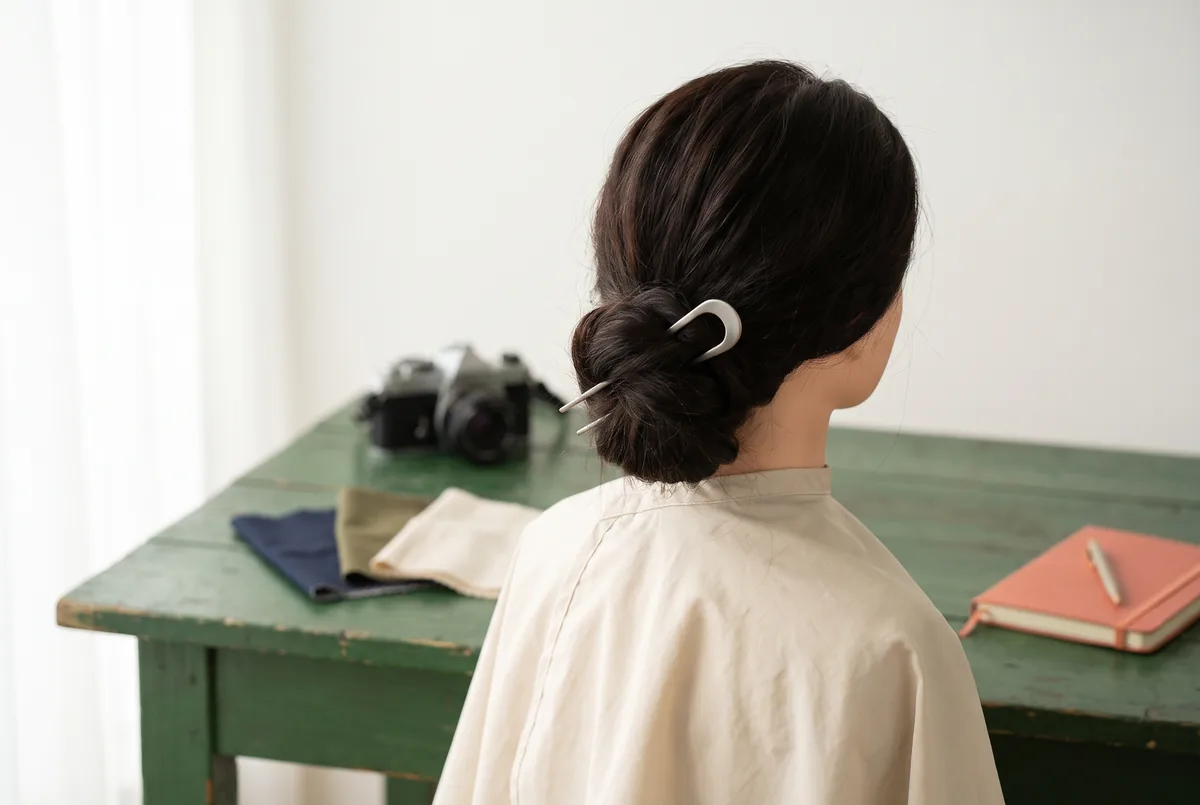
Short hair can reduce the amount of length resting on clothing, but it can still place volume close to the face or ears. A broad side silhouette and a forward fringe occupy different spaces. Treat crown height, side width and front direction as separate choices rather than buying one general promise of “easy curls.”
For the short option, mark where you want volume retained and where you want less of it. A photograph annotated “keep this crown shape; reconsider this forward section” is more useful than requesting an identical celebrity look. Ask how the proposed shape may sit after normal washing and drying, not only after a salon finish.
Vit So’s page on a perm for short hair can help frame a discussion about short-hair shape. Bring your spatial map and ask which parts of the reference depend on cutting, curl direction or temporary styling. The page cannot establish compatibility with your instrument, and a chemical service is not necessary merely because side volume needs reconsideration.
Also consider the period between shape adjustments. A short section that begins above the collar will not remain at that length indefinitely. Record when you personally notice that styling becomes harder, rather than converting a preferred haircut rhythm into a fixed chemical-treatment schedule.
4. Compare long curls by where the length is placed
Long curls offer more options for moving length behind a shoulder or loosely gathering it, provided the arrangement suits the individual. They also leave more hair to manage during transitions. Moving volume backwards does not eliminate it; it changes which clothing, head turns and chair positions need observation.
Distinguish the front sections from the main length. A loose arrangement can hold most hair away while leaving shorter face-framing sections free to move. Conversely, a fuller lower silhouette may provide the appearance you want without asking for equally prominent curls beside the eyes. These are consultation questions, not predictions of a particular result.
The reference page for a perm for long hair is relevant when discussing where visible curl begins and how much length to retain. Show your stylist the desired resting silhouette and your normal playing position. Ask about options that preserve flexibility for rehearsal, while accepting that a styled photograph cannot show movement, drying effort or the condition of your own hair.
For performances connected with Chinese culture and performing arts, include the actual costume collar and ensemble sight lines in the brief. Do not assume that a traditional programme dictates one hairstyle; confirm any presentation requirements with the organiser.
5. Try reversible placement and gentle care first
Before changing length or considering a perm, explore a different parting or a comfortable, loosely secured arrangement with your current hair. Begin away from the instrument, then observe ordinary playing only if the arrangement feels comfortable. Avoid treating a tightly pulled style as the solution to every loose section.
The American Academy of Dermatology recommends avoiding tight pulling, handling hair gently and reducing heat exposure. It also distinguishes combing conditions: its advice for textured hair or tight curls is gentle wide-tooth combing while damp, whereas straight hair is allowed to dry somewhat first. These are general care principles, not performance guarantees.1
A reversible arrangement answers a limited question: whether relocating existing hair helps with the issue you recorded. It cannot reproduce a future cut or chemical curl pattern. However, if moving one front section resolves your visibility concern, that is useful evidence against making a larger change solely for the performance.
If you are considering chemical processing, describe previous colouring, bleaching, perming and straightening accurately. Ask about suitability, likely maintenance and the actual product instructions. Do not choose a universal interval from a concert calendar. Persistent irritation, unusual breakage or hair-loss concerns call for appropriate professional help; a styling worksheet cannot diagnose the cause.
6. Compare whole-life cost, not the opening quote
For this decision, “whole-life cost” means the burden across the period you expect to keep the style, including maintenance and changing it later. It does not mean predicting lifelong expenditure. Pick a planning horizon that covers your rehearsal run and ordinary life, then compare the same categories for both options.
Keep cash costs and time in separate columns on your own copy. Time matters even when it has no quoted price: drying after an after-work rehearsal and arranging hair before an early call are different commitments. Do not assume either length is automatically cheaper.
| Cost category | Short curl placement: ask or record | Long curl placement: ask or record |
|---|---|---|
| Initial service scope | Whether reshaping, curl service and finishing are included | Whether retained length or selected curl placement changes the scope |
| Routine home care | Products and handling needed for the proposed shape | Products, detangling and drying needed for the retained length |
| Salon maintenance | What shape adjustments may be needed as sections grow | What trimming or placement adjustments may be needed over time |
| Performance preparation | Whether temporary front control needs separate preparation | Whether loosely securing or rearranging length needs extra preparation |
| Travel and appointment time | Confirmed appointment duration and travel allowance | Confirmed appointment duration and travel allowance |
| Later change of direction | What growing out or changing the short outline involves | What reducing length or changing the long outline involves |
Use the perm cost page as a starting point for checking current pricing information, then request a quote for the actual scope discussed. Record what is included, what is charged separately and what remains unconfirmed. A listed price alone does not answer whether your proposed cut, finishing or later maintenance is included, nor does it establish appointment availability.
Hong Kong Customs identifies false service descriptions and misleading omissions among practices covered by the Trade Descriptions Ordinance.2 For this comparison, the practical step is to clarify scope and payment conditions before agreeing. An unclear item is a question to resolve, not proof of wrongdoing or an automatic refund entitlement.
7. Apply the worksheet to a hypothetical rehearsal
Consider a hypothetical adult musician with shoulder-length curls, preparing a small Hong Kong evening performance after work. The player wants visible curl texture in photographs but finds that a front section sometimes moves across the score. This is an invented planning example, not a client case or test result.
The player's map would separate that front-section observation from the preferred lower curl silhouette. Shortening all the hair might address the amount of length to handle, but it would not necessarily change the front section's direction. Retaining length might preserve more arrangement options, but those options still need comfortable handling and rehearsal observation.
Use this sequence to turn the comparison into a decision:
- Record the normal position with current hair and performance clothing. Identify one priority issue, such as sight-line obstruction, rather than changing everything at once.
- Compare an ordinary loose arrangement with one reversible alternative. Keep posture and score position unchanged so you can understand what relocating hair changes.
- Mark observations as “still occurs,” “not observed in this rehearsal” or “not checked.” Add whether the arrangement remains comfortable between pieces.
- Take the map, annotated photographs and cost table to a consultation. Request a proposed shape and maintenance explanation before deciding on any service.
- Recheck the chosen arrangement with the agreed performance setup. Keep a simple fallback that does not depend on extra chemical processing or unfamiliar equipment.
Include the journey in your preparation plan. Hair arranged at home still needs consideration after carrying an instrument and travelling by MTR, then putting on performance clothing. Leave time to restore the agreed arrangement rather than relying on a photograph taken before departure.
FAQ
Are short curls always better for instrumentalists?
No. Short hair can reduce loose length while leaving side or front volume near working areas. Long hair may be easier to relocate for some players. Compare actual placement during normal movements, and do not treat either length as a certified safe choice for an instrument.
Can I use a photo to decide where curls should begin?
Use it to describe your preference, not to predict the result. Mark the front section, side width and lower volume separately. Add your playing-position sketch so the consultation covers movement as well as appearance. Lighting, styling and another person's hair can all affect the reference silhouette.
What should I do if hair touches the instrument?
Pause rather than repeatedly testing contact. Note where it happened and what ordinary movement preceded it. Reconsider hair placement without altering technique to compensate. If you need help with instrument position or handling, consult your music teacher or the appropriate equipment professional, not this article.
How soon before a performance should I arrange a perm?
There is no interval that suits every product, processing history or hair condition. Discuss suitability and instructions with the service provider, and allow for understanding the maintenance routine. If the available schedule is too constrained, consider postponing processing and using a familiar non-chemical arrangement instead.
What should I bring to a consultation?
Bring front-and-side references, the completed map, your processing history and questions about the quote. Vit So lists one reception address at 252 Hollywood Road, Sheung Wan. Confirm appointment arrangements and communication needs directly; an English-language website does not prove that an English consultation is available.
About this article
By FlintHub Academy, prepared with AI-assisted institutional editing for adult creative-learning and performance contexts. FlintHub Academy and Vit So share common ownership. This is not an independent endorsement, a hairstylist-authored review or medical advice. The planned illustrations are original explanatory scenes, not Vit So portfolio work, products or client photographs.
References
1 American Academy of Dermatology: general hair-care guidance.
2 Hong Kong Customs and Excise Department: unfair trade practices and service descriptions.
FlintHub Academy · AI-assisted editorial prepared from public information. FlintHub publishes creative-learning and activity-planning resources. This is not a first-hand salon test, a real client case or a claim of hairdressing, clinical or medical credentials.