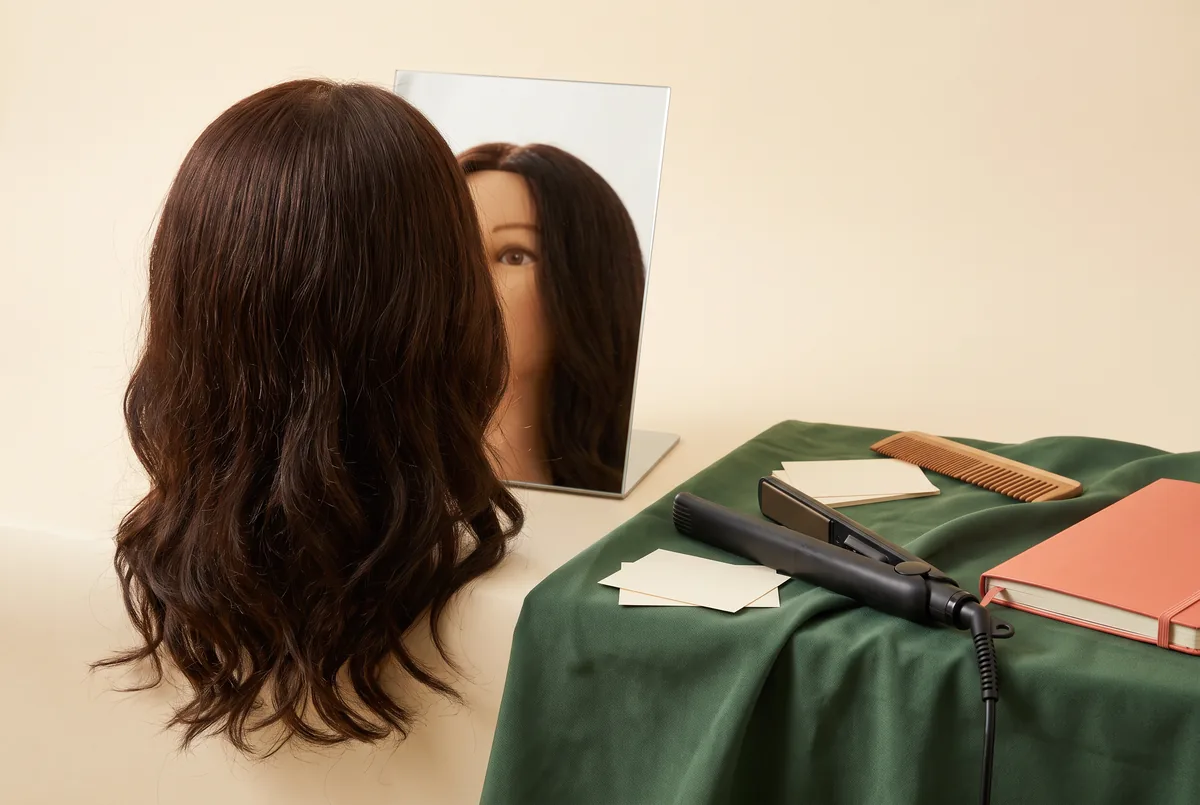
Keep your natural curls if you want their movement after the recital; discuss cosmetic conditioning for easier handling, and consider straightening only if changing the curl pattern is genuinely your goal. Start with what must remain, test a reversible performance style, then assess any proposed chemical process separately from pre-colour care, which cannot guarantee safe subsequent processing.
For an adult preparing a Hong Kong music or dance recital, “smooth” can mean several things: fewer distracting strands, softer ends or a straighter silhouette. Those wishes do not require the same response. This decision tree helps turn a stage preference into a clear brief without treating natural curls as something that needs correction.
1. Name the movement you want to keep
Look at your normally dried hair before choosing a reference photograph. Identify whether you value springy ends, fullness beside the ears or a curved fringe. Then describe the performance problem separately. Hair crossing your eyes during a turn is a visibility problem; rough-feeling ends concern handling. Neither automatically means the curl pattern should change.
Write two complete statements: “After an ordinary wash, I want to keep…” and “During the recital, I need…”. The first protects your everyday preference. The second defines a practical stage requirement. If the statements conflict, explore positioning and temporary styling before accepting a lasting texture change.
Stage work also has different viewing conditions from a dressing-room mirror. A musician may need hair clear of a microphone, while a dancer needs a stable outline during movement. FlintHub's Live-band performance planning provides a relevant performance context for considering microphone position, rehearsal flow and who checks the final stage appearance. It is not a hair-service booking or a combined salon package.
Ask the production team whether a supposedly sleek finish is actually required. “Face visible during the opening number” is actionable. “Everyone must look polished” needs clarification and should not quietly become “everyone must have straight hair”.
2. Follow the texture-choice decision tree
Start with the first row below and move towards a more substantial intervention only when the previous option does not address your stated goal. This is a decision aid, not a suitability test. Your preference determines the question to ask; it does not establish which product your hair can tolerate.
| Your deciding question | Route to explore | Main trade-off |
|---|---|---|
| Do I want my usual curls after washing? | Preserve texture and adjust the recital arrangement. | The natural pattern remains part of the silhouette. |
| Is softness or tangling the main concern? | Cosmetic conditioning and gentler handling. | Easier handling does not promise straightness or permanent repair. |
| Do I want a straighter look for this recital only? | A reversible styled finish, if suitable. | Styling takes preparation and may change with moisture or movement. |
| Am I considering a smoothing procedure? | Verify its actual purpose, formula and use of heat. | Some procedures can change curls; the name does not guarantee retention. |
| Do I want straighter hair in everyday life too? | Discuss an assessed shape-changing service. | Consider lost movement, future upkeep and growing out the change. |
Do not treat the branches as a ranking from basic to better. Keeping curls can fully satisfy a recital brief. A care-focused option may suit tangling but fail a straight-outline goal. A more lasting change may address the outline while creating a commitment you did not want.
Vit So's guide to hair smoothing vs hair straightening can help organise questions about feel, visible shape and upkeep. Read it against your two statements rather than selecting a treatment by its name. The comparison does not establish your suitability or prove that a proposed smoothing procedure will leave your curls unchanged.

3. Give the curl-preserving branch a fair rehearsal
If you like your curls, begin with a familiar arrangement that keeps them away from the face without excessive tension. Ask whether a different parting, a loosely secured section or the position of an accessory solves the stage problem. A neater front does not require eliminating movement through all the lengths.
General handling matters while you experiment. The American Academy of Dermatology recommends conditioner after shampooing, gentle detangling and absorbing water with a towel rather than rubbing. Its combing advice distinguishes textures: straight hair should dry a little before gentle combing, while textured hair or tight curls should be combed damp with a wide-tooth comb. It also advises lower heat and less frequent heated styling.1
Rehearse with the relevant costume and movement, not just a still photograph. An adult working on Chinese dance learning can use turns, arm pathways and changes of direction to identify where hair affects visibility or catches against clothing. Record the location of the problem rather than declaring the whole texture unsuitable.
Keep the rehearsal focused. Change one feature, such as the front section's placement, and repeat the same passage. Compare face visibility, comfort and whether you can reset the arrangement yourself. Stop pulling tighter if the style becomes uncomfortable. A visible curl is not a failed test; interference with the performance is the issue you are checking.
4. Separate an occasion look from an everyday commitment
Wanting a sleek outline for one evening is different from wanting less curl after every wash. A temporary styled finish can help you judge whether you enjoy the visual change. It cannot predict how a chemical process would affect your hair, and “temporary” does not mean repeated heat is harmless. Include both preparation effort and handling stress in the comparison.1
Look beyond the recital photograph. Would you miss the fullness of a curly ponytail? Would straighter ends sit differently against your costume collar? Would you want to add waves back with tools? These questions reveal whether removing the curl would simplify your routine or merely replace one styling task with another.
The Vit So article on hair straightening for naturally curly hair offers context for discussing different curl areas, ordinary washing and future texture contrast. Use it to prepare an everyday-life brief alongside your recital brief. It cannot confirm that your hair is suitable, promise retained volume or make a temporary trial an accurate preview of a lasting result.
Before agreeing to lasting straightening, discuss what happens if you later want your curls back. Ask how treated lengths would be managed alongside natural new growth, and whether growing out and trimming the change fits your preferred length. Do not let the recital deadline make that longer-term decision for you.
5. Check the procedure, not the attractive label
“Smoothing”, “keratin” and “silky” do not identify a complete formula or tell you whether heat changes the curl pattern. Ask for the actual product and the proposed steps. You need enough information to understand the intended change and precautions, not a chemical recipe to reproduce at home.
The FDA explains that certain hair-smoothing products release formaldehyde when heated and explicitly notes that not all smoothing products contain it. It recommends questions about ingredients, product instructions, application training and ventilation. Names it identifies include formaldehyde, formalin and methylene glycol.2 These are product-specific checks, not claims about which ingredients Vit So uses.
| What to confirm | A useful recital-specific question | Why the answer matters |
|---|---|---|
| Intended texture change | What movement is expected after normal washing, without salon finishing? | Separates the process from the styled appointment result. |
| Product information | Can I review the product name, ingredients and relevant Safety Data Sheet? | A menu label alone cannot establish ingredients or precautions. |
| Heated conditions | Is heat part of this procedure, and what safeguards and ventilation apply? | Exposure questions belong to the actual application conditions. |
| Hair history | How do earlier colour, bleach or texture services affect this plan? | Different areas may need different assessment. |
| Visit contents | Are washing, finishing or cutting included in the proposed scope? | Prevents assuming an entire recital look is covered. |
| Aftercare and timing | Will the instructions fit costume changes, rehearsal and my washing routine? | Identifies practical conflicts before committing. |
The FDA material is US consumer guidance, not a statement of Hong Kong law or brand approval. If a product causes a bad reaction, stop using it and seek healthcare advice.2 Breathing difficulty requires urgent medical help. Do not accept irritation as a necessary price of achieving the stage look.
6. Keep pre-colour care outside the texture decision
If you are also considering colour, make it a separate discussion. A conditioner or preparatory care step may address a cosmetic handling goal, but a softer feel is not evidence that subsequent colouring or straightening is safe. The AAD identifies colouring, perming and relaxing among practices that can damage hair.1 Care does not cancel the need to assess further processing.
Vit So's pre-colour hair treatment sits within its cosmetic hair-care information. Ask what the proposed care step is intended to do, which sections it concerns and how it relates to any separately proposed colour service. Do not interpret the word “protection” as guaranteed damage prevention, restored untreated hair or permission to combine otherwise unsuitable processes.
Bring the history of the lengths, not just the roots: earlier bleach, colour, straightening, perms and home products. Mark unknown product names as unknown. Photographs help locate an area, but cannot replace an assessment. Current scalp discomfort and repeated breakage should be raised before any new process; cosmetic care is not medical diagnosis or treatment.
Plan backwards from rehearsal without inventing a universal waiting period. The actual product instructions and professional assessment should determine what can be considered and when. If the plan remains unclear, use a familiar reversible recital arrangement and postpone the texture decision. A booking gap before the performance does not itself establish suitability.
7. Complete a hypothetical recital worksheet
The following is a planning example, not a client case or reported result. Imagine an adult singer-dancer whose natural curls feel familiar and expressive, but whose front sections cross the eyes during a turn. They initially request “smooth hair” and are also considering a colour change.
Step 1: Record the non-negotiable. Their worksheet says, “I want my normal curls after washing, and I need enough length to tie back.” This rules out assuming that a straighter everyday pattern is desirable merely because one reference image looks sleek.
Step 2: Define the stage task. They write, “Keep the front clear during the opening turn and leave space for the microphone.” They attach ordinary front and side photographs and identify the interfering section. The reference image is annotated “borrow the clear forehead”, not “copy the whole texture”.
Step 3: Rehearse a reversible option. They try a comfortable front-section arrangement with familiar products and repeat the relevant passage in costume. They record whether the face stays visible, whether the accessory catches and whether resetting is manageable. These are observations to collect, not outcomes this example claims occurred.
Step 4: Separate unresolved questions. If the ends still catch during gentle detangling, they request a care discussion. If they genuinely want a lasting straighter outline, they reopen the texture branch and consider its everyday consequences. They do not add colour simply because preparatory care is available.
Step 5: Establish the fallback and handoff. The sheet names a familiar curl-preserving arrangement as the fallback, identifies who checks it at rehearsal and records outstanding product and timing questions. Any enquiry to Vit So concerns its single address at 252 Hollywood Road, Sheung Wan. Confirm availability, appointment scope and communication language; an English website does not establish English-language consultation.
The useful final brief is one page: what must remain, what the performance needs, the option being explored and what still requires confirmation. That makes a refusal or postponement workable rather than leaving the recital dependent on an unconfirmed transformation.
Frequently asked questions
Can my curls look smooth without becoming straight?
Yes. Softer-feeling lengths and a clear stage outline can coexist with curls. However, a service called smoothing may also change the pattern. Ask about the actual procedure and the expected appearance after ordinary washing, not only the finished salon photograph.
Is temporary straight styling the best way to choose a chemical service?
It can help you decide whether you like the silhouette, but it cannot establish chemical suitability or predict a lasting result. You may also discover that you prefer your curls. Avoid repeated heat trials just to pursue certainty.
What if the recital team requests a sleek look?
Ask which visible feature they need: a clear face, a defined parting or a specific costume outline. Offer a curl-preserving arrangement that meets that requirement. If straightness is genuinely part of the brief, discuss temporary options without assuming a permanent change is necessary.
Does pre-colour conditioning make colour and straightening safe together?
No guarantee follows from a care step or improved softness. Each proposed process needs consideration against your hair history, current condition and actual products. Keep cosmetic care separate from the decision about whether additional processing should proceed.
How close to the recital should I book a texture change?
There is no universal interval in this article. Follow the actual procedure's instructions and assessment, including washing and tying restrictions. If they conflict with rehearsals or costume needs, postpone the change and use a familiar fallback rather than compressing an uncertain plan.
About the author and editorial disclosure
By FlintHub Academy. This article was prepared with AI-assisted institutional editing for adult creative-learning and performance planning. FlintHub Academy and Vit So share common ownership. It is not an independent endorsement, a hairstylist-authored review or medical advice, and no expert or clinician review is claimed. The proposed images are original editorial illustrations, not Vit So work, products or client results. The cited authorities do not endorse Vit So.
References
1 American Academy of Dermatology. 10 hair care habits that can damage your hair. General guidance on conditioning, texture-specific combing, heat, tension and chemical-service damage.
2 US Food and Drug Administration. Formaldehyde in Hair Smoothing Products: What You Should Know. Product-specific questions about ingredients, heating, ventilation and reactions.
- [1] 10 hair care habits that can damage your hair
- [2] Formaldehyde in Hair Smoothing Products: What You Should Know
FlintHub Academy · AI-assisted editorial prepared from public information. FlintHub publishes creative-learning and activity-planning resources. This is not a first-hand salon test, a real client case or a claim of hairdressing, clinical or medical credentials.