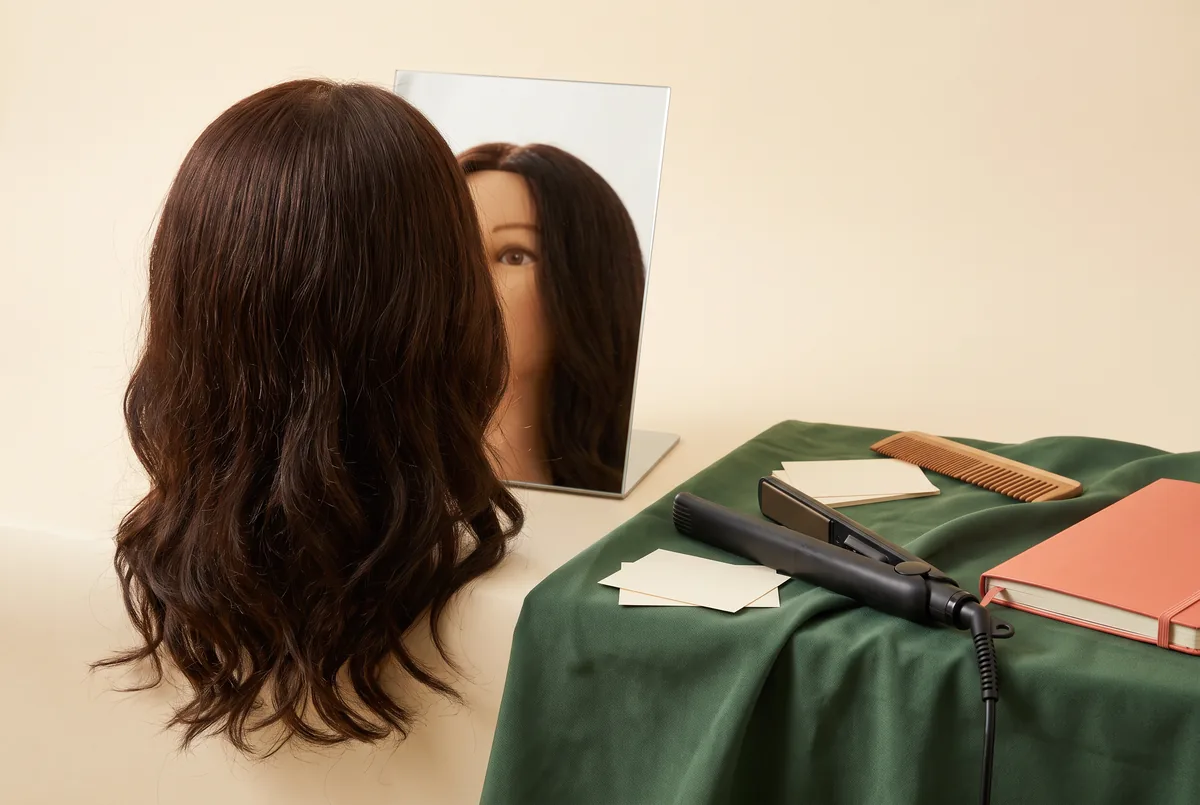
Define “sleek” as specific visible qualities—such as a narrower outline, straighter lengths or controlled movement—before comparing a straightening quote. Then test whether lighting or temporary arranging meets the performance-image goal, and assess any proposed service by its actual scope and products rather than its name.
An adult preparing a publicity portrait and an adult performing on stage may need different solutions, even when both share the same reference photograph. This straightness goal and quote checklist separates the image you want from the work you might buy. It also makes room for retaining natural texture rather than treating straight hair as the default professional appearance.
1. Define what sleek must look like
Start with the image’s use. A seated portrait permits careful placement of the lengths. A performance recording includes turns, gestures and changing views. A promotional still may need a clean shoulder line, while the live appearance must leave the eyes unobstructed during movement. Decide which of these is essential before discussing a procedure.
Write one sentence containing the visible change, its location and what must remain. “I want the outer lengths to sit closer to the shoulders, but I want root lift and a soft bend at the ends” is more useful than “make it completely sleek.” It allows a stylist and an image-maker to identify different responsibilities without promising a particular outcome.
Distinguish straightness from neatness. A wave can be neatly arranged; a straight section can still cross the face or interrupt a costume line. Gloss is another separate quality. A bright reflection in a reference picture does not demonstrate a changed curl pattern or show how the hair behaves after ordinary washing.
For adults exploring Chinese culture and performing arts, the useful connection is the relationship between presentation and performance. Ask the production lead about headwear, costume changes and movement before deciding on hair placement. Do not infer one traditional hairstyle from the broad cultural category, or assume that an educational programme includes salon services.
2. Separate silhouette from lighting and arranging
Use reference pictures as visual instructions, not evidence of treatment. Mark the feature you like: the outer edge, the parting, the reflection or the position of the ends. Include an ordinary picture of your current hair so that a polished reference does not become the only description of the starting point.
A simple comparison can isolate the problem. Keep the camera position and hair arrangement unchanged while trying a different light direction. Then keep the light fixed and change the parting or move the lengths behind one shoulder. Review the intended crop and a wider view. A solution that works in a close portrait may disappear when the performer turns.
| Visual goal | Photographic or arranging alternative | Tradeoff to check |
|---|---|---|
| A narrower shoulder outline | Place the lengths behind one shoulder or adjust the pose. | The effect may not survive a turn or work from both sides. |
| A more even-looking reflection | Adjust light direction and check exposure. | Lighting changes appearance, not the underlying hair shape. |
| Less visible surface flyaway hair | Try a gentler arrangement and reconsider strong edge lighting. | Reducing edge light may also reduce separation from the background. |
| Straighter lengths after normal drying | Discuss whether temporary styling or assessed straightening addresses the bend. | A camera adjustment cannot supply an everyday shape change. |
| Hair kept clear of the face | Consider a comfortable tuck or suitable loose fastening. | Placement must remain compatible with movement and equipment. |
The Photography and image workshop is a relevant learning route for understanding how image choices affect a visual brief. Keep that photographic work separate from decisions about chemical processing. An image-maker can help describe what the camera sees; a photograph alone cannot establish which procedure the hair can tolerate.

3. Match the treatment area to the actual problem
Divide the hair into roots, middle lengths and ends. Note where you want a change and where you do not. A wide outline near the shoulders is not automatically a request for flat roots. Likewise, wanting a predictable fringe does not mean the whole head needs the same work.
Use the Vit So hair straightening page to identify the listed service category, then bring a location-specific brief to the discussion. Ask which sections the proposed work would address, whether focused work is suitable and available, and what movement might remain. The page is a starting point for clarification, not an assessment of your hair or confirmation of a fringe-only service.
Specify the viewing condition too. “Closer lengths in the front publicity image” and “straighter hair after my ordinary drying routine” are different requests. The first may be resolved by placement for one session. The second concerns continuing behaviour beyond the photograph and deserves a different suitability and maintenance discussion.
Ask how the proposed outline would work when tied back or worn with performance accessories. Treat retaining lift or curl as a genuine requirement, not an optional detail added after selecting the service. If the desired changes conflict, decide which priority can be relaxed before comparing costs.
4. Treat ionic wording as a label, not proof
The term ionic straightening identifies wording used for a listed service; it does not, on its own, establish the ingredients, heat conditions, safety profile or predictable longevity. Ask for the actual product and procedure proposed for your hair. Do not assume that an attractive technical name means no chemical processing, no damage or no future styling.
The US Food and Drug Administration advises consumers considering hair smoothing products to ask about ingredient information, safety documentation and ventilation. It notes that not all smoothing products contain formaldehyde, and identifies formaldehyde, formalin and methylene glycol as names to check in the product information. Its guidance addresses exposure concerns associated with products that contain or release formaldehyde during heated smoothing.1
This is a reason to ask product-specific questions, not to assign those ingredients to every straightening service or to Vit So. The FDA source is US consumer guidance, not a Hong Kong regulatory certification or a brand endorsement. An ingredient list is useful information, but it should not be treated as a personal guarantee of suitability.
Longevity also needs a defined meaning. Ask separately about the shape of treated lengths, the appearance of new growth and the finish after routine drying. “Lasting” could refer to any of these. Request an explanation of likely maintenance for the proposed work rather than converting a service label into a universal number of months.
5. Record hair history before scheduling a change
Prepare a brief timeline of colour, bleach, perms, previous straightening and home treatments. Identify which older treatments may remain in the lengths. If the product name or date is unknown, write “unknown”; do not fill the gap with a guess based on the hair’s present colour.
Describe existing observations without diagnosing them. Mention tangling, breakage, rough ends or scalp discomfort, and say where they occur. Share future plans as well, including a colour change or a performance requiring clips or headwear. These details help frame questions about assessment and whether postponement would be more appropriate.
The American Academy of Dermatology recommends reducing heat-tool use, choosing the lowest heat setting and avoiding pulling or tightly secured styles. It also identifies colouring, perming and relaxing among practices that can damage hair.2 These general principles support gentler planning; they do not establish a universal safe interval between chemical services or prove that temporary styling is risk-free.
Ask for care instructions matched to the actual products, including any washing or fastening restrictions. Do not borrow a timetable from a differently named treatment. Persistent scalp irritation or unexplained hair loss calls for medical advice rather than a cosmetic diagnosis. If discomfort develops during a service, tell the practitioner immediately rather than enduring it for the planned photograph.
6. Compare quotes only after making scope equivalent
When reviewing a hair straightening price, use the published menu to locate the relevant entry and distinguish a starting charge from an assessed total. Then request the amount for your agreed work, including any applicable additions. A cheaper headline is not a meaningful saving if it covers a different area or excludes something necessary for your brief.
Use the same questions for each proposed option. Keep “not confirmed” visible instead of treating silence as inclusion. A service with no cutting included may still fit your needs if the existing cut works. Conversely, adding cutting automatically can waste money when the concern belongs to photographic placement rather than shape.
| Quote component | What to record | Why it matters for the performance image |
|---|---|---|
| Treatment area | Roots, selected lengths or another explicitly agreed scope. | Avoids comparing different amounts of work as equivalent. |
| Product and procedure | Actual product, assessment needed and explanation of heat steps. | Separates a service name from the proposed process. |
| Cutting and preparation | Included, separately charged or unnecessary. | Keeps optional restyling apart from the core goal. |
| Finishing | What finish is included and what remains for the shoot. | A salon finish does not imply backstage touch-ups. |
| Additional charges | Applicable length conditions and other agreed additions. | Makes the full amount clearer before work begins. |
| Timing and care | Confirmed duration and product-specific restrictions. | Reveals conflicts with rehearsal, costume or travel. |
Retain the agreed scope and ask what happens if assessment changes the plan before work starts. Confirm payment and cancellation conditions rather than assuming a general refund entitlement. Discuss ongoing care separately from the appointment total; neither a menu entry nor an enquiry confirms later maintenance costs.
For local logistics, Vit So has one stated appointment location at 252 Hollywood Road, Sheung Wan, Hong Kong. Allow for travel from that location to your rehearsal or shoot, but use confirmed appointment timing rather than an assumed quick visit. An English website does not prove English-language consultation; request communication arrangements if they matter to you.
7. Complete a hypothetical goal-and-quote checklist
Hypothetical planning example: An adult performer is preparing a publicity portrait for a small Hong Kong production. The reference shows a narrow outline and glossy lengths. The performer wants to keep natural root lift and use the same hair arrangement at rehearsal. No salon result or price is assumed in this example.
Their brief reads: “Keep the forehead clear and the lengths close to the costume shoulders in front and three-quarter views; preserve root lift and comfortable movement.” This separates the required outline from the optional glossy effect. The performer also records previous highlights in the lower lengths and leaves the product details marked unknown.
Complete the worksheet in this order:
- Name the required view. Record portrait crop, stage view or recording, and identify who approves the image.
- Mark change and retention areas. Note which sections should sit differently and which lift, wave or length must remain.
- Compare reversible arrangements. Check the preferred view and a turn under consistent light, without escalating heat or tension to force a match.
- List unresolved suitability questions. Bring the processing timeline and observations to the service discussion; do not self-test with chemicals.
- Record the complete proposed scope. Fill in the second table, including unknowns, total charge and care conflicts.
- Choose proceed, revise or postpone. State what information is needed before an unresolved option can become a booking.
In this hypothetical case, a lighting comparison would answer whether the desired reflection is mainly an image-making issue. An arranging comparison would address shoulder placement. Neither exercise would establish chemical suitability. If temporary placement meets the portrait need but fails during movement, the performer can discuss a separate live arrangement rather than automatically purchasing full-length straightening.
The final decision should fit ordinary life too. Include the Hong Kong commute, rehearsal activity and any outdoor wait when describing the day. An air-conditioned portrait room is only one part of that schedule. Keep a workable fallback, such as a revised pose or comfortable arrangement, if assessment or care requirements make the preferred service unsuitable for the production date.
FAQ
Does a sleek publicity portrait require chemical straightening?
No. First identify whether the concern is outline, placement, reflection or everyday bend. Lighting and arranging may meet a still-image goal, although they may not work during a live turn. Choose according to the intended use rather than the reference photograph’s polish.
Can ionic wording tell me how long the result will last?
No. Ask about the proposed procedure, treated areas, expected home routine and new growth. A polished appointment finish and the shape after ordinary drying are different things. The label alone cannot predict either for your starting hair.
Is temporary styling always the safer alternative?
It avoids the particular chemical procedure being considered, but it is not automatically harmless. Repeated heat and tight pulling can damage hair.2 Compare the actual handling required, and do not force an arrangement that causes discomfort simply because it is temporary.
How can I compare two quotes with different inclusions?
Request a comparable scope covering treatment area, cutting, preparation, finishing and applicable additions. Mark unknown items explicitly. If the options still involve different work, compare their ability to meet your defined goal rather than declaring the lower amount better value.
What if the shoot date conflicts with aftercare?
Raise the costume, washing, fastening and rehearsal requirements before agreeing to a date. Follow instructions for the actual product and assessed work, not a universal waiting period. Revise the appointment or use a non-chemical image plan if the conflict remains unresolved.
About the author: FlintHub Academy prepares practical learning resources connecting creative education with image planning. This article uses AI-assisted institutional editing and is not a hairstylist-authored review or medical advice. FlintHub Academy and Vit So share common ownership; the service links are not independent endorsements. The planned illustrations are conceptual scenes, not Vit So client work, product photographs or evidence of results.
References
- [1] Formaldehyde in Hair Smoothing Products: What You Should Know
- [2] 10 hair care habits that can damage your hair
FlintHub Academy · AI-assisted editorial prepared from public information. FlintHub publishes creative-learning and activity-planning resources. This is not a first-hand salon test, a real client case or a claim of hairdressing, clinical or medical credentials.