
Before washing, identify the fibre, read the sewn-in label, note what touched the wig during the performance, and check that the cleanser is meant for that particular fibre. A small care card prevents the expensive shortcut of treating every wig, every trace of stage product, and every shampoo as interchangeable.
A post-show wash is not automatic. Brief, dry liner wear without spray, transfer, or perspiration may call for label-consistent airing and a wear note. Heavy product, hot lighting, or body contact instead requires questions while the event is fresh.
Why the card starts with fibre, not with dirt
“Dirty” describes a condition; it does not identify a material. Human hair, conventional synthetic fibre, and heat-friendly synthetic fibre can look similar under stage lights but may have different washing, drying, detangling, and heat limits. A manufacturer’s guide is the controlling instruction for the particular piece. For example, Jon Renau distinguishes these fibre groups, advises against heat styling and blow-drying on its conventional synthetic fibres, and advises allowing the cap to dry fully before storage.1 Those are useful prompts for the card, not universal rules for every brand or model.
Write down the fibre exactly as the maker states it. If the label says only “synthetic”, do not infer that it is heat-friendly. If the listing, label, or retailer record cannot be found, treat heat and chemical changes as unresolved rather than guessing from the feel of the hair.
| Card field | What to record after the show | Why it changes the next decision |
|---|---|---|
| Fibre declaration | Human hair, synthetic, heat-friendly synthetic, or unknown; copy label wording | Determines whether heat, product type, and drying method are even options |
| Cap and attachment | Lace/front construction, clips, elastic, tape or adhesive use, liner worn | A cap can need different handling from the strands; attachment residue is not the same as hair residue |
| Exposure | Sweat, humidity, rain, powder, hairspray, glitter, smoke effects, makeup transfer | Separates a light refresh from a full cleanse or a targeted spot treatment |
| Product history | Name of spray, mousse, conditioner, adhesive remover, and approximate amount | Avoids layering an incompatible cleaner over an unknown product |
| Label instruction | Washing, conditioning, heat, colouring, storage, and attachment directions | Keeps the plan tied to the actual product, not a generic online routine |
Fibre type and cap construction are separate descriptions. The American Cancer Society likewise notes that hair material and cap type are different considerations when choosing a wig.2
Take a two-minute post-performance inventory
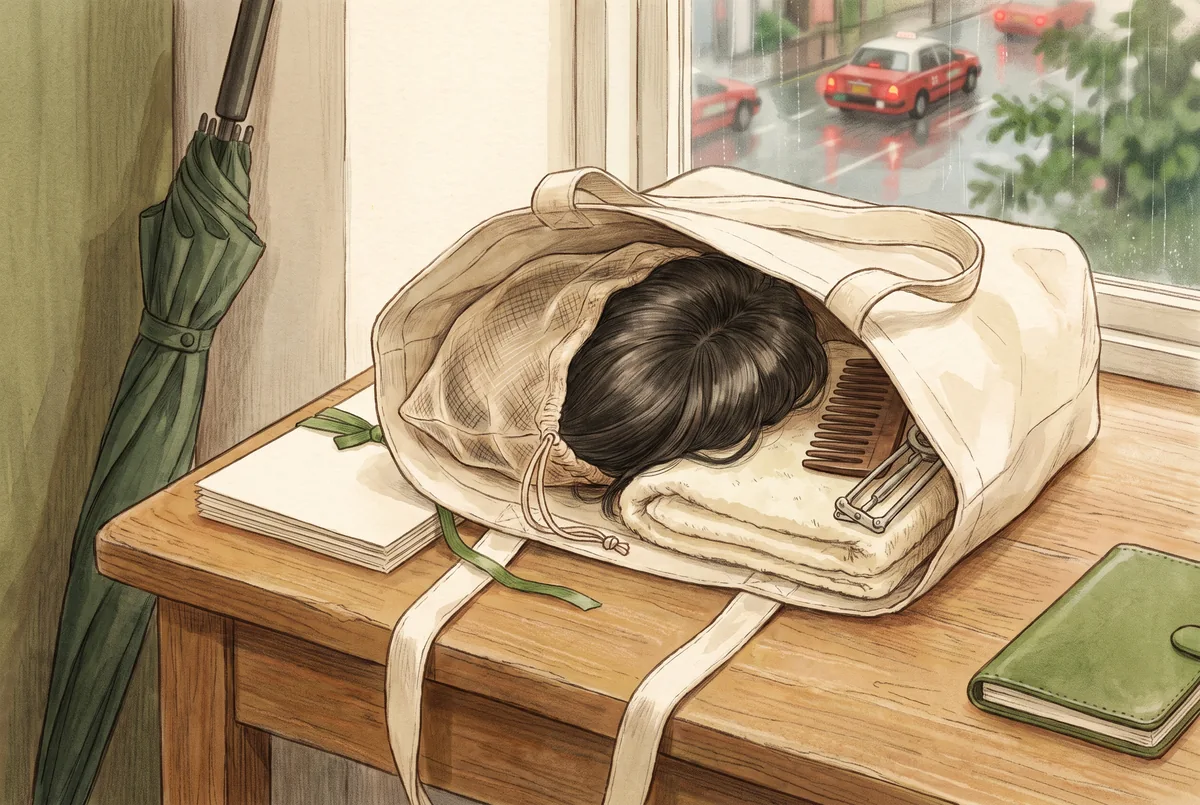
Do the inventory before brushing aggressively, spraying “just in case”, or leaving the wig compressed in a bag. The aim is not to create a laboratory record. It is to preserve enough factual context for tomorrow’s decision.
- Set it on a suitable stand or clean towel. Remove pins or accessories slowly, following the maker’s attachment guidance. Do not pull at a lace edge or a tangled section to speed up pack-down.
- Read the label and any supplied care sheet. Photograph or copy the wording into the card if the tag is difficult to access. A product page is supplementary, not a replacement for instructions supplied with the piece.
- Look and smell, without over-interpreting. Note visible powder, stiff product, tangling at the nape, makeup on the inside, dampness, or a strong product odour. Do not call a fibre “damaged” solely because it has stage spray in it.
- Separate the strand issue from the cap issue. Mark where residue sits: lengths, fringe, crown, underside, lace, clips, or attachment zone. One issue may be removable without washing the whole piece.
- Choose one next action. Air, detangle when dry, spot-clean according to the label, wash according to the label, or pause for maker/retailer advice. “Not yet decided” is a valid action when information is missing.
Useful rule: Do not make a heat, dye, bleach, adhesive, or product-substitution decision while the fibre category is unknown. A short pause has a lower cost than trying to reverse an unsuitable process.
After an energetic Latin dance class, for instance, a card might record perspiration near the nape, a liner, and no styling spray. That differs from a theatre quick-change where glitter has landed on the crown and a hold spray was used on the front. Both are “after performance”, but they do not point to the same care sequence.
Read instructions as conditions, not as permission slips
Labels often contain conditional language: use a named product range, wash only at a stated interval, avoid a stated temperature, or keep a particular attachment area dry. Copy the condition alongside the instruction. “Wash gently” is incomplete if the label also says to avoid rubbing, direct heat, or a certain chemical process.
Use a three-colour status on the card:
- Green — confirmed: the fibre and the relevant label direction are known; the proposed step follows both.
- Amber — limited: the fibre is known but the product, attachment method, or previous treatment is not. Choose the least aggressive label-permitted action or obtain clarification.
- Red — stop: the instruction prohibits the step, the fibre is unknown, the cap is still damp, or there is an unresolved adhesive, scalp, or structural concern.
The reference page human hair vs synthetic wig care can be used as a plain-language prompt for questions to ask about the two broad material families. OwnStrand is an external website with the same owner as FlintHub Academy; it is included as practical reading, not as an independent comparison or recommendation. Its general information cannot override the care conditions for an individual wig.
A “human hair” label is not blanket permission to colour, bleach, perm, or use any hot tool. Prior colouring, processing, ventilation method, cap materials, and manufacturer directions can all matter. Likewise, “heat-friendly” does not state a safe temperature on its own. Use the piece’s specified conditions; if none are available, do not invent them from a generic tutorial.
Match the performance residue to the lightest suitable response
The card should distinguish residue from routine wear. Cleaning more often than necessary can add handling, friction, drying time, and product exposure. Cleaning too little can leave product build-up or trapped moisture. The practical trade-off is not “wash versus neglect”; it is choosing the least invasive label-consistent response that addresses the actual issue.
| What you observed | First question on the card | Lower-intervention option if label permits | When a fuller wash or advice may be appropriate |
|---|---|---|---|
| No visible residue; short, dry wear | Was a liner used and is the cap fully dry? | Air on a stand and record the wear | Follow maker’s stated wash schedule or wash if later inspection finds residue |
| Light tangling at nape | Is the hair fully dry and what is the fibre? | Detangle gently in the label-approved direction and tool | If tangling is paired with product stiffness, matting, or an unknown fibre treatment |
| Makeup on cap or lace | Is it on strands, cap fabric, or attachment area? | Use only the maker’s permitted targeted method | Seek product-specific guidance where lace, adhesive, or staining is involved |
| Heavy spray, mousse, or texture product | Which exact product was applied and to which section? | Do not add another product until instructions are checked | A label-directed cleanse may be needed; test assumptions with the maker if products are unclear |
| Rain, perspiration, or damp cap | Is the entire cap dry before storage? | Air dry in the specified manner; avoid compressing it | If odour, residue, or an attachment issue remains after drying |
| Glitter, smoke-effect residue, or unknown transfer | Can it be removed without rubbing or solvent? | Isolate the piece and read its care instructions | Pause rather than use household solvents or improvised mixtures |
The table deliberately avoids a “wash after every show” rule: two performances can leave different conditions.
Check the cleanser and tools against the fibre
A bottle described as “wig shampoo” still needs to match the fibre and the label’s conditions. Do not substitute human-hair shampoo, a household laundry product, dish liquid, or a strongly fragranced cleanser simply because it is available backstage. The practical question is not whether a cleaner sounds gentle; it is whether its stated use and the wig maker’s instructions align.
Before using a cleanser, record these five details:
- exact product name and, if known, its intended fibre type;
- whether the care label directs or excludes it;
- whether the product will touch only the strands or also lace, knots, cap fabric, clips, tape, or adhesive;
- any previous styling product or chemical treatment that could affect the plan; and
- the required water temperature, handling method, drying method, and storage condition.
For a focused checklist about product compatibility, shampoo for synthetic wigs is another same-owner OwnStrand resource, rather than independent product advice. Treat the page as a place to frame questions, then defer to the supplied label, seller’s written directions, and any product-specific instructions.
“Conditioner fixes everything” is another shortcut to avoid: the issue may instead be product build-up, fibre abrasion, an attachment concern, or the cap.
Run the card through a simple decision path
- Is the fibre confirmed? If no, stop heat, chemical processes, and cleanser substitutions. Locate the label, order record, or maker guidance.
- Is the cap dry and structurally sound? If no, air it according to instructions before storage or further handling. Do not seal moisture into a bag.
- What is the observable issue? Pick one or more: none, tangling, spray/product, makeup, dampness, attachment residue, or unknown transfer.
- Does the label cover that issue and proposed method? If yes, follow it. If the label is silent, select a lower-intervention option or seek clarification; silence is not approval.
- Will the method affect lace, attachments, or the wearer’s skin? If yes, use product-specific instructions and do not extrapolate from fibre-only guidance.
- What needs recording for the next wear? Note the action, products used, dry time, and any condition that should be rechecked.
For a label-led sequence of how to wash a wig, consult the exact piece’s supplied conditions first, then compare the practical steps with the information available. This OwnStrand page remains same-owner information, not an independent endorsement.
This sequence accommodates a busy programme such as a Music performance without promising a one-size-fits-all turnaround. It also makes handovers more reliable: the next person sees what happened instead of guessing whether a damp cap was washed, sprayed, or simply packed away.
Spot the mismatch before it becomes a routine
- “It looks like real hair, so a normal hair routine will do.” Appearance does not establish fibre composition, prior processing, or heat tolerance.
- “It says synthetic, so every synthetic-wig cleaner will do.” Conventional and heat-friendly synthetics may have different conditions; the individual label remains primary.
- “The cap feels damp, so I will blow-dry it quickly.” Conventional synthetic fibres may have no-heat instructions. Drying conditions and cap construction must be checked first.1
- “The hold spray is only at the fringe, so I will rub it out.” Rubbing can tangle or abrade fibre; identify the product and follow permitted handling instead.
- “The shampoo worked last time, so it will work after adhesive use.” Strand cleanser, adhesive remover, and cap/lace care are different questions.
- “It was purchased online, so it can always be returned if a treatment goes wrong.” Confirm the seller’s written terms before purchase or alteration. Hong Kong’s Trade Descriptions Ordinance addresses false or misleading trade descriptions, but it does not create a universal promise that every online purchase is returnable.3
Where an attachment product is involved, use the attachment manufacturer’s directions as well as the wig instructions. If a wearer has broken skin, persistent irritation, an unexpected reaction, or is receiving medical care that affects the scalp, do not use a care card as a medical assessment. The American Cancer Society advises discussing wigs and adhesives with the care team in relevant treatment contexts.2 A wig is an appearance item, not a treatment, and no routine can guarantee that a person will avoid sensitivity.
Planning example: a fictional card, not a client result
Assumption only: Mei is a fictional performer preparing for two weekends of dance and stage work. She owns one wig whose label says “synthetic”; it does not state heat-friendly, and the supplied guidance says to avoid heat. On Friday she wears it for a one-hour set over a liner. She records light perspiration at the nape, no rain, no hairspray, no makeup transfer, and a dry cap after airing.
Her card therefore marks fibre as confirmed synthetic, heat as red, and cleansing as amber until she re-reads the supplied wash conditions. Instead of washing by habit, she places it on a stand, lets it dry fully, gently checks the nape with the permitted method, and records “no cleanser used”. On Sunday, a different card entry records firm styling product at the front and a known product name. That entry triggers a label check for the appropriate wash method and a note to avoid rubbing.
Copy-and-use fibre-first care card
Use this worksheet on paper, in a notes app, or as a shared wardrobe log. Leave a field blank rather than filling it with a confident guess.
FIBRE-FIRST CARE CARD
Date and event: ______
Wig/piece identifier: ____
Fibre wording copied from label: __
Care label consulted (yes/no; location): __
Cap, lace, clips, tape, or adhesive present: __
Liner worn / time worn / weather or lighting:
Observed residue: ☐ none ☐ spray ☐ makeup ☐ moisture ☐ tangling ☐ unknown transfer
Products already used (name and location): _
Fibre status: ☐ green confirmed ☐ amber limited ☐ red stop
Proposed action: ☐ air ☐ label-approved detangle ☐ targeted clean ☐ label-directed wash ☐ ask maker/seller
Heat, dye, bleach, or adhesive decision: _
Drying and storage instruction copied from label:
Action taken / time / person recording: __
Recheck before next wear: ____
The card is a record, not a certification; it makes unknown processing, formula changes, and attachment limits visible before a wash becomes an uncontrolled experiment.
Know when the card should hand over to a specialist
Pause for the maker, seller, attachment-product manufacturer, salon professional, or healthcare professional when instructions conflict, fibre is unknown before heat or chemical work, the cap is damaged, matting is extensive, lace or attachment care is unclear, a product reaction occurs, or there is a scalp concern. Save the written answer with the card.
A fibre-first card does not make every performance low-maintenance, nor does it promise that a wash will restore a particular appearance. It makes the decision proportionate: identify the piece, identify the exposure, honour the supplied conditions, and only then choose the smallest suitable intervention.
FlintHub Academy · AI-assisted editorial
FlintHub Academy publishes planning information for creative learning and events. This article is editorial guidance, not wig-fitting, product-safety, or medical advice. Learn more about FlintHub Academy.
References
- [1] Alternative Hair Care Guide
- [2] Wigs for Hair Loss
- [3] Trade Descriptions Ordinance consumer protection information
FlintHub Academy · AI-assisted editorial. FlintHub publishes creative-learning and event-planning information. This article is a desk-researched planning resource, not a first-hand product test or a claim of wig-fitting or medical qualifications.