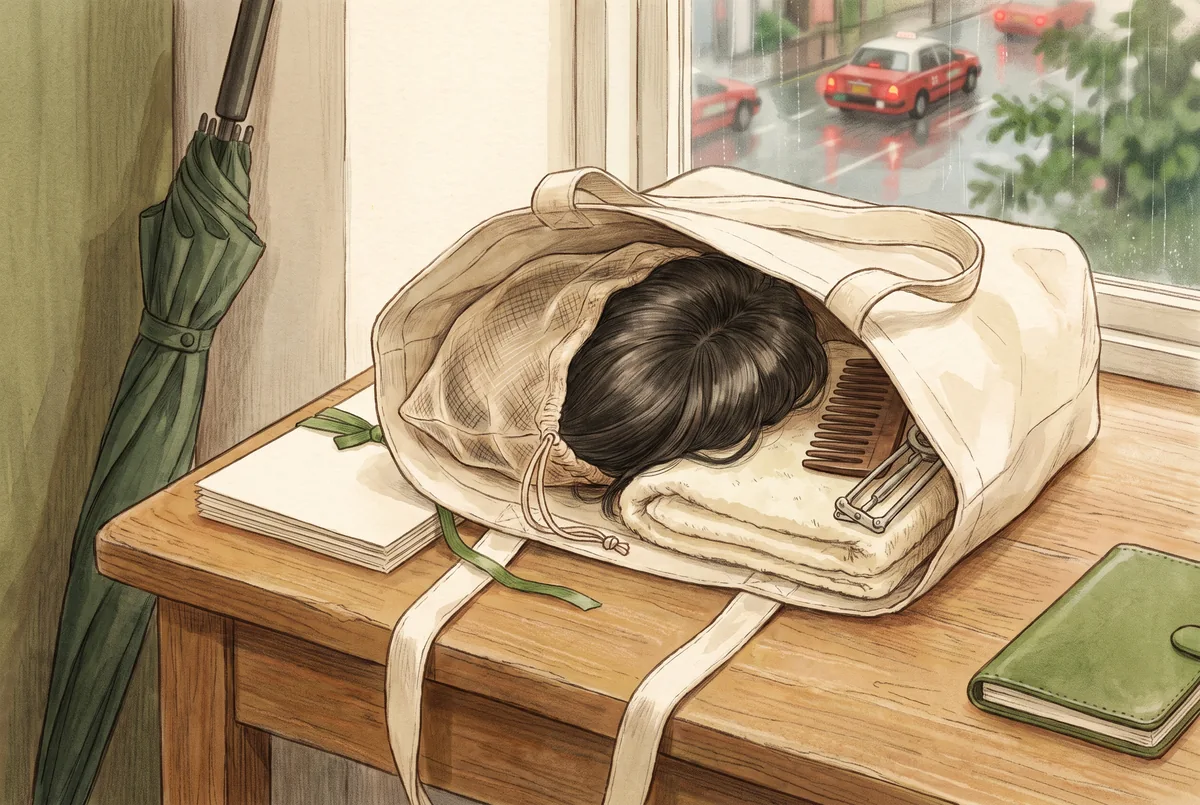
A useful humid-event kit is built from the hairpiece’s fibre, current ends, supplier instructions and the day’s exposure—not from a blanket promise that humidity will cause one particular outcome. Record the forecast and what actually happens, then pack tools in the order you will use them so a quick change or a damp commute does not turn into rushed, forceful detangling.
This is a planning guide for a creative event, rehearsal, shoot or class day; it does not claim a kit can stop frizz, shedding or scalp discomfort. OwnStrand is an external website with the same owner as FlintHub Academy, so links below are supplier information, not independent recommendations. Treat its product pages and the instructions supplied with a piece as inputs to check, alongside your experience of that fibre and cap.
Start with known facts, not a generic “humidity rule”
Before looking at a weather app, make a one-minute build card for the piece. “Wig” is not a care category. Human hair, ordinary synthetic fibre and heat-friendly synthetic fibre can have different approved methods, and cap construction is a separate question. Jon Renau’s guide distinguishes them; for its ordinary synthetic fibres, it advises against heat styling, blow-drying and rubbing, and says the cap should be completely dry before storage. These are manufacturer-specific guardrails, not universal permissions. 1
Write down only what you can verify from the supplier label, order record or care card. If a detail is unknown, mark it unknown. Defer the action, test it in a low-stakes moment, or ask the supplier or a qualified stylist who works with that material.
Your build card should contain:
- fibre stated by the supplier: human hair, standard synthetic, heat-friendly synthetic, or unknown;
- cap type and attachment method, plus any adhesive, clip or tape instruction already supplied;
- present condition of the nape, crown and ends: smooth, slightly dry, tangled, wet or unknown;
- allowed cleansing, conditioning, heat and storage instructions; and
- the last action taken, such as washed, air-dried, styled, worn for rehearsal or packed.
Decision principle: weather changes exposure; it does not override the material instructions. Start with the approved care method, then use the log to decide whether you need a gentler routine, a protected route or extra time.
Turn the forecast into an exposure log
A humidity percentage alone is too broad to tell you what to pack. A sheltered taxi ride to an air-conditioned venue is a different exposure from walking beside the harbour or moving between a warm stage and a cooled studio. Rain, wind, perspiration, condensation inside a bag and time outdoors can matter as much as the number in the forecast.
Use the forecast to plan the route, not as a diagnostic for the fibre. Record conditions at departure, arrival and return. In the “result” column, describe only what you see: “nape caught after collar,” “front separated after rain,” or “ends felt dry after indoor rehearsal.” Avoid declaring a cause after a single day; prior product, friction, a strap, a wet cap or starting condition may also matter.
| Exposure question | Low-load choice | Higher-load choice | What to log afterwards |
|---|---|---|---|
| How long will the piece be outdoors? | Covered door-to-door transfer | Walking, queues or an outdoor set | Minutes outside and whether rain or wind reached the hair |
| What touches the ends? | Open neckline or smooth layer | Collar, scarf, costume trim or bag strap | Location and type of tangling or roughness |
| What happens at the venue? | Seated workshop, controlled room | Dance, lights, repeated costume changes | Heat, perspiration, head movement and change times |
| How will it travel home? | Dry storage space and time to air-dry | Packed straight after a wet commute | Whether cap and fibre were dry before storage |
After two or three comparable outings, the log may show a pattern—perhaps friction at one neckline or packing while damp—without claiming humid days are bad for all fibres. For a Dance class, add warm-up, active practice and cool-down to the itinerary. Movement changes the packing and check-in plan.

Choose the care path by fibre and present condition
Ask: “What is approved for this fibre, and what is the smallest action that addresses its current condition?” Begin with clean, dry hands and visual inspection. Separate small sections from the ends upward only if the supplier allows brushing. Do not pull a knot tight to keep a schedule.
| What you know now | Conservative event-day action | Do not assume | Escalate or postpone when |
|---|---|---|---|
| Standard synthetic, care instructions confirm no heat | Protect from rubbing; use only the approved detangling method and allow drying time | That a hot tool or blow-dryer will “reset” the fibre | Tangling resists gentle sectioning or the cap is damp |
| Heat-friendly synthetic, temperature range is supplied | Follow that exact range and tool guidance, if you have time and skill | That “heat-friendly” means any heat, any tool or wet styling is fine | Temperature or method is not documented, or the piece is already stressed |
| Human hair, supplier care instructions are clear | Use its stated wash, detangle and styling routine; protect ends from friction | That human hair makes bleaching, perming or every heated style risk-free | You are considering chemical work or notice persistent breakage or matting |
| Fibre or prior treatment is unknown | Choose low-friction storage and defer alterations | That appearance identifies fibre or heat tolerance | You would need heat, dye, adhesive changes or strong product to proceed |
A wig brush is appropriate only when its design and the supplier’s direction match the piece. Pack it clean and protected. For a piece that is smooth at departure, hands, a supplier-specified wide-tooth method, or no in-transit intervention may be more proportionate. The goal is to avoid introducing a new variable immediately before an event.
Pack in the order the day will ask for tools
A travel pouch often becomes chaotic because it is organised by category rather than sequence. Build it as four small zones: arrival, maintenance, changeover, and return. Put only the approved item for each zone inside.
- Arrival zone: build card, optional mirror, clean hands and a cover or storage solution that does not crush the style.
- Maintenance zone: the supplier-approved detangling tool and only a compatible product. If considering a wig detangler spray, check its fibre compatibility, permitted amount and drying time before wearing or storage.
- Changeover zone: known-suitable attachment items, a barrier for predictable collar friction and a clean setting-down space. Do not introduce tape, glue or remover at the venue without instructions and time to assess tolerance.
- Return zone: supplier-recommended storage, a way to separate damp items, and the log. If the cap is wet, dry it as directed before storage. 1
Labeling zones is not overpacking. It is a time-saving control: at a hurried change, you reach for the next approved action instead of applying a strong product because it is the first bottle you find. If travel includes a KPOP dance class, give the changeover zone enough space for the costume, neckwear and accessories that may touch the ends.
Use a two-minute check before each transition
A log is most helpful when it is brief enough to complete. Check at departure, after arrival, before performance or class, and before the journey home. Use the same sequence each time. The check is observation, not an invitation to repeatedly handle the hair.
Two-minute transition check
- Look at the cap and hairline without adjusting anything. Is the attachment behaving as expected, and is there any visible dampness?
- Feel only as far as your supplier’s instruction allows. Is the nape or ends catching at a collar, scarf or strap?
- Note the environment: indoors/outdoors, rain or wind exposure, active or seated, and approximate time worn.
- Choose one response: no action; move the friction source; use the approved gentle method; protect for the return trip; or stop and deal with it later in a suitable space.
- Record the result after—not during—the creative activity: unchanged, minor catch cleared, still tangled, damp, or needs a home routine.
The important restraint is the “one response” line. Repeated brushing, product layering or tugging can make it impossible to tell which intervention helped. For guidance focused on a particular scenario, the supplier page about wig frizz in humidity may be a useful starting point, but verify that its fibre and styling assumptions match your own piece before applying it.
Copy this event worksheet into your notes app
This worksheet converts a vague concern—“it might frizz”—into a record for next time. It does not measure humidity’s effect scientifically or replace supplier instructions. Its value is consistency: the same fields make patterns easier to recognise and a one-off mishap easier not to overinterpret.
| Field | Fill in before leaving | Fill in after returning |
|---|---|---|
| Piece and care basis | Fibre; cap; relevant supplier instruction; last wash/style | Any instruction that needs checking before next wear |
| Itinerary and exposure | Indoor/outdoor blocks; transport; collar/strap; activity level | Actual route, rain/wind, warm lights, perspiration and delays |
| Starting and ending condition | Nape, ends and cap: dry/smooth/caught/unknown | Same three areas, with exact location of any change |
| Tool sequence | First permitted action, backup action, stop point | What was used, in what order, and whether it helped |
| Next decision | Pack, air-dry, home detangle, ask supplier or do nothing | One adjustment for a comparable future event |
A stop point might be: “If gentle sectioning does not clear the catch within two minutes, protect the piece for the return trip and address it at home.” This makes unapproved heat, aggressive brushing or unfamiliar adhesive less likely, and turns a disappointing day into a useful note.
Planning example: a clearly hypothetical creative-day log
This is a fictional planning example, not a customer story, test or promised result. Maya is a made-up attendee travelling to an afternoon indoor creative workshop followed by a short outdoor queue. Her fictional build card says “standard synthetic; no heat or blow-drying per supplied care instructions.” The ends are smooth at departure, and she knows a high neckline has caused nape catches on a previous outing.
Her plan says: covered transit where possible; a smooth overshirt for the queue; no hot tool; an approved gentle detangling method only if needed; and a return zone that keeps the piece separate from a damp umbrella. The log includes actual queue minutes, whether the neckline touched the nape, and whether the cap is dry at home.
At the venue, the imagined log records “indoor, active, 90 minutes; nape slightly caught after overshirt.” Her first response is to remove the friction source and check later, not brush immediately. If the catch remains, the stop point directs her to protect the piece and complete approved care at home. The lesson is not that this works for every synthetic piece; a prewritten sequence prevents a rushed decision becoming a broad humidity conclusion.
The framework’s trade-off: a lighter, fibre-specific pouch may leave out convenient but unapproved fixes. That is deliberate. Convenience can be valuable, but not when it replaces the instructions that apply to the piece in your care.
Spot common mismatches before they become event-day problems
The most avoidable mistakes mismatch the item, action and setting. Correcting one can be more useful than adding products.
- Fibre label versus heat plan: calling an item heat-friendly because a friend’s piece was, or because it resembles human hair. Match the exact product instruction, tool and temperature range instead.
- Wet journey versus closed storage: putting a damp cap straight into an airtight pouch. Separate damp items and follow the stated drying method before storing.1
- Nape tangling versus more product: adding product when a collar, lanyard, scarf or backpack is the repeated contact point. Change the contact first, then observe.
- New adhesive versus rushed application: testing glue, tape or remover on an event day. Follow the product directions and seek professional or medical advice where scalp sensitivity, treatment-related skin changes or persistent irritation are concerns; no accessory can promise suitability for every person.
- Human hair versus unrestricted chemistry: treating human hair as permission to bleach, colour, perm or heat-style without limits. Chemical and heat work depend on the piece’s condition and its supplier’s directions; a qualified professional should assess unfamiliar or high-risk work.
- Supplier description versus a verbal assumption: relying on a listing screenshot without checking the written terms for the actual product. Hong Kong Customs explains that false trade descriptions and misleading omissions are prohibited; keep a copy of the listing, material description and written terms, then check the seller’s current conditions before purchase or return decisions. 2
Keep the limits visible
This method makes a packing decision more traceable; it cannot diagnose a scalp condition, predict weather, prove product compatibility or guarantee appearance. If hair loss or scalp comfort is connected to medical treatment, a wig remains an appearance choice, not treatment. The American Cancer Society notes that material and cap type are different dimensions, and advises discussing adhesive use or treatment-related scalp issues with the care team. This is not a statement about Hong Kong funding, insurance or services. 3
For routine event planning, the limit is simpler: do not substitute an online guide for the care instructions of the item in front of you. Where details conflict, pause at the more conservative instruction and contact the supplier or a suitably qualified stylist. If the cap, attachment or fibre is persistently uncomfortable, unusually tangled, damaged or damp, do not promise yourself that one more product will solve it on a deadline.
A log makes future packing calmer because it separates evidence from assumption. After each outing, retain one useful detail—such as “smooth collar reduced nape catches”—and avoid turning it into a rule for every fibre, body or humid day.
References
FlintHub Academy · AI-assisted editorial
About the author: FlintHub Academy creates planning information for creative learning. This article is practical planning information, not wig-fitting, cosmetic chemistry or medical advice.
- [1] Alternative Hair Care Guide
- [2] Trade Descriptions Ordinance consumer protection information
- [3] Wigs for Hair Loss
FlintHub Academy · AI-assisted editorial. FlintHub publishes creative-learning and event-planning information. This article is a desk-researched planning resource, not a first-hand product test or a claim of wig-fitting or medical qualifications.