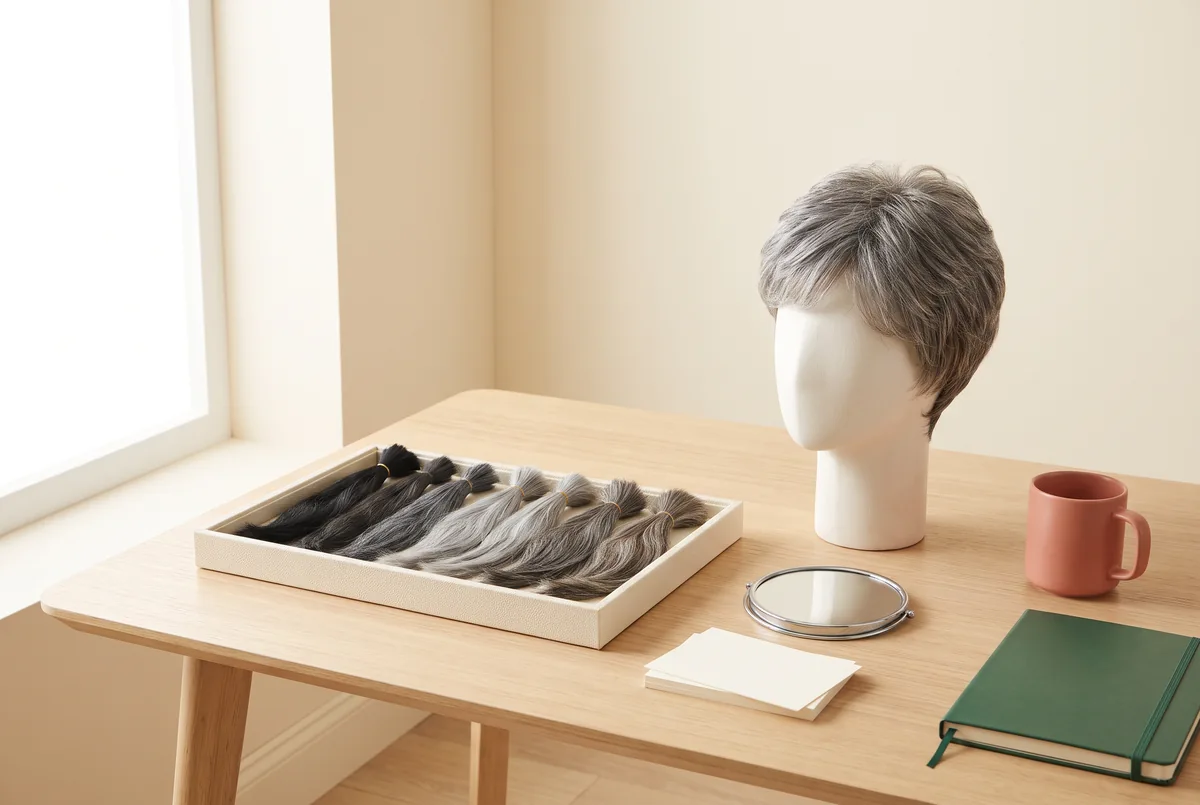
Choose grey wigs by specifying where the grey should be visible at the front, temples and crown, rather than relying on one overall percentage. Write down the appearance you want in your usual hairstyle, the reference that explains it, and the sample-to-piece differences you would accept before committing to a custom request.
This is a brief for your everyday appearance: commuting, working, meeting friends and wearing your hair as you normally would. It is not a prescription for how grey should look at a particular age. A useful request can be modest: “Keep the temple grey recognisable, soften the front, and leave the crown darker.” The task is to make those words specific enough to discuss.
1. Begin with the grey you want to keep
Start with intention, not a colour label. You might want to preserve familiar grey at the sides, introduce a more even salt-and-pepper appearance, or make the front less prominent without removing every light strand. These are different requests, even if someone describes all three as “natural grey”.
Write one sentence naming what should stay recognisable and one naming what should change. For example, a hypothetical buyer might write: “The grey beside my ears is part of the appearance I want to retain. I want the hair above my forehead to look more mixed, rather than like a separate pale band.” That separates a personal preference from an assumed need to cover grey.
Choose your ordinary hairstyle at this stage. A side part, fringe or habit of tucking hair behind the ears determines which areas you need to discuss. Jon Renau’s buying guide places lifestyle, fibre, cap construction and length among the basic selection considerations.1 Grey placement belongs alongside those decisions, not ahead of every other requirement.
If your intention is still unclear, FlintHub’s discussion of how much grey a mature adult host might keep can help separate retention from softening or coverage. Its close-up context is background reading; your daily brief should reflect your own preference, not a host’s role or camera requirement.
Finish by naming your priority. If retaining the temple appearance matters more than achieving a particular overall lightness, say so. This gives a supplier something useful to work with when the available options cannot satisfy every wish equally.
2. Treat a percentage as shorthand, not a map
An overall grey percentage does not tell you whether light strands are concentrated at the temples, dispersed across the crown or grouped at the front. Two arrangements can share a numerical description while answering different personal requests. A number can start a conversation, but it cannot replace the location information.
When browsing grey wigs, use photographs to identify distribution patterns worth discussing. Do not assume that a catalogue image confirms a particular percentage, custom placement option or available piece. Note what attracts you: a darker centre, lighter sides, fine scattered strands or a distinct front section.
If a percentage is offered, ask what it describes. Is it the whole piece, an individual zone, a named blend or a supplier’s visual estimate? Ask whether the grey and darker component can be discussed separately. A percentage without an agreed meaning may sound precise while leaving the important decision unresolved.
| Description | What it communicates | What it leaves unresolved | Useful follow-up |
|---|---|---|---|
| Overall percentage | A proposed quantity or blend label | Where grey appears | Ask which area the figure describes |
| Evenly mixed grey | A preference for dispersed light strands | How noticeable the front will be | Review the mixture in the intended style |
| Temple-led grey | Sides should carry the main grey emphasis | Left-right balance and crown appearance | Describe each temple and the top separately |
| Distinct front section | A visible feature near the forehead | Its width, edge and relation to the part | Identify boundaries on a labelled sketch |
Choose descriptive wording first. Add a percentage only if the supplier can explain and confirm how it relates to that wording. This avoids turning an unverified number into the acceptance rule for your order.
3. Describe the front, temples and crown separately
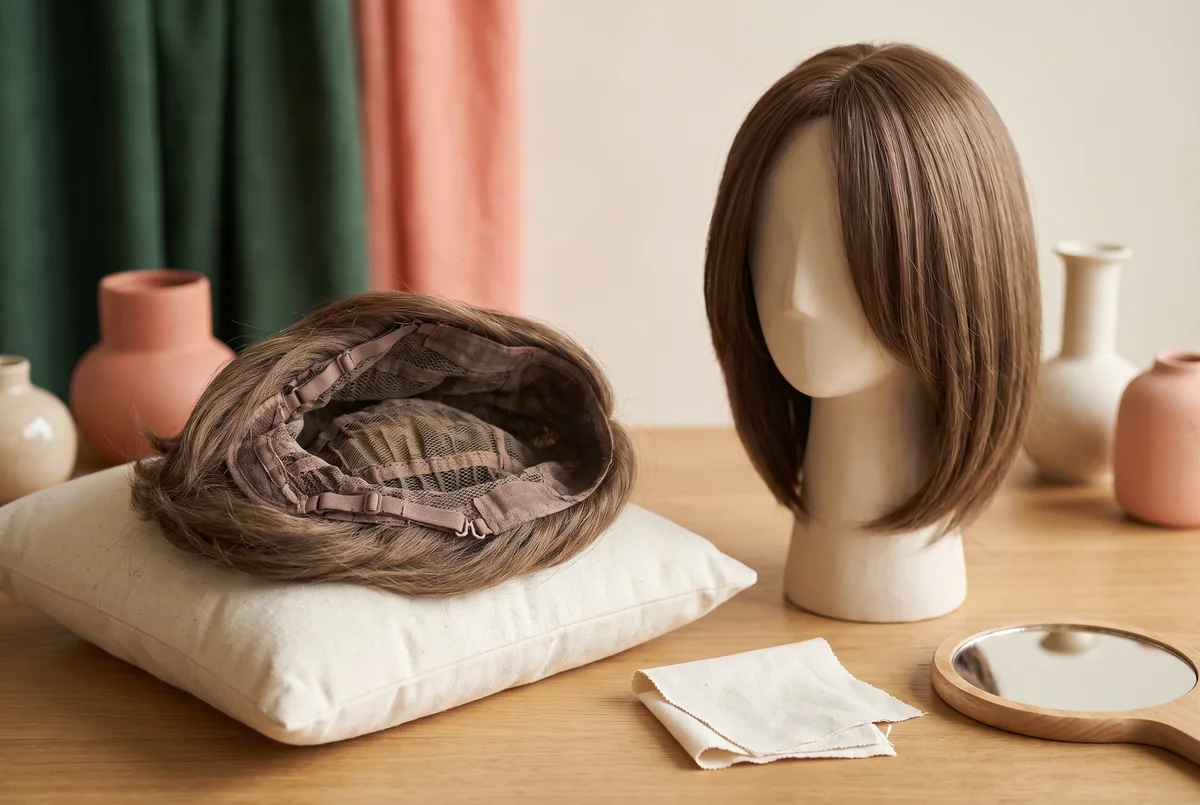
Draw a simple head outline viewed from the front and above. Label the wearer’s left and right explicitly so a mirrored selfie does not reverse your request. Mark the usual part, fringe direction and ear-tucking habit. These are reference points, not instructions for constructing the piece.
For the front, describe the area above the forehead and the hair that falls toward the face. Say whether you want grey dispersed through that area, concentrated beside the part, or less visible than at the temples. Distinguish a light streak from a mixed section. “Some grey at the front” leaves both possibilities open.
For the temples, record each side independently. Specify whether they should look alike, retain an intentional difference, or simply carry more grey than the crown. If you usually tuck one side behind your ear, flag that side. An appearance judged with both sides hanging loose may not answer the request you wear every day.
For the crown, describe the top behind the front section, including the visible part area. Ask whether you want a dispersed mixture, a darker-looking top or a gradual transition from the sides. Do not confuse the crown’s grey distribution with visible scalp, cap construction or overall hair density; those need their own checks.
Finally, state what should happen between zones. “Lighter temples with a gradual transition toward a darker crown” is different from “clearly separate pale sides”. Include the back and nape if they matter to you, but keep the main map readable. The aim is a few observable relationships, not a strand-by-strand drawing that nobody has agreed to reproduce.
4. Use samples to verify the words you have chosen
A reference should have a declared job. An older photograph might show the temple placement you want to retain, while a supplier sample might establish an acceptable mixture. Do not hand over several images and leave the supplier to decide which feature from each one matters.
For a custom wig with a percentage of grey hair, ask whether the requested blend can be distributed differently at the front, temples and crown. Also ask what can be shown before confirmation: a colour sample, an existing display piece or another agreed reference. These are questions about the proposed service, not a guarantee that every arrangement is available.
Label references by intention: “placement only”, “mixture only” or “overall appearance”. If a photograph shows lighter temples but an unwanted fringe, write that the fringe is not part of the request. Include an example you would reject if it clarifies a meaningful boundary, such as a broad pale front section rather than scattered grey.
Ask what the sample actually represents. A loose bundle can help discuss a mixture without showing how it will sit around your face. A display piece may demonstrate placement but have a different length or part. Neither should silently become evidence for features it does not show.
Record which reference was discussed and what remained unconfirmed. Hong Kong Customs’ guidance on unfair trade practices covers false service descriptions and misleading omissions.2 For this decision, the practical step is to clarify the proposed product and service scope in writing; the brief itself is not legal advice or a promise of any particular remedy.
5. Agree tolerances without demanding identical colour everywhere
Look at an available sample in natural light where practical, as well as the indoor setting in which you are discussing it. The American Cancer Society’s wig-selection guidance suggests photographs and natural-light colour samples as comparison aids.3 This is a general buying principle, not a requirement to disclose a health history or a guarantee of colour accuracy.
Separate appearance in a particular setting from placement. If a temple section looks brighter beside a window, ask whether its position still matches your intention. If the apparent mixture changes when hair is moved across the part, check the proposed style before concluding that the colour specification is wrong. The goal is an everyday preference you can explain, not identical colour in every environment.
When considering a custom human hair wig Hong Kong request, ask how the shown sample relates to the proposed piece’s hair, construction and styling. Confirm the actual features rather than treating the custom label as proof of unrestricted colour choice, exact replication or any particular cap design.
Define tolerances as relationships where possible: “The temples must remain visibly greyer than the crown; a small difference in the scattered strands is acceptable.” If you cannot judge a proposed variation, leave it pending rather than approving it because it sounds minor.
Avoid “no difference whatsoever” unless the supplier has explained a realistic verification method and agreed to it. Equally, do not accept an open-ended “colour may vary” if placement is your main reason for commissioning the piece. Ask which differences are expected and which would require another discussion.
6. Complete your personal grey placement brief
Use the following as a copyable consultation record. Fill it in with your wording before asking the supplier to confirm what can be provided. A blank or disputed field stays pending; it does not count as consent.
| Record field | Buyer entry | Supplier confirmation needed | Pause condition |
|---|---|---|---|
| Reference intention | Reference ID: ___; use for placement, mixture or overall appearance: ___ | What this reference can demonstrate | Different references have conflicting jobs |
| Front | Desired grey visibility: ___; part or fringe: ___ | Available distribution in the intended style | Front appearance has not been discussed |
| Left temple | Desired mixture and boundary: ___ | Whether the request is achievable | Wearer’s left is not clearly labelled |
| Right temple | Match left or differ: ___; ear tuck: ___ | Side balance and visible transition | Symmetry has been assumed without agreement |
| Crown | Desired relationship to front and sides: ___ | Top placement and part limitations | Colour is confused with density or cap appearance |
| Sample-to-piece variation | Acceptable difference: ___; unacceptable change: ___ | Expected variation and review method | Only an undefined variation disclaimer is offered |
| Review and revisions | Reference version: ; reviewer: ; pending questions: ___ | Review stage, adjustment scope and any charges | Responsibility for a disputed difference is unclear |
Read the completed brief aloud as one short description. If it says “even throughout” but also requests much lighter temples, resolve that conflict now. Rank one must-have, one preference and one flexible detail. That hierarchy makes compromise explicit instead of leaving it to a supplier’s interpretation.
Before sending it, check:
- [ ] Left and right refer to the wearer, not the photograph.
- [ ] The usual part, fringe and ear-tucking habit are recorded.
- [ ] Front, both temples and crown have separate entries.
- [ ] Each reference has one clearly stated purpose.
- [ ] Acceptable variation and a reason to pause are named.
This brief does not certify a match. It creates a shared account of what you asked for and which parts have been confirmed.
7. Confirm the next step and the revision boundary
Send the brief with labelled references and ask for a reply against the unresolved fields. Useful wording is: “Please identify which zone requests you can provide, which require a sample discussion, and which you cannot confirm.” A specific reply is more helpful than general reassurance that the result will look natural.
Agree when placement can be reviewed and what happens if a proposed difference exceeds the recorded tolerance. Ask whether any revision is included, separately charged or unavailable, and whether a changed request affects the schedule. These conditions should be established before treating a sample discussion as approval to proceed.
Keep the colour brief separate from fitting and construction checks. A satisfactory grey map does not establish correct size, comfortable wear or suitable attachment. A full wig, topper and hair system are also different product categories; confirm which one the discussion concerns rather than transferring this full-wig request unchanged to a partial piece.
Do not use a production estimate as a collection or delivery commitment. Ask for the stages that remain, including any sample confirmation, fitting or revision discussion. If a must-have zone is unavailable, choose between relaxing that preference, considering a different confirmed option or pausing the purchase.
The next step need not be an order. A completed map with two pending questions is already more useful than an attractive photograph and an unexplained percentage.
Frequently Asked Questions
Is an overall grey percentage a placement map?
No. It may describe a blend or quantity without saying where grey appears. Ask what the figure covers, then specify the front, both temples and crown independently. Use the percentage only with the supplier’s confirmed meaning.
Can a sample guarantee identical colour everywhere?
No single sample establishes identical appearance in every setting or style. Record what it demonstrates and discuss expected sample-to-piece differences. Placement relationships can be useful acceptance criteria when exact colour identity is not a realistic agreed standard.
Who chooses how much grey to retain?
The wearer chooses the intention. A supplier can explain feasible options but should not be left to infer whether you want retention, softening or coverage. You do not need to justify the preference through age or medical information.
What belongs in the placement brief?
Include the usual style, labelled zones, each reference’s purpose, acceptable variation and unresolved questions. Record who confirmed the request and how it will be reviewed. Leave unconfirmed construction or fitting details separate rather than treating colour approval as approval of everything.
Is a production estimate a delivery commitment?
Not by itself. Confirm the remaining stages, proposed review arrangements and the actual collection or delivery terms. A revised placement request may require further discussion, so retain a pause option if the confirmed plan no longer meets your needs.
References
- [1] Jon Renau: The Beginner’s Guide to Wig Buying
- [2] Hong Kong Customs: Unfair Trade Practices
- [3] American Cancer Society: Choosing and Wearing a Wig
Editorial disclosure
FlintHub and OwnStrand share ownership. FlintHub Academy prepared this article with AI-assisted organisation of declared public sources and editorial decision tools. It is not an independent expert endorsement, wearer review or medical advice. Actual products, supply and service arrangements require provider confirmation.
FlintHub Academy · AI-assisted editorial prepared from public information. FlintHub publishes creative-learning and personal-planning resources. This is not a first-hand product test, a real client case or a claim of wig-fitting, hairdressing or medical qualifications. OwnStrand and FlintHub Academy have the same owner.
Connect this guide with your planning
For comparison tables and enquiry tools on this same subject, visit Wig Selection & Personal Styling journal. This is an information journal, not a course, product or medical service.