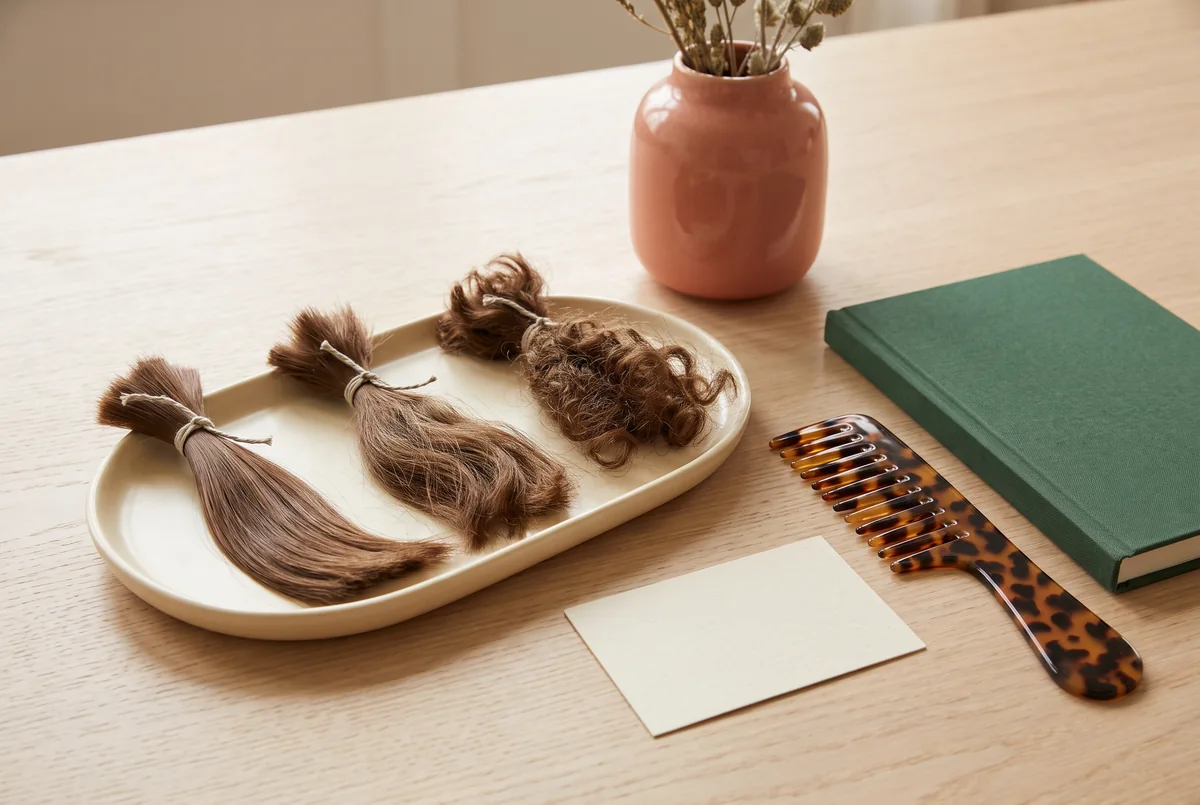
Choose wig fibre by the routine you can sustain: ordinary synthetic fibre may suit a repeatable style with limited restyling, while human hair may suit changing finishes when you can handle or outsource the extra work. Neither wins automatically; the deciding test is whether the particular model meets your weekday needs within your available time and confirmed care conditions.
1. Start with an ordinary working week
Begin with the morning when everything competes for attention, not the leisurely Saturday when trying a different hairstyle feels enjoyable. Write down the minutes genuinely available after breakfast, dressing and other obligations. Record time you would willingly spend, rather than time you could theoretically create by waking earlier.
Separate three windows: getting ready, a possible daytime check and upkeep outside working hours. A free evening does not solve a morning task unless that task can actually be completed beforehand under the model's instructions. Likewise, a long lunch break is irrelevant if there is nowhere suitable to make the adjustment you expect.
Define an acceptable finish in observable terms. Perhaps the fringe must stay clear of your glasses, the outline should look tidy with a work shirt, and the same part is welcome all week. Another reader might want a straight finish for meetings and a different texture for evening social plans. These are different purchasing briefs, not different levels of taste.
Jon Renau's buying guide treats lifestyle, fibre, cap construction and length as connected choices.1 Use that principle to resist selecting the material before describing the job it must do. FlintHub's working artist's hair time diary is related reading for identifying realistic routine windows; it is not a wig-care prescription.
Finally, identify your least flexible day. A candidate that works only when the calendar is clear has not yet passed a workweek test.
2. Separate fibre from style and cap construction
Fibre describes the hair material. It does not, by itself, tell you whether a fringe works with glasses, a cap fits, or the available parting suits your preferred outline. Avoid attributing everything you like about a sample to its human-hair or synthetic label.
For a useful comparison, ask to consider candidates with broadly similar length and styling goals. Otherwise, you may be comparing a short, settled shape with a long, changeable one and mistaking the difference in your intended routine for a verdict about materials. Cap construction remains a separate question: the buying guide discusses it alongside fibre rather than treating one as a substitute for the other.1
The following table identifies purchasing questions, not guaranteed preparation times. Fill in the answer for each actual candidate before treating an option as manageable.
| Candidate or requirement | Possible workweek fit | Commitment to investigate | Evidence needed |
|---|---|---|---|
| Human hair | You want different approved finishes | Who creates and maintains each finish? | Model instructions and a demonstrated routine |
| Ordinary synthetic fibre | You welcome one repeatable style | What attention does that style still need? | Care directions and permitted adjustments |
| Heat-friendly synthetic fibre | You want an approved restyling option | Does the process fit your time and skills? | Exact fibre designation and model-specific conditions |
| Similar length and outline | You want a fair material comparison | Are differences really caused by the cut or cap? | Comparable samples and construction details |
Use OwnStrand's human hair vs synthetic wigs page as a route for comparison questions. Bring your weekday brief so that the discussion concerns particular candidates, rather than assuming a category label establishes convenience or suitability.

3. Compare the upkeep commitments you can verify
Ask what the candidate looks like before additional finishing, and what work separates that state from your acceptable workday appearance. A sample prepared by someone else may hide the part of ownership you most need to understand. The important question is not simply whether it can achieve the look, but who will reproduce it later.
Request a distinction between routine wearer tasks and occasional specialist tasks. For each, note the required skill, suitable setting and whether it must happen before wear. Manufacturer care guidance distinguishes human hair, ordinary synthetic and heat-friendly synthetic requirements; it does not justify one universal routine.3 This article therefore supplies no fixed washing interval or styling-time estimate.
Do not equate willingness with capability. You may enjoy choosing a finish but have no interest in creating it yourself. That preference is workable if a suitable provider and service arrangement are confirmed. Conversely, liking a demonstration does not mean you will repeat the process on a crowded Tuesday.
Ask for a demonstration of the tasks you would retain. Watch where the demonstrator pauses, uses specialist knowledge or starts from a condition that will not match your own routine. Record those dependencies without trying to recreate an unconfirmed technique.
Then run a desk rehearsal against your diary: place each task into a genuine window. If it displaces sleep, meals or a fixed departure time, shorten the desired styling brief or keep another candidate in consideration. An attractive finish is not yet a sustainable routine.
An evening window also needs boundaries. If the only usable space must be cleared for family meals, ask whether the candidate's required work can fit around that constraint. If professional collection falls during your working hours, investigate another arrangement before counting the task as outsourced. The point is to match ownership to available space and access, as well as minutes.
4. Do not treat heat-friendly as a universal label
A heat-friendly designation is a condition to investigate, not a promise of effortless flexibility. Jon Renau's care guidance separates ordinary synthetic fibre from heat-friendly fibre and human hair, and warns against heat tools on ordinary synthetic styles.3 Do not transfer another brand's tool settings or methods to the candidate in front of you.
Ask for instructions tied to the exact model, including restrictions and which changes require professional handling. If you cannot establish that a planned adjustment is permitted, leave it outside your workweek plan. An unknown is not a spare styling option that becomes available when you are running late.
Heat-friendly may also be unnecessary for your brief. If you want the same outline throughout the week, investigate whether the supplied style already meets that requirement. Paying attention to permitted restyling matters more when a change is essential than when it is merely something you might try eventually.
The same caution applies when browsing human hair wigs. Ask which finishing and care conditions apply to the actual piece; the material name does not establish unrestricted colouring, chemical alteration or a particular service package. Manufacturer guidance does not guarantee chemical-change results.3
Keep two questions separate: “Can this model support the finish?” and “Can my routine support the process?” A positive answer to the first cannot compensate for missing time, missing instructions or a task you do not wish to perform.
5. Include outsourced finishing in the decision
Outsourcing is a legitimate capacity choice, not evidence that you selected the wrong fibre. It can make a desired finish feasible when you prefer professional handling. But it shifts work into booking, transport, handover and collection; it does not remove those obligations from your calendar.
Ask a prospective provider to confirm the model they accept, the tasks included, the condition expected at handover and how collection is arranged. Establish whether any adjustment is permanent before authorising it. “Styling available” is too broad to tell you whether your specific finish and schedule are covered.
Hong Kong Customs identifies false service descriptions and misleading omissions among unfair trade practices.2 That supports requesting clear service scope, not assuming a legal entitlement or guaranteed refund. Keep the provider's written answer with the product instructions so your plan rests on the same understanding.
When considering synthetic wigs, ask what upkeep remains yours and whether professional work is suitable for the particular model. A simpler intended finish may reduce your desired restyling, but “synthetic” should never be translated into “no attention required” or a confirmed stock claim.
Test the arrangement against one missed appointment. If the finish you need depends on a booking, what acceptable option remains while you wait? Possibilities include retaining the current approved style, choosing a less demanding candidate or postponing a change. None requires buying a second piece automatically.
Include the quoted service charge and travel burden in your decision, without inventing an annual frequency. The relevant cost is the arrangement you can confirm and sustain.
6. Use a capacity grid rather than a material ranking
Make one copy of this grid for each shortlisted model. Its purpose is to connect four facts that catalogues often separate: your morning capacity, your minimum acceptable finish, work handled elsewhere and conditions still unknown. The blanks are intentional; the tool does not predict how long any wig takes to prepare.
| Working day | Available morning time | Minimum acceptable finish | Task retained or outsourced | Label condition still unknown |
|---|---|---|---|---|
| Monday | ___ minutes | Describe part, fringe and outline | Task: ___; owner: ___ | ___; ask before relying on it |
| Tuesday | ___ minutes | Note the least flexible requirement | Task: ___; owner: ___ | ___; record the model reference |
| Wednesday | ___ minutes | State whether a change is essential | Task: ___; booking window: ___ | ___; keep change conditional |
| Thursday | ___ minutes | Include any evening requirement | Task: ___; collection plan: ___ | ___; seek written instructions |
| Friday | ___ minutes | Define an acceptable fallback | Task: ___; fallback owner: ___ | ___; pause if essential |
Use fits, conditional and does not fit as outcomes, not scores. A candidate fits when required tasks have realistic windows and confirmed conditions. It remains conditional when a specific answer or service arrangement is outstanding. It does not fit when an essential task exceeds your capacity or is something nobody has agreed to handle.
Consider a hypothetical office worker with brief weekday mornings who accepts one outline but wants a different finish on Friday. A repeatable synthetic style is worth investigating for ordinary days; the Friday change stays conditional until its permitted process and owner are confirmed. Human hair remains a candidate if the desired change is supported and the worker can sustain the finishing arrangement.
Do not average away a failed day. The grid exposes a bottleneck; it is not a material league table.
7. Leave options open when care conditions are unknown
Distinguish an unresolved preference from an unresolved requirement. Not knowing whether you will ever want another texture need not block a candidate that meets your current brief. Not knowing whether the essential weekday finish is permitted should block reliance on that finish until you obtain a clear answer.
Before committing, use this short checklist:
- [ ] Match the care information to the exact candidate and fibre designation.
- [ ] Describe a minimum finish for the least flexible weekday.
- [ ] Give each necessary task an owner and a realistic time window.
- [ ] Confirm any outsourced work, collection arrangements and quoted scope.
- [ ] Identify an acceptable fallback and unresolved conditions that require a pause.
Send only the missing questions next. For example: “I need this outline ready before an early departure, and I do not want to restyle it myself. Which tasks would remain mine, and what service arrangement would cover the others?” That brief is more actionable than asking which material is best.
If the reply remains vague, retain both candidates or postpone purchase. A confident category description cannot replace instructions for the actual model. These checks are editorial decision tools, not a substitute for a provider's directions or an assessment of physical fit.
The grid addresses full-wig purchasing, not a topper's blending requirements or a bonded hair system's attachment arrangements. It also cannot establish comfort or diagnose scalp problems. Stop if wearing causes discomfort; health concerns belong with a qualified healthcare professional. Choose fibre only after the model and workable routine align.
Frequently Asked Questions
Is human hair always the better fibre?
No. A human-hair candidate may support the changes you want but still require work you cannot accommodate. A synthetic candidate may suit a repeatable weekday style. Compare actual models against your minimum finish and confirmed task ownership, not a presumed hierarchy.
Does a heat-friendly label replace model directions?
No. It identifies a category to investigate. You still need the exact model's permitted methods and restrictions. Do not import another product's settings or rely on an unsupported change for an essential workday finish.
Should outsourced upkeep enter the workweek grid?
Yes. Record both the specialist task and your booking, handover and collection obligations. A service only solves a capacity problem when its scope and practical access are confirmed; willingness to pay alone does not establish availability.
Does the grid prescribe washing frequency?
No. It records available capacity and responsibility, not a maintenance calendar. Care intervals and methods must follow the applicable product directions and provider advice. Do not derive a cleaning schedule simply from five working days.
What if care conditions are missing?
Keep the affected task conditional and ask for information tied to the exact model. If it is essential to your intended routine, delay commitment rather than assume permission. You can simplify the finish, investigate another candidate or choose not to buy yet.
References
- [1] The Beginner's Guide to Wig Buying — Lifestyle, Fibre and Cap Choices
- [2] Hong Kong Customs — Unfair Trade Practices
- [3] Jon Renau — Alternative Hair Care Guide
Editorial disclosure
FlintHub and OwnStrand share ownership. FlintHub Academy prepared this article with AI-assisted synthesis of public sources and editorial decision tools. It is not an independent expert endorsement, a wearer review, a stylist's test or medical advice. Actual products, supply and services require provider confirmation.
FlintHub Academy · AI-assisted editorial prepared from public information. FlintHub publishes creative-learning and personal-planning resources. This is not a first-hand product test, a real client case or a claim of wig-fitting, hairdressing or medical qualifications. OwnStrand and FlintHub Academy have the same owner.
Connect this guide with your planning
For comparison tables and enquiry tools on this same subject, visit Wig Selection & Personal Styling journal. This is an information journal, not a course, product or medical service.