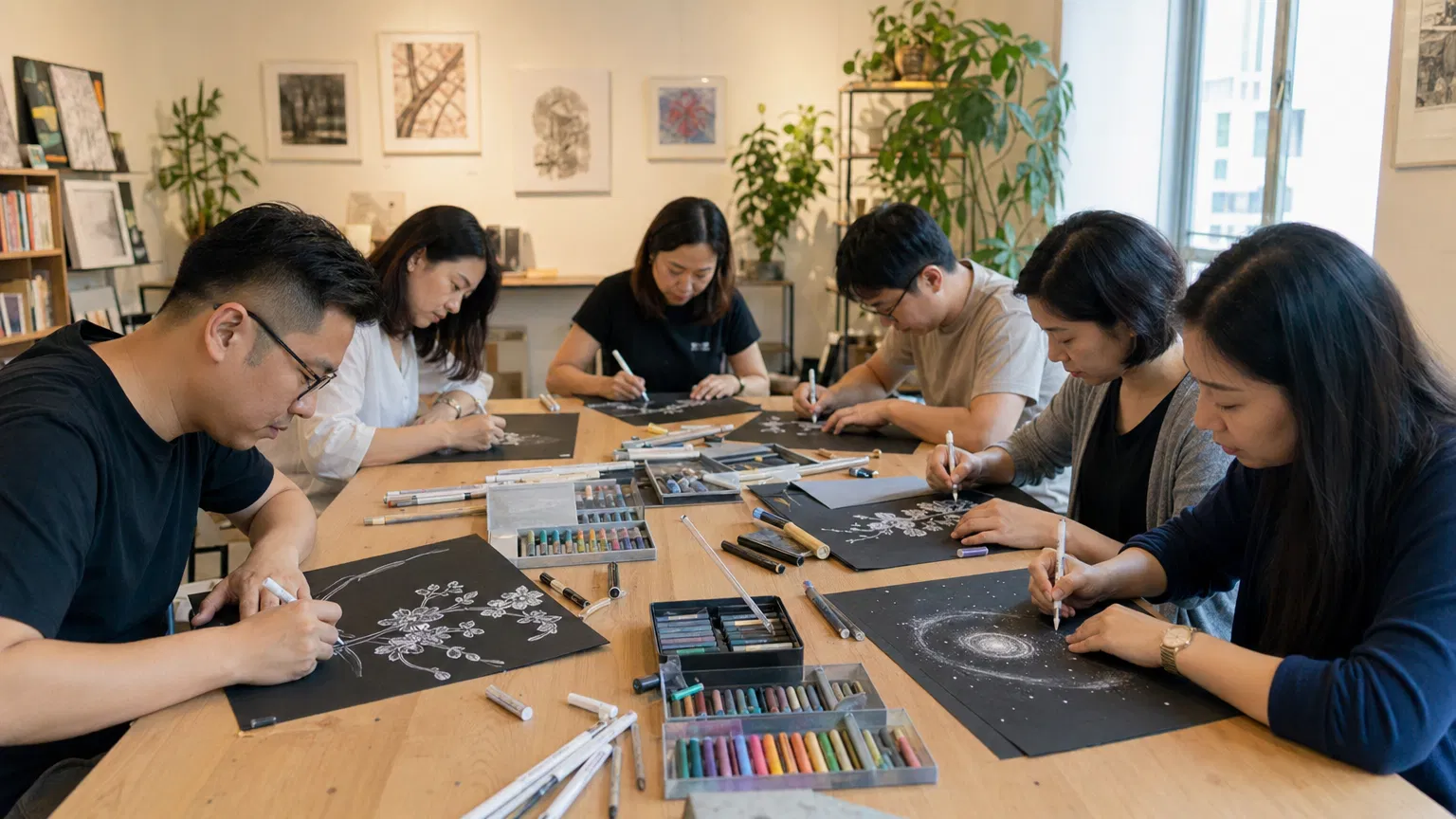
Choose the creative format from the purpose of the gathering
Individual canvases and shared surfaces serve different aims
When people need quiet personal expression or a piece to take away, separate canvases and self-selected colours may be the clearer starting point. When the aim is conversation and joint decision-making, a larger shared surface, connected panels, or a turn-taking approach may fit better. These choices affect table layout, discussion time, storage, and how participants move through the room.
Use prompts without prescribing one answer
A prompt can refer to a season, a school value, a team theme, or a family memory without dictating an image that everyone must copy. Leaving choices of colour, composition, and medium open makes space for people who prefer symbols, blocks of colour, simple marks, or collage rather than observational drawing. The prompt should support participation, not turn the activity into a test.
In an enquiry, explain whether the desired outcome is conversation, visual observation, reflective making, or preparation for a display. Also say whether small-group sharing is wanted. With that context, an organiser can discuss an appropriate sequence, scale of work, and level of prompting instead of assuming that every group needs the same format.
Compare media by handling needs and creative skills
Paint, drawing tools, and collage create different conditions
Paint can invite mixing, layering, and coverage; drawing tools can suit line, pattern, and smaller detail; paper collage brings cutting, arranging, and adhesion into the process. Each option changes drying time, clothing protection, ventilation, table covering, and whether work can be moved immediately. Select media according to the actual venue and participant conditions, not simply because a material sounds familiar.
Build an accessible starting sequence
For a group new to art making, a sequence might begin with colour selection, test marks, simple shapes, and one area of a composition before any optional mixing or collage. Participants with more confidence may prefer their own composition or a layered approach. No one should be assumed to need identical skills, make the same image, or work at the same pace.
For children, ask what media and tool sizes are being considered, whether adults need to accompany them, and what cleaning arrangement is practical. If a school or organisation wants to retain work for a display, ask separately about drying, labelling, protective packing, and collection. Those details should be confirmed for the specific session rather than presented as included by default.
Fit the activity to Hong Kong school learning and administration
Connect visual making to a defined learning intention
A school can first decide whether the activity supports visual arts learning, a themed week, class connection, or an image-based response to reading or a community topic. That choice can guide individual work, paired mark making, or a class surface. It also keeps the plan centred on artistic exploration rather than mislabelling it as a coding or technology lesson.
Plan around lesson timing and campus space
Put the real lesson periods, transition time, year groups, number of groups, and available staff support into the enquiry. Mixed ages may need different explanations and tool-management approaches. Whether bilingual guidance is suitable, how detailed a demonstration may be, and whether discussion is included are session-specific points that require confirmation rather than assumptions.
Classrooms, halls, and specialist rooms differ in desk arrangement, handwashing access, floor protection, and temporary storage. A school can share photographs or a simple layout, identify an on-site contact, and note arrival times and campus rules. This gives the organiser enough information to discuss a process that respects teaching order and the need to clear the room afterwards.
Adjust the pace for teams and family groups
Team participation is collaboration, not a drawing contest
A team can use a shared image as a discussion starting point: participants might agree on areas, colour relationships, and a loose visual story before connecting their work. The value lies in noticing and negotiating, not in ranking the strongest picture. For an activity around a meeting, state the available time, whether quiet making is important, and whether a short voluntary share is desired.
Family plans need age-aware participation
A family may prefer separate small pieces assembled into one group image, or an adult and child sharing one surface. Younger participants usually need clearer material boundaries and adult assistance. Ask about the age range, accompanying adults, rest needs, and whether work is intended to travel home. These are practical planning questions, not evidence that any particular format will be available.
For colleagues and relatives alike, avoid requiring people to disclose personal feelings in front of the group. Sharing can be optional and limited to colour choices, a source of inspiration, or a collaboration decision. That approach respects different communication styles while keeping the occasion focused on art making and social connection rather than an evaluation of anyone's ability.
Start with venue readiness, safety, and cleaning
Check surfaces, routes, and material handling
Before planning, check that tables are stable, routes between seats remain clear, floors can be protected if needed, and materials can stay apart from food areas. Paint, adhesives, and tools should be discussed in relation to participant ages and venue rules. These are cautious planning checks, not a substitute for a site-specific safety assessment or individual advice.
Allow time for drying, washing, and departure
Where cutting or mess-prone steps are contemplated, tools can be issued in stages, used in defined places, and observed by adults when younger children take part. Water access, cloths, waste sorting, and handwashing locations also shape the timetable. If a venue restricts water use or ventilation, raise that early so a suitable medium or process can be discussed.
Work that is not dry may need to lie flat or be separated, so departure should not be timed only from the final creative step. Enquire about protective sheets, labels, holding space, and collection procedures. Reserve time at the end for wiping tables, inspecting floors, and checking materials, reducing disruption in a school, office, community venue, or home.
Compare proposals by process, not canvas size alone
Break the schedule into workable stages
When reviewing possible arrangements, divide the total time into introduction, material selection, making, any optional sharing, clearing, and handling of work. A short slot may be better for one or two focused actions and a simple prompt. A longer slot may allow more compositional exploration or peer viewing, but the actual sequence still depends on group size and the space available.
Separate confirmed details from possible adjustments
Do not decide that one option is better simply from canvas dimensions or the stated number of participants. Compare whether each person has enough working room, whether groups need to rotate, whether accompanying staff can assist, and whether the activity must connect to a wider schedule. Those conditions often affect participation more than the name of a material does.
Dates, fees, minimum or maximum numbers, teaching language, facilitator arrangements, material lists, handling of finished work, progression, and any certificate information are not default promises. Confirm each point in writing, together with the host's venue rules. Doing so makes it easier to compare arrangements that can actually be delivered under the stated conditions.
Use a complete enquiry checklist to test feasibility
Information a host should share first
When enquiring about Art Jamming Hong Kong, provide the preferred date or date range, district, expected number and ages, purpose, usable time, venue type, and budget range. Raise language needs, accessibility considerations, separation from food areas, or school entry requirements early as well. This prevents a process from being redesigned late because essential practical information was omitted.
Questions to recheck before confirming
After receiving a suggestion, ask which media are under consideration, how much space each person or group needs, how demonstration and collaboration would be paced, how work would be handled, and how cleaning responsibilities would be divided. If participants need to take home or display their pieces, ask about dimensions, drying conditions, labels, and packing compatibility.
Keep confirmed and unconfirmed items in separate notes: fees, dates, ages, facilitators, numbers, venue conditions, teaching language, delivery of work, progression, and certificates. Replying with this checklist helps a school, company, or family compare practical options without assuming a fixed syllabus, a guaranteed material list, or a pre-set outcome.
For a school arts day that balances observation and expression, achildren’s art class Hong Kongcan be discussed alongside the venue workflow and class timetable.
Before setting a family activity theme, ask how anart workshop Hong Kongwould fit the group’s ages, room conditions, and cleaning needs.
When moving from two-dimensional work into tactile making, compare the operating rhythm of hand-building and a wheel.pottery class Hong KongA pottery class Hong Kong enquiry can bring material feel, vessel ideas and aftercare into one practical plan.