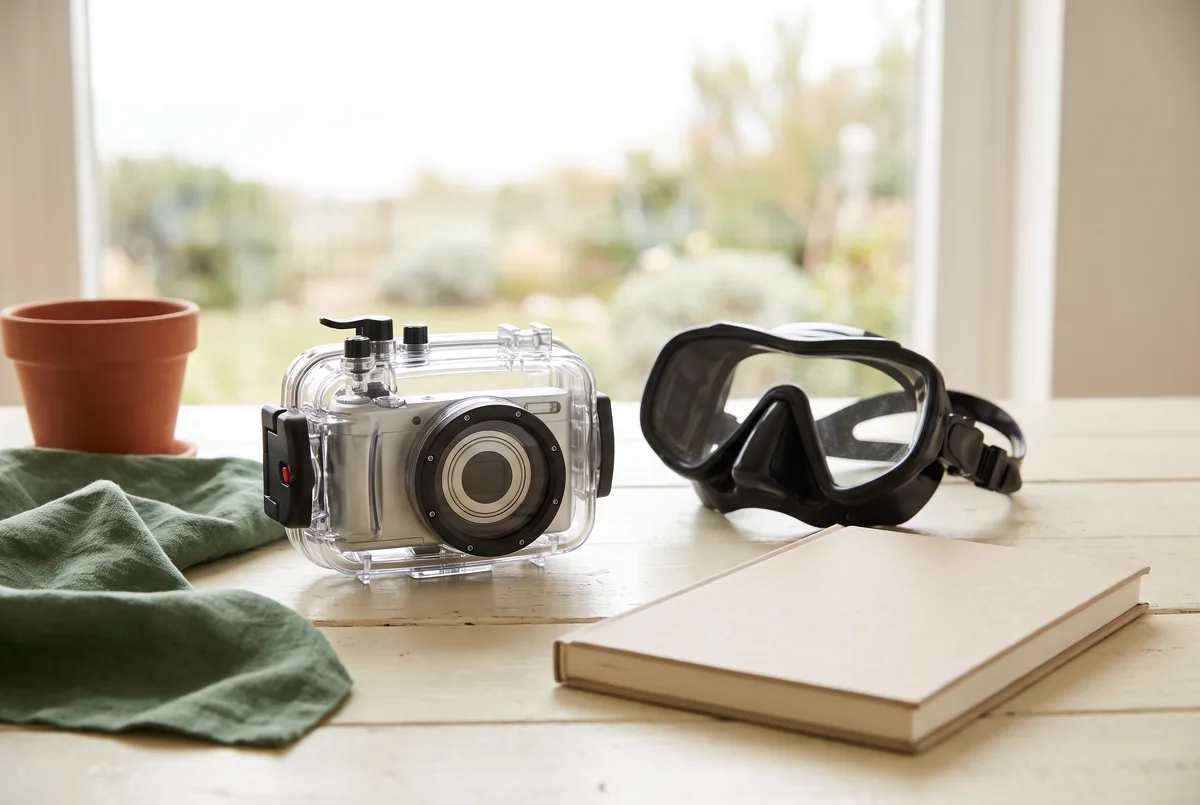
Choose a photography project whose creative purpose survives a decision not to enter the water. That might be a visual story about coastal colour, a sequence about learning, or a small exhibition combining shore photographs with later underwater work. The important feature is not the camera model. It is whether the project can wait while each participant's learning and current circumstances are considered.
An enthusiastic group can agree on a theme, but it cannot establish anyone's underwater readiness. A useful brief therefore separates the desired images from the decision to participate. The project postponement filter below helps you choose between an enquiry, shore-based reworking and postponement; none of those outputs approves a dive.
Define a creative aim without making water entry mandatory
Start with the story rather than a compulsory shot. “Show how coastal textures change with light” leaves room for photographs from appropriate public shore locations. “Everyone must produce a close-up underwater photograph for the final display” creates a dependency on participation before individual questions have been resolved. Both briefs involve photography, but only the first can readily accommodate a change of plan.
Write a one-sentence aim and a separate description of the preferred medium. For example, a hypothetical team might choose “Explore the contrast between manufactured equipment and natural coastal patterns.” Underwater images could become one part of that work later. Photographs of equipment on land, shore observations and an illustrated planning notebook could communicate the same contrast without suggesting an underwater session occurred.
| Project choice | What depends on water entry? | How it can wait or change |
|---|---|---|
| A coastal colour study | Underwater examples are optional | Complete a shore series and reserve space for later additions |
| A photographic learning journal | Images of an underwater lesson depend on actual participation | Begin with enquiry notes, dry-land images and honest captions |
| A portrait of one particular marine animal | The central image depends on an encounter that may not happen | Broaden the theme or postpone rather than promise the encounter |
| A group exhibition with one underwater image per person | Every participant's contribution depends on entering water | Accept different media and give underwater work no mandatory quota |
The tradeoff is deliberate: a flexible brief offers less certainty about the final collection but reduces pressure to manufacture a result. Choose an exhibition format that can accommodate that uncertainty before announcing a compulsory image list. A blank space labelled “future study” is more honest than presenting a planned underwater photograph as inevitable.
Separate equipment ownership from underwater competence
Owning a camera, housing or lighting accessory answers an equipment question. It does not answer whether someone is prepared for the proposed underwater activity. Nor does skill in land photography establish how a person will manage a camera while participating in a diving lesson. Treat photographic experience and diving experience as different parts of the enquiry rather than substituting one for the other.
Use the underwater photography diving course Hong Kong information page as an enquiry starting point, not evidence that your group can enrol together or begin immediately. Describe the creative aim, each person's relevant learning history and the equipment you hope to use. Ask the provider to confirm current entry requirements, how photography learning relates to diving competence, and whether camera use may need to wait until other learning has been addressed.
Keep ownership out of the role-allocation rule. “Alex owns the camera, therefore Alex must take the underwater images” puts a purchased object ahead of individual review. The owner could instead contribute dry-land equipment photographs, lead the edit or help write captions. Those contributions use photographic interest without implying underwater competence or asking someone to prove the value of their purchase.
Ask about refresher needs before allocating camera roles
Ask about recent diving experience before naming an underwater photographer. A person's last relevant activity, changes since then and areas of uncertainty are more useful enquiry details than a confident group description such as “everyone has dived before.” An unresolved refresher question should remain visible in the project plan, not disappear because somebody wants a camera role.
The Hong Kong scuba refresher boat dive page is a relevant place to begin that discussion. Ask whether the individual needs a refresher or other review before photography learning, what the current arrangement covers, and whether the camera project should be considered separately. Do not assume a refresher is included, available within the proposed project, or sufficient for every participant's circumstances; request written confirmation of the provider's current terms and requirements.
Health questions belong in a separate, private conversation. DAN's return-to-diving health guidance discusses reviewing health status and obtaining appropriate medical evaluation where indicated. A project organiser, website or enthusiastic companion cannot provide individual medical clearance. Each participant should complete their own health information and seek suitable medical advice when the relevant screening or concerns call for it. 2
For the creative brief, record only the necessary planning consequence, such as “participation review outstanding.” Do not collect diagnoses in a shared photography spreadsheet. A hypothetical participant returning after a break could keep an editing role while their refresher and health questions are addressed privately. The group can continue shaping the story without setting a deadline for that person's water entry.
Keep group lessons distinct from individual assessment
A shared lesson can create a common learning theme; it does not turn several people into one learner. Group agreement is useful for choosing the audience, caption style and exhibition format. It is not a vote on whether an individual is ready, whether they should carry a camera, or whether they should participate at all. Keep those decisions outside the group's creative consensus.
When enquiring about private group scuba lessons Hong Kong, explain that the project permits different learning routes and outcomes. Ask how individual requirements are considered, whether someone can defer photography participation, and what arrangements would need separate confirmation. Private organisation should not be read as a promise of identical progress, automatic eligibility or a session built around every requested image.
| Group dependency | Why it makes the brief fragile | A more flexible design |
|---|---|---|
| Every member must appear underwater | One person's decision changes the entire deliverable | Offer voluntary shore portraits with separate consent |
| The camera owner must take every key image | Ownership becomes a participation obligation | Keep essential images achievable on shore |
| All participants must progress together | Individual learning needs become a group deadline | Allow different contributions and later additions |
| Publication requires a particular marine encounter | The story depends on a subject that may not appear | Use a broader theme and publish only what was actually observed |
A practical group agreement should state that declining water entry does not remove someone's creative contribution. It should also separate permission to participate from permission to be photographed or named. In a hypothetical workplace project, a colleague might prefer anonymous editing work rather than a public learning portrait. Respecting that choice makes the final story more representative without recruiting people through peer pressure.
Apply non-contact habitat principles to every shot idea
Review the proposed image before anyone becomes attached to it. Ask whether the composition depends on moving an organism, touching a surface, feeding an animal or placing a prop in habitat. If it does, change the concept. The creative aim must adapt to the habitat, not the habitat to the camera.
AFCD's Hoi Ha Wan Marine Park visitor guidance asks visitors to avoid damaging natural habitats and prohibits activities including touching or feeding marine life and collecting organisms. Its guidance also warns against standing on fragile coral. These are conservation boundaries, not optional styling preferences for a photograph. Check the current rules and access arrangements for the actual location rather than assuming one site's information covers every destination. 1
Non-contact planning means leaving out poses that depend on manipulating wildlife or natural features. It does not mean declaring a shot acceptable merely because nobody plans to touch anything. Whether a participant can undertake a proposed activity appropriately remains a separate learning and provider-review question. A good image idea can still be unsuitable for the present project.
Consider a hypothetical brief asking for a small animal beside a branded object. Moving the animal or positioning a prop in its habitat is not an acceptable way to secure that composition. Photograph the object on land and use clearly labelled separate images in a layout, or abandon the pairing. Do not imply that a composite records an actual encounter. Accept that no suitable photograph may result.
Use the filter to choose a postponable project
The project postponement filter is a planning worksheet, not a readiness score. Complete its five inputs in ordinary language. Use “unresolved” when you lack an answer, rather than filling the space with an assumption. Its purpose is to reveal dependencies that the group can change and questions that need an appropriate individual enquiry.
- Creative aim: What should the finished work communicate, and which requested images are genuinely essential?
- Readiness questions: What individual learning history or current participation questions still need review, and who should address them?
- Refresher query: What have you asked about a refresher or other review, and what remains unconfirmed?
- Group dependency: Does the project require every person, a particular camera owner or a promised encounter to produce underwater work?
- Shore substitute: What credible image set or other creative contribution could deliver the aim without water entry?
Choose rework-on-shore when the aim is achievable without underwater participation and the main problem is the original format. Replace compulsory underwater portraits with voluntary shore portraits, for example, and rewrite captions accordingly. This is a creative decision, not a statement that an unresolved participation question has been cleared. Reworking can happen while individual enquiries continue separately.
Choose postpone when the essential result depends on unresolved learning or participation questions, or when the group refuses a non-contact alternative. Remove the commitment to produce underwater images. State what would need to be reconsidered before reopening the brief, such as a provider response about learning requirements. An organiser's deadline or an unused camera does not resolve that dependency.
Choose proceed-to-enquiry when the aim is flexible, the questions are clearly recorded, the group accepts individual outcomes and a credible shore substitute exists. Send the brief and outstanding questions to the relevant provider. This output authorises no activity: it only means your enquiry is sufficiently clear to make a useful conversation possible. The provider's response may still lead to shore reworking or postponement.
A hypothetical group planning a coastal texture exhibition has one returning diver, one new learner and two shore photographers. Their substitute is a complete shore sequence; they will not require underwater contributions from anyone. Their filter result can be proceed-to-enquiry because the questions and fallback are clear—not because the group has established the returning diver's readiness or the new learner's eligibility.
Accept a shore substitute as a valid creative outcome
Make the shore version publishable in its own right. Give it a coherent sequence, thoughtful captions and an audience rather than treating it as compensation for a cancelled ambition. A coastal colour study might combine wide views from appropriate public locations with close photographs of personally owned equipment on land. It should describe what was actually made and leave future underwater work explicitly optional.
For groups whose main aim is collaboration or visual storytelling, FlintHub's photography workshop offers a related enquiry route. Discuss the intended creative outcome and ask what the current workshop can accommodate. Do not assume it includes diving, underwater practice or individual assessment. Shore-based photographic learning and a diving enquiry can remain separate projects with different questions and participation choices.
The tradeoff is that a shore substitute cannot truthfully claim to show underwater competence or an underwater encounter. It can still explore colour, framing, selection and narrative. Label concept images, staged land photographs and composites clearly. Avoid captions suggesting that a participant completed a lesson or photographed marine life when the final work contains only planning material.
Before closing the project, ask whether someone who deferred water entry still has a meaningful contribution and whether the story remains accurate without the hoped-for image. If both answers are yes, postponement has protected the creative aim rather than defeated it. Keep any later underwater chapter as a new enquiry, not an obligation carried forward from the original group brief.
FAQs
Does owning a camera prove readiness?
No. Ownership shows access to equipment, not underwater competence or current suitability for the proposed activity. Include photographic experience in the enquiry, but keep it separate from diving history and individual review. Camera ownership should not make someone responsible for delivering underwater images.
Can the group decide individual competence?
No. Members can agree on a creative brief and voluntary roles, but enthusiasm or a majority vote does not assess an individual. Keep learning and participation questions with the appropriate provider and person concerned. Allow different contributions without requiring everyone to progress together.
Is a refresher guaranteed within the project?
No. Ask the provider whether a refresher or other review is needed and confirm the current arrangement separately. Do not promise that it is included or that completing it automatically settles every photography participation question. The creative project should remain able to wait.
May habitat be disturbed for an image?
Do not build a shot around touching, feeding, collecting or rearranging marine life or damaging habitat. Change the image idea instead and check the actual location's current conservation rules. An absent subject or unsuitable composition is a reason to accept no image, not to manipulate the scene.
Is postponement a valid outcome?
Yes. Postpone when essential dependencies remain unresolved, or rework on shore when the story can be told there. A completed worksheet is not dive approval. Record the outstanding enquiry and preserve voluntary participation rather than forcing an underwater deliverable to meet the group brief.
References
- [1] AFCD: Hoi Ha Wan Marine Park visitor and habitat protection guidance
- [2] DAN: Health Status Overview for returning to diving
Author note
FlintHub Academy prepared this article with AI assistance using verified public information. It is creative-project and enquiry guidance, not instruction from a qualified diving instructor, medical advice or individual clearance. The examples are hypothetical. DiveHarbour and FlintHub Academy have the same owner; related resource, not an independent recommendation.
FlintHub Academy · AI-assisted editorial prepared from public information for learning and enquiry planning. The author is not a diving instructor or medical expert. This is not first-hand course testing, a real student case or medical clearance. DiveHarbour and FlintHub Academy have the same owner.