1. Decide what the menu plan must solve
Asian party menus are easiest to coordinate when the organiser starts with the event, not a list of dishes. Is food a main part of the gathering, a brief pause between sessions, or a meal around speeches and activities? The answer affects when people can eat, how much time they have, and whether guests need to remain seated. Write down the event purpose, approximate attendance, venue and planned programme before asking for menu options. These are planning inputs, not a guarantee that any particular menu or service is available.
Keep cuisine, service and logistics as separate decisions. A cuisine preference does not by itself establish portion sizes, serving equipment, staff, delivery arrangements or dietary suitability. A clear enquiry asks about each of those points directly and records the answer. For a Hong Kong event, treat the location as a planning context only: access, venue rules and timings should be checked for the actual address. Do not assume a supplier has a local branch or a particular service scope.
2. Coordinate the handover, access and exceptions
Food service needs a workable handover between the venue, organiser and supplier. Confirm the address and the permitted unloading point, then ask what access arrangements apply: for example, whether a lift, loading bay, security check or advance venue booking is relevant. Agree who will meet the delivery, who can be reached on the day, and what happens if the programme changes. These are questions to settle in writing, not assurances about arrival time or venue access.
Share the event flow, including speeches, performances, presentations and any period when guests cannot leave their seats. UC San Diego’s Event Planning Tips recommends giving catering planners the event purpose and information about programme elements because those details can affect timing, staffing, menu and service style 1. That is useful planning guidance from a university catering operation, not a Hong Kong rule or a promise about any supplier’s offer. Confirm the proposed setup, opening and clearing times against your venue’s requirements.
A practical handover note should name the decision-maker and list exceptions: a late venue opening, a change in attendance, a delayed programme, or a guest arriving after service begins. Ask whether changes can be accommodated, by when they must be reported, and whether charges or other terms change. Do not infer flexibility from a general menu page; request the applicable terms for the specific enquiry.
3. Compare service approaches before choosing a menu
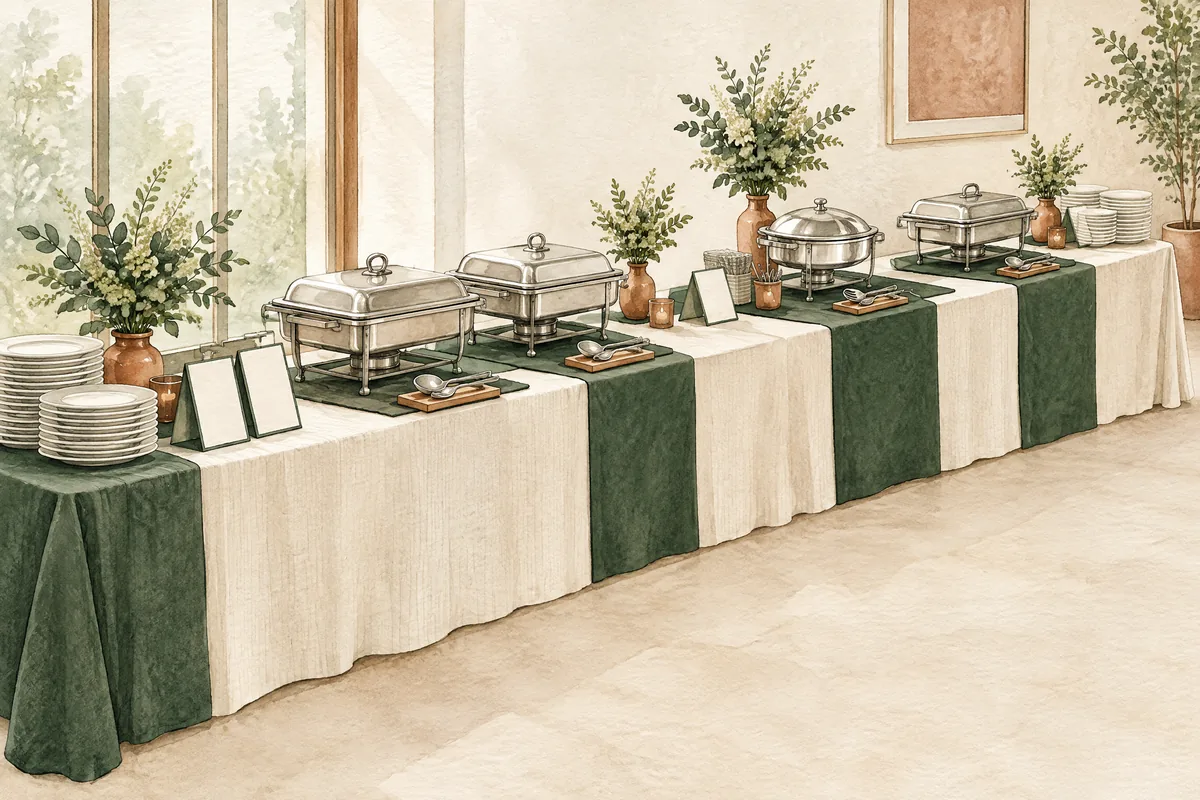
Service style changes the guest experience and the work required at the venue. The University of California San Diego distinguishes buffet-style service, which may need less staff but can still require someone to distribute main dishes, from individually served meals, which require more staff and adequate kitchen preparation space 3. Treat this as a comparison of approaches, not a staffing estimate for your event. Ask what is actually included and what the venue must provide.
| Approach | Potential fit | What to ask before choosing |
|---|---|---|
| Buffet or self-service | Guests can choose from the displayed options, and the event has space for a serving area and a flow past it. | Who replenishes or portions dishes? What serving equipment and utensils are supplied? How will a queue fit the room? |
| Individually served meals | Guests remain seated, or the programme benefits from a more controlled serving sequence. | Is staffing offered, and for which tasks and hours? Is there enough preparation space? What does the venue need to provide? |
| Individually packed portions | The organiser wants a defined handout process or guests are moving between activities. | How are portions labelled and handed out? Can the supplier accommodate the requested choices? What packaging and disposal arrangements apply? |
These are alternatives to discuss, not claims that any one is available through a particular supplier. Consider the room layout and the time guests have to eat alongside cuisine and menu variety. A buffet may appear simple but still need a person to manage serving or a plan for replenishment. Conversely, a seated format may be inconvenient if guests need to move between activities. Ask the venue and supplier to confirm their respective responsibilities rather than treating “catering” as a complete service description.
4. Turn cuisine enquiries into specific requirements
Cuisine pages can help an organiser describe what they want to explore, but the page label is not a complete quote, a service specification or an endorsement. If you are considering a Japanese-style menu, Japanese Catering is a page label to use as an enquiry starting point. Ask for the proposed dishes, portions, service format and written terms for your event; the label alone does not confirm availability, equipment, staffing, delivery or suitability for individual dietary needs.
The same discipline applies when comparing different cuisine directions. For a Korean-style menu, Korean Catering can identify the subject of an enquiry, but it cannot answer whether the proposed dishes, quantities or arrangements fit the guest list and venue. Request itemised options in writing, then compare them against the same criteria: timing, service method, dietary requests, included equipment and any additional charges. Leave details unanswered until the supplier confirms them; do not fill gaps with assumptions based on a cuisine name.
If a Thai-style direction is under consideration, Thai Catering likewise functions only as a page label and enquiry resource. Ask what menu choices are proposed and whether the requested service format can be arranged for the actual venue and event flow. Any open point—including quantities, staffing, utensils, setup, delivery arrangements and fees—requires written confirmation. None of these page labels establishes a guaranteed scope or a food-safety or dietary assurance.
5. Use the service-style decision cards
Use these decision cards as a working worksheet before sending an enquiry. Fill in each field for your event, then share the answers with the venue and supplier. If a point is unknown, write “confirm” rather than guessing. The cards are a decision aid, not an order form or a promise that a particular option can be supplied.
Card A — Event and flow
Purpose: __. Expected attendance: _. Venue and room: . Programme moments that interrupt or constrain eating: . Preferred eating window: . Person coordinating the venue handover: ___.
Card B — Service and room
Preferred approach: buffet / individually served / packed portions / undecided. Reason for preference: __. Serving-area or preparation-space constraints: _. Who provides tables, equipment and utensils? . Who portions, replenishes and clears? ___. Confirm each task with the responsible party.
Card C — Menu and guest choices
Menu direction or alternatives to explore: __. Dietary requests guests have reported: _. Number of requested portions for each option: . Questions for the supplier about ingredients, preparation or cross-contact: ___. These questions do not establish that a dish is safe or suitable for any person; guests with specific needs may require direct, detailed confirmation.
Card D — Terms and exceptions
Final attendance deadline: __. Process for late additions or changes: _. Setup and collection responsibilities: . Possible additional charges to confirm: . Day-of contact and fallback contact: . Written answer received from: , on: ___.
Once filled in, compare the same fields across proposed options. If a supplier cannot yet confirm a field, mark it open and decide whether that uncertainty is acceptable before approval. This avoids turning an attractive menu description into an assumed service commitment.
6. Map participant needs and quantities
Start with an attendance estimate and the type of meal. The University of Rochester’s Green Events Handbook advises estimating attendance accurately and planning food orders strategically to reduce waste 2. That principle does not provide a portion formula, and it does not say how to count adults, children, snacks or full meals. Ask the supplier to explain the quantity basis for the particular proposed menu and how changes to the headcount are handled.
List guest requests without assuming that a menu can meet them. Record the request in the guest’s own terms where appropriate, then ask the supplier exactly what information is needed to respond. Do not translate “vegetarian,” “no nuts” or another broad request into a safety guarantee. The brief and the cited planning resources do not establish allergen-free, medical-diet or other suitability assurances. If a guest has a specific dietary concern, seek precise written information and let that guest assess what is appropriate for them.
Portion distribution also deserves a direct question. UC San Diego notes that splitting two main dishes evenly may leave one option depleted before all buffet guests have chosen 1. This is a possible planning risk, not a prediction or a universal ordering rule. Ask how the supplier proposes to estimate quantities for the actual attendance and choice pattern, and whether a different allocation can be discussed. Avoid inventing per-person weights, guaranteed reserves or an extra-order percentage when none has been confirmed.
For organisers planning a family activity, our event catering resource can reconnect food planning with the practical flow of a parent-child workshop. Use it as a learning and activity-planning prompt, not evidence that food is included in any FlintHub course or that a particular menu suits every participant. For workplace organisers, corporate training hong kong is a separate FlintHub planning route that may help frame the relationship between a training agenda and event arrangements; it does not bundle catering with training.
7. Resolve open questions before approval
Before approving an option, compare the written proposal against the event worksheet. Confirm the final attendance deadline, what the quoted scope includes, how dietary requests will be handled, and whether late changes affect charges. Ask about setup and collection windows, equipment, utensils, staffing tasks and who is responsible for clearing. The answers should describe the actual arrangement; a general menu description is not a substitute for them.
| Planning question | Supplier-managed service, if offered | Organiser-managed service, if feasible |
|---|---|---|
| Serving and replenishment | Ask which serving tasks staff would perform and during which hours. | Identify who would portion dishes, replenish the serving area and handle guest questions. |
| Equipment and utensils | Request an itemised list of what the proposal would supply. | Ask the venue what is available and identify anything the organiser would need to arrange. |
| Clearing and collection | Ask whether clearing and equipment collection would be included, and on what terms. | Assign clearing responsibilities and confirm any supplier equipment-return requirements. |
| Programme changes | Ask how a revised eating window would affect staffing and charges. | Check whether the assigned organisers could cover the revised window and venue handover. |
These responsibility models are alternatives to discuss, not confirmed offers; a mixed arrangement may also be worth asking about. If a material item remains open, decide whether to delay approval or proceed only after an authorised person accepts that uncertainty. Keep the written response with the event plan so that the person coordinating on the day can see what was agreed. The editorial preparation date for this article is 2026-11-10; it is not a known publication date or a date for any supplier offer.
Frequently asked questions
How should I choose between buffet and individually served food?
Start with the room, guest movement, programme and available preparation space. Compare who handles portions, replenishment, serving and clearing, then ask the supplier and venue to confirm responsibilities in writing. The service label alone does not establish included staff or equipment.
How do I estimate quantities for a party?
Use a considered attendance estimate and ask the supplier how quantities are calculated for the proposed menu and service style. Confirm the deadline for final numbers and how changes are handled. General planning guidance does not provide a universal portion formula.
Can I rely on a menu label for dietary suitability?
No. A cuisine or menu label does not establish ingredients, preparation details or suitability for an individual. Ask specific questions and request written information. Do not treat a broad dietary description as an allergen-free, medical or other safety guarantee.
What should I confirm with the venue before ordering?
Ask about access, unloading, setup and collection windows, room layout, permitted equipment, preparation space and day-of contacts. Confirm which party handles each task. Venue arrangements vary, so a planning example from another institution is not Hong Kong law or a venue approval.
Does a catering enquiry page confirm price or service scope?
No. A page label is a starting point for asking about a proposed menu, quantities, service format, equipment, staffing, timing and applicable charges. Treat unanswered details as open questions and rely on written confirmation for the specific event.
Editorial disclosure
FlintHub Academy and YumYum have the same owner. This article was prepared with AI assistance by FlintHub Academy’s editorial team and is not an independent recommendation or an assessment of YumYum’s services. FlintHub Academy does not claim medical, veterinary or professional qualifications. The cited university guidance is used as planning context only, not as Hong Kong law or proof of a supplier’s capabilities. Open service, menu and commercial details require written confirmation from the relevant supplier and venue.
References